Olber's Paradox: Why is the Sky Dark at Night?
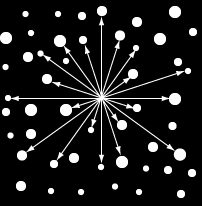 | If the universe were infinite and filled with stars in a uniform distribution, then every line of sight would terminate on the surface of a star and should be bright. To be sure, those further away would be fainter, but there would be more of them. Careful analysis suggests that the sky should be as bright as the surface of an average star. 如果宇宙是无限的,并且充满了均匀分布的恒星,那么每条视线都会终止在一颗恒星的表面,天空应当是明亮的。当然,远处的恒星会更暗,但它们的数量也会更多。仔细分析表明,天空的亮度应与一颗普通恒星的表面亮度相当。 |
Noting that the night sky is obviously not that bright, there are two lines of explanation. First, the universe appears to be of finite age and that light from stars at an infinite distance would not have reached us in the age of the universe. Second, we observe that the universe is expanding and that stars further away from us are receding at a faster rate. The result of this expansion is that the light from more distant stars is Doppler shifted more toward the red and beyond a certain distance would not contribute significantly in the visible region of the electromagnetic spectrum.
Star concepts
Reference
Shu
Ch 16
| HyperPhysics***** Astrophysics
HyperPhysics ***** 天体物理学 | R Nave |