Bilingual edition: English is preserved and Chinese follows each unit. Terminology uses the confirmed v20260916 glossary; automated semantic review remains traceable.
中英双语版:英文原文完整保留,中文紧随对应单元;术语采用 v20260916 确认表,自动语义审校结果可追溯。

Stellar Parallax

恒星视差
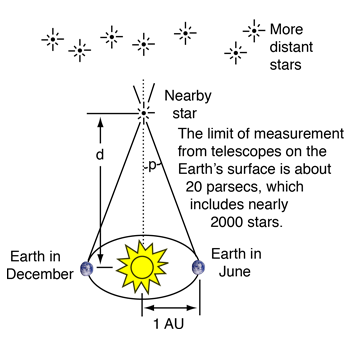
A nearby star's apparent movement against the background of more distant stars as the Earth revolves around the Sun is referred to as stellar parallax.

This exaggerated view shows how we can see the movement of nearby stars relative to the background of much more distant stars and use that movement to calculate the distance to the nearby star.

这种夸张的视图展示了我们如何通过观察附近恒星相对于背景中更遥远恒星的运动,来计算附近恒星的距离。
The parallax can be used to measure the distance to the few stars which are close enough to the Sun to show a measurable parallax. The distance to the star is inversely proportional to the parallax. The distance to the star in parsecs is given by
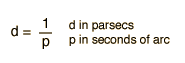
The nearest star is proxima centauri, which exhibits a parallax of 0.762 arcsec, and therefore is 1.31 parsecs away.
视差可以用来测量那些足够接近太阳,能够显示出可测量视差的少数恒星的距离。恒星的距离与视差成反比。恒星的距离(以秒差距为单位)由公式给出。最近的恒星是半人马座比邻星,其视差为0.762角秒,因此其距离为1.31秒差距。
Some well-known examples of distance measurement by parallax are 61 Cygni at 1/3 of an arcsec, distance 3 parsecs, and Barnard's Star at 1.8 parsecs = 5.9 light years. Barnard's Star also exhibits a large proper motion.

The distance at which parallax can be reliably measured has now been greatly extended by space-based instruments like the Hipparcos satellite.

通过如Hipparcos卫星这样的空间仪器,能够可靠测量的视差距离已大大扩展。
当地球绕太阳公转时,附近恒星相对于更远处恒星的视运动被称为恒星视差。已知的利用视差测量距离的例子包括61 Cygni,其视差为1/3角秒,距离为3秒差距,以及巴纳德星,其距离为1.8秒差距=5.9光年。巴纳德星还表现出较大的自行。
Index

Distance measurement

References
Kaufman, Universe

Chaisson & McMillan
索引距离测量参考Kaufman, 宇宙Chaisson & McMillan
 
HyperPhysics***** Astrophysics
HyperPhysics ***** 天体物理学
R Nave
Go Back
返回


Distance Units

距离单位

The average distance between the Earth and the Sun is a natural distance unit and is called an Astronomical Unit (AU).

地球与太阳之间的平均距离是一个自然的距离单位,称为天文单位(AU)。
1 AU = 1.495978 x 10¹¹ m

The light year (ly) is another often used distant unit

光年(ly)是另一个常用的距离单位
1 ly = 9.46053 x 10¹⁵ m = 6.324 x 10⁴ AU

An often preferrable large distance unit is the parsec (pc) , the distance at which one AU would subtend a second of arc:

一个常用的较大距离单位是秒差距(pc),即当一个天文单位(AU)所对应的角秒为1弧秒时的距离:
1 pc = 3.085678 x 10¹⁶ m = 3.261633 ly = 206265 AU

Magnitude
量值
Time Units
时间单位
1 AU = 1.495978 × 10¹¹ m;1 light-year = 9.46053 × 10¹⁵ m = 6.324 × 10⁴ AU;1 parsec = 3.085678 × 10¹⁶ m = 3.261633 light-years = 206265 AU
Index

Distance measurement
索引距离测量
 
HyperPhysics***** Astrophysics
HyperPhysics ***** 天体物理学
R Nave
Go Back
返回


Proper Motion

自行运动

The change in a star's position in the sky as a result of its true motion through space is called proper motion. This is distinguished from the annual apparent motion in the sky caused by the Earth's orbit around the Sun. This apparent motion permits distance measurement by parallax.

恒星由于通过空间的真实运动导致其在天空中的位置变化,称为自行。这种现象与由于地球绕太阳公转引起的天空中的年度视运动相区别。这种视运动可以通过视差来测量距离。

The largest proper motion is exhibited by Barnard's Star which is about 5.9 light years from the Earth. Barnard Star's proper motion is 10.3 arcseconds per year, taking only 200 years to travel the angular diameter of the moon across the sky.

Barnard星显示出最大的自行,它距离地球约5.9光年。Barnard星的自行为每年10.3角秒,仅用200年就能跨越月球在天空中的角直径。
Index

索引
 
HyperPhysics***** Astrophysics
HyperPhysics ***** 天体物理学
R Nave
Go Back
返回


Time Units

时间单位

The sidereal year = 365.2564 mean solar days = 365d 6h 9m 10s

恒星年等于365.2564个平太阳日=365天6小时9分10秒

The tropical year = 365.2422 mean solar days = 365d 5h 48m 46s

恒星年等于365.2422个平太阳日=365天5小时48分46秒

The tropical year is different from the sidereal year because of the precession of the Earth.

恒星年与回归年不同,这是由于地球的岁差运动造成的。
Index

索引
 
HyperPhysics***** Astrophysics
HyperPhysics ***** 天体物理学
R Nave
Go Back
返回


Magnitude

量值

Magnitude is a historical unit of stellar brightness and is defined such that a change of 5 magnitudes represents a factor of 100 in intensity. First magnitude was supposed to be the brightness of the brightest stars, but with quantitative measurement some stars were found to be brighter than those used for the standard. The definition of magnitude above reduces to the following expression for change in magnitude:

亮度是一个历史上的星体亮度单位,其定义是5个等级的改变对应强度的100倍。第一等星原本被认为是最亮的星,但随着定量测量的进行,发现有些星体比用来作为标准的星体更亮。上述亮度的定义可以简化为以下关于亮度变化的表达式:

Magnitude change = implies x10^ times intensity.

As a number assigned to the visual brightness of an object, the magnitude is said to be the apparent magnitude. Star A will have the same apparent magnitude as star B if B has four times the luminosity but is twice as far away. The light power that reaches us drops off according to the inverse square law. To compare the intrinsic brightnesses of objects, their apparent magnitudes can be adjusted to that which would be observed at the same distance. A distance of 10 parsecs has been chosen as a convenient distance for comparison, and the magnitude an object would have at 10 pc is called its absolute magnitude.

作为物体视觉亮度的数值,这个量被称为视星等。如果星B的光度是星A的四倍,但距离是星A的两倍,那么它们的视星等相同。到达我们的光功率遵循平方反比定律衰减。为了比较物体的固有亮度,它们的视星等可以调整为在相同距离时的观测值。已选定10秒差距作为比较的方便距离,物体在10秒差距处的视星等称为它的绝对星等。

The magnitude scale was devised by the second century Greek astronomer Hipparchus. He divided all stars into 6 magnitudes with magnitude 1 being the brightest star and magnitude 6 being the faintest star visible with the unaided eye.

亮度量级是由二世纪的希腊天文学家希帕恰斯提出的。他将所有恒星分为6个亮度等级,其中亮度1级是最亮的星,亮度6级是人眼能辨别的最暗的星。
Magnitude Examples
量级示例
幅度变化=意味着强度乘以10的幂次。
中文译文中的待填/计算数值依次对应:1:dm 2:ib 3:ip。实际数值以上方原输入框为准。
Index

索引
 
HyperPhysics***** Astrophysics
HyperPhysics ***** 天体物理学
R Nave
Go Back
返回


Magnitude Examples

量级示例

The magnitude is a comparative stellar brightness scale. First magnitude was supposed to be the brightness of the brightest stars, but with quantitative measurement some stars were found to be brighter than those used for the standard. About 6th magnitude represents the faintest stars which can be seen by the unaided eye. Some other examples are:

亮度是衡量恒星相对亮度的尺度。最初第一等星被定义为最亮的恒星,但随着定量测量的进行,发现有些恒星比用于标准的恒星更亮。大约第六等 magnitude 表示肉眼可见的最暗的恒星。一些其他例子是:
Sun
太阳
-26.8
Moon
月球
-12.6
Venus
金星
-4.4
Faintest for naked eye visibility
肉眼可见最暗的星体
+ 6
Brightest quasar
最亮的类星体
+12.8
Faintest star visible at Kitt Peak
凯特峰最暗的可见星
+24

Index

索引
 
HyperPhysics***** Astrophysics
HyperPhysics ***** 天体物理学
R Nave
Go Back
返回