The Planck Satellite
The Planck satellite was launched in 2009 with the mission of precise mapping of the Cosmic Microwave Background (CMB) radiation that pervades the universe. It follows the earlier work of the COBE and WMAP satellites. It collected data for 4.5 years, ending it's mission on 23 October, 2013. Like the WMAP satellite, it made use of the Earth-Sun L2 Lagrange point during its operational lifetime, but was moved into a stable orbit around the Sun at the end of its mission.

Image credit ESA and the Planck Collaboration
The prior WMAP mission provided the first detailed full-sky map of the microwave background radiation in the universe. The map produced is characterized as a map of the effective temperature of the microwave background radiation as depicted below. This is a synopsis of the description of the mission from the WMAP mission report on the NASA website. The illustrations are NASA graphics.
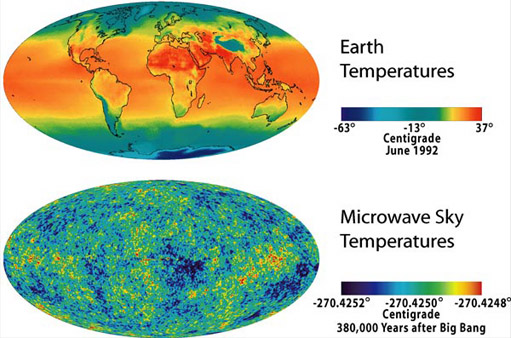
Note that the temperature variation on the Earth covers about 100°C while those measured by WMAP range only over about 0.0004 °C, a smaller range by a factor of a quarter of a million.
The wavelengths of radiation detected by WMAP were in the microwave region of the electromagnetic spectrum as depicted in the NASA graphic below.

| Early universe chronology
早期宇宙时间线 |
| Age of the universe
宇宙的年龄 |
References

Planck and CMB
WMAP home page
| HyperPhysics***** Astrophysics
HyperPhysics ***** 天体物理学 | R Nave |