The Wilkinson Microwave Anisotropy Probe (WMAP)
The WMAP mission provided the first detailed full-sky map of the microwave background radiation in the universe. The map produced is characterized as a map of the effective temperature of the microwave background radiation as depicted below. The later Planck satellite refined that map.
This is a synopsis of the description of the mission from the WMAP mission report on the NASA website. The illustrations are NASA graphics.
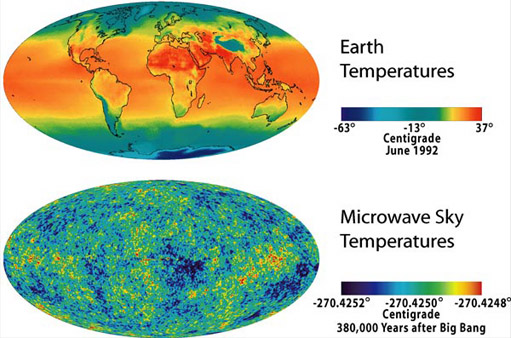
Note that the temperature variation on the Earth covers about 100°C while those measured by WMAP range only over about 0.0004 °C, a smaller range by a factor of a quarter of a million.
The wavelengths of radiation detected by WMAP were in the microwave region of the electromagnetic spectrum as depicted in the NASA graphic below.

The synopsis of the implications of WMAP as summarized in the mission report includes the following quote from the WMAP site:
- Universe is 13.7 billion years old, with a margin of error close to 1%.
宇宙的年龄是13.7十亿年,误差接近1%。
- First stars ignited 200 million years after the Big Bang.
大爆炸后2亿年,首批恒星开始点燃。
- Light in WMAP picture is from 379,000 years after the Big Bang.
WMAP图中的光来自大爆炸后379,000年。
- Content of the Universe:
- 4% Atoms, 23% Cold Dark Matter, 73% Dark Energy.
4% 原子,23% 冷暗物质,73% 暗能量。
- The data places new constraints on the Dark Energy. It seems more like a "cosmological constant" than a negative-pressure energy field called "quintessence". But quintessence is not ruled out.
这些数据对暗能量提出了新的限制。它更像一个‘宇宙常数’,而不是一种被称为‘第五元素’的负压能量场。但第五元素仍不能被排除。
- Fast moving neutrinos do not play any major role in the evolution of structure in the universe. They would have prevented the early clumping of gas in the universe, delaying the emergence of the first stars, in conflict with the new WMAP data.
高速运动的中微子在宇宙结构的演化中不起主要作用。它们会阻止宇宙早期气体的聚集,延迟第一颗恒星的出现,这与新的WMAP数据相矛盾。
宇宙的内容: - 4% Atoms, 23% Cold Dark Matter, 73% Dark Energy.
- Expansion rate (Hubble constant) value: H0 = 71 km/sec/Mpc (with a margin of error of about 5%.
膨胀率(哈勃常数)的值:H₀ = 71 km/s/Mpc(误差约为5%)
- New evidence for Inflation (in polarized signal).
关于宇宙膨胀的新证据(在极化信号中)
- For the model which fits our data, the Universe will expand forever. The density parameter Ω is measured to be 1.02 +/- 0.02 . (The nature of the dark energy is still a mystery. If it changes with time, or if other unknown and unexpected things happen in the universe, this conclusion could change.)
对于符合我们数据的模型,宇宙将永远膨胀。密度参数Ω测量为1.02 ± 0.02。(暗能量的性质仍是一个谜。如果它随时间变化,或者宇宙中发生其他未知且意外的事情,这一结论可能会改变。)
The positioning of the WMAP satellite made use of the Earth-Sun Lagrange point L2 which permitted it to be kept in place with a minimum expenditure of fuel and always keep its sensors pointed away from both the Earth and the Sun.
| Early universe chronology
早期宇宙时间线 |
| Age of the universe
宇宙的年龄 |
References

WMAP home page
| HyperPhysics***** Astrophysics
HyperPhysics ***** 天体物理学 | R Nave |