Models of Earlier Events早期事件的模型
To model the Big Bang cosmology at earlier times than those covered in Weinberg's First Three Minutes, certain time regimes have been proposed with the types of events which would be happening at those times. 为了模拟早于Weinberg《前三分钟》中所涵盖的时间之前的宇宙大爆炸模型,某些时间阶段已被提出,这些阶段中会发生特定类型的事件。
|
Index Reference Smith 索引参考史密斯 | ||
|
Go Back
返回 |
Before 1 Planck Time在1普朗克时间之前
Before a time classified as a Planck time, 10-43 seconds, all of the four fundamental forces are presumed to have been unified into one force. All matter, energy, space and time are presumed to have exploded outward from the original singularity. Nothing is known of this period. 在被分类为普朗克时间(约10^-43秒)之前,四种基本力被认为已经统一为一种力。所有物质、能量、空间和时间都被认为是从原始奇点向外爆炸出来的。这一时期的情况目前尚不清楚。
It is not that we know a great deal about later periods either, it is just that we have no real coherent models of what might happen under such conditions. The electroweak unification has been supported by the discovery of the W and Z particles, and can be used as a platform for discussion of the next step, the Grand Unification Theory (GUT). The final unification has been called a "supergrand unification theory", and becoming more popular is the designation "theory of everything" (TOE). But "theories of everything" are separated by two great leaps beyond the experiments we could ever hope to do on the Earth. 我们对后期时期了解不多,只是因为我们没有真正一致的模型来描述在这样的条件下可能发生的情况。电弱统一已经被W和Z粒子的发现所支持,可以作为讨论下一步,即大统一理论(GUT)的平台。最终的统一被称为“超大统一理论”,而“万物理论”(TOE)的称呼正变得越来越流行。但“万物理论”与我们所能进行的地球上的实验相比,存在两个巨大的差距。
|
Index Reference Smith 索引参考史密斯 | ||
|
Go Back
返回 |
Era of 1 Planck Time1普朗克时间时代
In the era around one Planck time, 10-43 seconds, it is projected by present modeling of the fundamental forces that the gravity force begins to differentiate from the other three forces. This is the first of the spontaneous symmetry breaks which lead to the four observed types of interactions in the present universe. 在约10^-43秒的普朗克时间时期,根据对基本力的当前模型,重力力开始从其他三种力中分化出来。这是导致现今宇宙中四种观察到相互作用类型的首次自发对称破缺。
Looking backward, the general idea is that back beyond 1 Planck time we can make no meaningful observations within the framework of classical gravitation. One way to approach the formulation of the Planck time is presented by Hsu. One of the characteristics of a black hole is that there is an event horizon beyond which we can obtain no information - scales smaller than that are hidden from the outside world. For a given enclosed mass, this limit is on the order of 回溯来看,总体思想是,在超过1普朗克时间的领域之外,我们无法在经典引力的框架内做出有意义的观测。Hsu提出了一种接近普朗克时间的表述方法。黑洞的一个特征是,存在一个事件视界,越过这个视界后我们无法获得任何信息——比这个尺度更小的结构对外界是不可见的。对于给定的封闭质量,这个极限大约是
![]() where G is the gravitational constant and c is the speed of light. But from the uncertainty principle and the DeBroglie wavelength, we can infer that the smallest scale at which we could locate the event horizon would be the Compton wavelength. 其中,G 是引力常量,c 是光速。但根据不确定性原理和德布罗意波长,我们可以推断出能够定位事件视界的最小尺度就是里德伯波长。
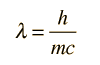
![]() Equating L and λ, we obtain a characteristic mass called the Planck mass: 将L和λ相等,我们得到一个称为普朗克质量的特征质量:

![]() Substituting this mass back into one of the length expressions gives the Planck length 将此质量代入其中一个长度表达式中,得到普朗克长度

![]() and the light travel time across this length is called the Planck time: 且光穿越此长度所需的时间称为普朗克时间:

![]() Keep in mind that this is a characteristic time, so its order of magnitude is what should be noted. Sometimes it is defined with the wavelength above divided by 2π, so don't worry about the number of significant digits. 请注意,这是一个特征时间,因此其数量级是需要注意的。有时它被定义为上述波长除以2π,因此不要担心有效数字的位数。
|
Index Reference Smith Hsu Ch 16 索引参考史密斯胡斯 Ch 16 | ||
|
Go Back
返回 |
Separation of the Strong Force强力的分离
At a time around 10-36 seconds, present models project a separation of the strong force, one of the four fundamental forces. Before this time the forces other than gravity would be unified in what is called the grand unification. The spontaneous symmetry breaking which occurs in this era would distinguish as a separate interaction the force which would hold nuclei together in later eras. 在约10^-36秒的时候,现有模型预测强力——四种基本力之一——开始分离。在这一时间之前,除了重力以外的其他力会在所谓的大统一时期统一。这一时期发生的自发对称破缺会将后来时代中使原子核结合的力区分开来。
In the 1970's. Sheldon Glashow and Howard Georgi proposed the grand unification of the strong, weak, and electromagnetic forces at energies above 1014 GeV. If the ordinary concept of thermal energy applied at such times, it would require a temperature of 1027 K for the average particle energy to be 1014 GeV. 20世纪70年代,Sheldon Glashow和Howard Georgi提出了在高于10¹⁴ GeV的能量下,强相互作用、弱相互作用和电磁力的统一理论。如果在这种情况下应用普通的热能概念,那么要使平均粒子能量达到10¹⁴ GeV,就需要温度为10²⁷ K。
Though the strong force is distinct from gravity and the electroweak force in this era, the energy level is still too high for the strong force to hold protons and neutrons together, so that the universe is still a "sizzling sea of quarks". 尽管强力与重力和电弱力在这一时代有区别,但能量水平仍过高,使得强力无法将质子和中子结合在一起,因此宇宙仍是一个‘炽热的夸克海’。
|
Index References Smith Kaufmann Ch. 29 索引参考 Smith Kaufmann 第29章 | ||
|
Go Back
返回 |
Inflationary Period暴胀时期
Lemonick and Nash in a popular article for Time describe inflation as an "amendment to the original Big Bang" as follows: "when the universe was less than a billionth of a billionth of a billionth of a second old, it briefly went through a period of superchanged expansion, ballooning from the size of a proton to the size of a grapegruit (and thus expanding at many, many times the speed of light). Then the expansion slowed to a much more stately pace. Improbable as the theory sounds, it has held up in every observation astronomers have managed to make." Lemonick 和 Nash 在《Time》杂志的一篇通俗文章中描述了膨胀说,将其称为‘对原始大爆炸的修正’,他们这样写道:‘当宇宙还不到十亿分之一的十亿分之一的十亿分之一秒那么老时,它短暂地经历了一段超快速膨胀期,从质子大小膨胀到葡萄大小(因此以远超光速的速度膨胀)。然后膨胀速度减缓到一个更为优雅的节奏。尽管这个理论听起来不可思议,但天文学家所做的一切观测都支持这一理论。
|
Index Reference Smith Guth Lemonick & Nash 索引 参考 Smith Guth Lemonick & Nash | |||||
|
Go Back
返回 |
Quark-antiquark Period夸克-反夸克周期
As the inflationary period ends, the universe consists mostly of energy in the form of photon , and those particles which exist cannot bind into larger stable particles because of the enormous energy density. They would exist as a collection of quarks and antiquarks along with their exchange particles, a state which has been described as a "sizzling sea of quarks". This time period is estimated at 10-32 seconds to 10-5 seconds. During this period the electromagnetic and weak forces undergo the final symmetry break, ending the electroweak unification at about 10-12 seconds. 随着膨胀期结束,宇宙主要由光子形式的能量组成,那些存在的粒子由于巨大的能量密度无法结合成更稳定的粒子。它们会以夸克和反夸克以及它们的交换粒子的形式存在,这种状态被描述为一种‘炽热的夸克海’。这一时期估计持续从10^-32秒到10^-5秒。在此期间,电磁力和弱力经历最后的对称性破缺,结束于大约10^-12秒的电弱统一。
|
Index Reference Smith 索引参考史密斯 | ||
|
Go Back
返回 |
Quark Confinement夸克禁闭
When the expansion of the "primordial fireball" had cooled it to 1013 Kelvin, a time modeled to be about 10-6 seconds, the collision energies had dropped to about 1 GeV and quarks could finally hang onto each other to form individual protons and neutrons (and presumably other baryons.) At this time, all the kinds of particles which are a part of the present universe were in existence, even though the temperature was still much too high for the formation of nuclei. At this point we can join the standard "big bang" model as outlined by Steven Weinberg in The First Three Minutes. 当“原始火球”的膨胀冷却到10¹³开尔文时,即大约10⁻⁶秒的时间,碰撞能量下降到约1 GeV,夸克终于能够相互结合形成单独的质子和中子(以及可能的其他重子)。此时,构成现今宇宙的所有粒子种类均已存在,尽管温度仍然太高,无法形成核素。此时我们可以将标准的“大爆炸”模型纳入其中,如史蒂文·温伯格在《前三分钟》中所概述的那样。
|
Index References Smith 索引参考Smith | ||
|
Go Back
返回 |