Velocity Curves for Spiral Galaxies
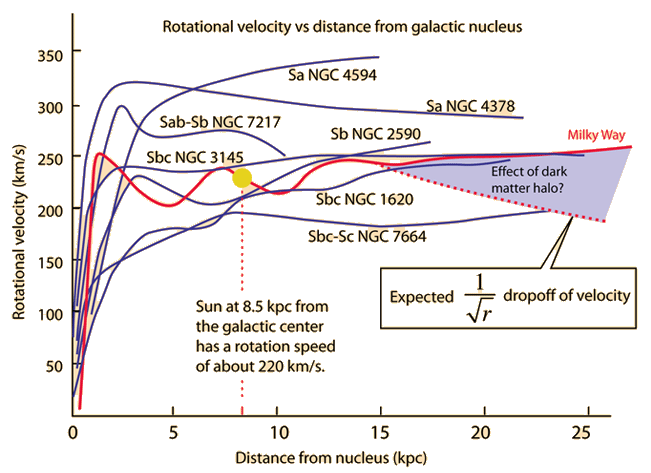
The first and perhaps most direct evidence for dark matter in the universe is found in the measurement of rotational velocities for objects in spiral galaxies as a function of distance from the nucleus. When you reach the outside of the matter of a rotating galaxy, the rotational velocity for an orbit about the galactic center should drop off proportionately to the inverse square root of the distance from the galactic center.
The Sun lies about 8.5 kpc from the galactic center of the Milky Way galaxy, and the visible spiral arms and globular clusters extend out to about 15 kpc. But the rotational velocity does not drop off, as shown in the above illustration. This indicates the presence of gravitational mass beyond 15 kpc, but it cannot be detected by any mechanism which has been tried.
It is important to note that this non-Keplarian behavior is not unique to the Milky Way, but has been observed for other spiral galaxies. The data for the other spiral galaxies in the above illustration is from Rubin, Ford, and Thonnard, Ap. J. Lett., 225, L107, 1978 and is discussed in Chapter 24 of Carroll and Ostlie.
| Dark Matter
暗物质 |
Reference
Carroll & Ostlie
Ch 24
Rohlf
Ch. 19
Kaufmann
Ch. 28
| HyperPhysics***** Astrophysics
HyperPhysics ***** 天体物理学 | R Nave |