Dark Matter
Suppose the dark areas in the picture of the center of our Milky Way galaxy below represented just as much mass as the bright areas. Does that sound plausible? The results of the WMAP assessment of mass density in the universe indicate that 27% of the effective density of the universe is in mass, but that only 4.4% is ordinary "baryonic matter". The remainder is "dark matter", the composition of which is unknown to us. Although we don't know the geometry of the dark matter distribution, the picture below was outlined so that the total area is about six times the area of the bright visible matter, the ratio of the total mass density to the detectable ordinary matter of the galaxy.
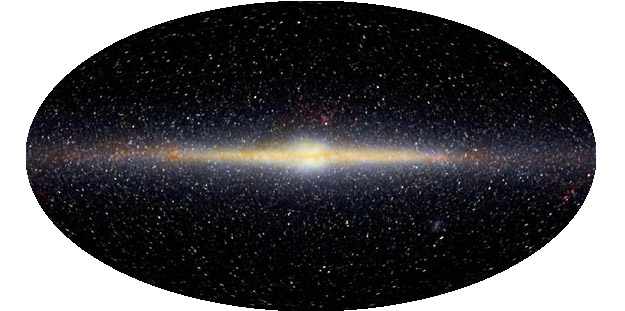 Infrared view of the center of the Milky Way galaxy from the COBE satellite.
The dark matter is undetectable by any electromagnetic radiation at our disposal - we can't see it in the visible range, can't detect it by radio waves at the low end of the spectrum or by the xrays at the high end of the spectrum. It appears not to interact by the electromagnetic force. The obvious question is then "How do we know it is there?" For some 80 years we have known the answer to that - it interacts by gravity and thereby produces measurable results.
When the orbital velocity of material about the center of our galaxy is examined, it is found that there is much more mass than can be accounted for by observation at any wavelength. The orbital velocity is a measure of the mass within the orbit, and once the orbit of any object is outside the collection of mass that attracts it, the orbit velocity diminishes with the inverse of the square root of the orbit radius in the so-called Keplerian orbit.
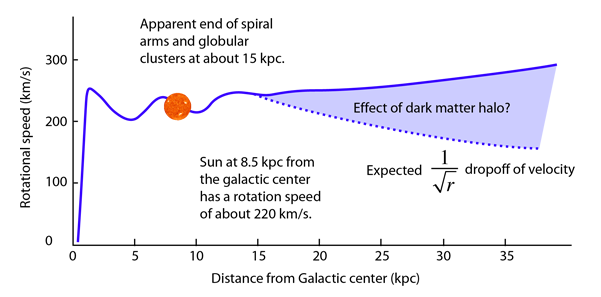
The Sun lies about 8.5 kpc from the galactic center of the Milky Way galaxy, and the visible spiral arms and globular clusters extend out to about 15 kpc. Radio frequency methods should detect gas and dust past this radius, but not much is found. It was expected that the orbital velocity of that matter which is detected should diminish, but it stays more or less constant well beyond any significant detectable mass concentrations. The orbital velocity data clearly indicates the presence of gravitational mass, and the term "dark matter" is used to describe it.
On a larger scale, the measurement of the speeds of galaxies within clusters gives a value for the total mass of the cluster. Again the inferred total mass seems to be several times larger than the visible mass of the galaxies. This was first observed with the Coma Cluster by Franz Zwicky in 1933.
There have been observations of gravitational lensing which forms multiple images of distant galaxies around a closer galactic cluster. When that lensing is modeled, the apparent mass of the lensing cluster is much larger than the implied mass of the visible constituents.
Two types of proposed constituents of the dark matter have been proposed and investigated, and have been given the labels WIMPS and MACHOS. WIMP is an acronym for weakly interacting massive particle and MACHO is an acronym for massive compact halo object. WIMPS would be new kinds of particles interacting by the weak interaction, and efforts have been made to observe them using techniques used for detecting neutrinos. MACHOS could be planet-sized objects, primordial black holes, brown dwarfs, etc., which just cannot be detected out in the halo. Some candidates have been observed, but at present not nearly enough of them to account for a mass so much larger than the currently visible ordinary matter. A mystery for the WIMP hypothesis is why the dark matter should be out in the halo beyond the visible matter. If they were particles produced in the big bang and are gravitationally bound, one would expect more concentration toward the center of galaxies.
References:
Wimps and Machos, Encyclopedia of Astronomy and Astrophysics (pdf)
Wiki:Weakly Interacting Massive Particles
Wiki:Massive Compact Halo Objects
| Velocity curves for other galaxies
其他星系的速度曲线 |
Reference
Carroll & Ostlie
Ch 29
Rohlf
Ch. 19
Kaufmann
Ch. 28
| HyperPhysics***** Astrophysics
HyperPhysics ***** 天体物理学 | R Nave |