The Transparency Point and the Decoupling of Light
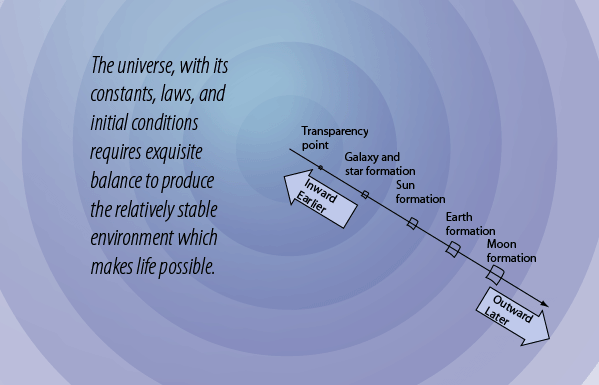
The transparency point is a transition from an era in which radiation was strongly coupled to the particles of the expanding universe to an era in which they were essentially free to fill all of space in an equilibrium that is characteristic of a blackbody radiator. The transparency temperature is the temperature at which stable atoms can form, and this leads to a decoupling of the radiation from the particles.

When the temperature drops below about 3000 K, where a representative energy is kT = 0.26 eV, it is possible for protons to attract electrons and form neutral hydrogen atoms for a reasonable length of time. The high energy photons of electromagnetic radiation interact much less strongly with neutral atoms than they do with the superhot plasma of protons and electrons, so we say that the universe at this temperature became "transparent". To illustrate, we can see the Moon clearly through many miles of atmosphere because the photons from the Moon can pass through almost unimpeded. But we cannot see through a hot plasma because of the strong interaction of the photons with the charged particles of the plasma.
As the now transparent universe continued to cool, the wavelengths of the radiation field increase proportionately (Weinberg) toward what we see now as the cosmic background radiation with effective temperature about 2.7K. The matter (particles) also continue to cool and reach the stage where gravitational attraction can begin to form galaxies.
| How do galaxies and stars form?
星系和恒星是如何形成的? |
HyperPhysics  | R Nave |