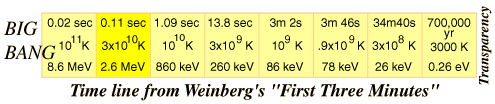
![]() Density 4 x 10⁹ 密度 4 x 10 9
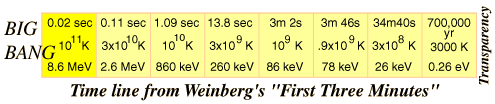
Universe is mostly light (photons ) "...it was light that then formed the dominant constituent of the universe, and ordinary matter played only the role of a negligible contaminant." Reminiscent of "Let there be light...". 宇宙大部分由光(光子)组成……那时光成为了宇宙的主要组成部分,而普通物质仅扮演着可忽略的杂质角色。这让人想起‘要有光……’。
Electrons and positrons created from light (pair -production ) and destroyed by annihilation at about equal rates. The pair-production threshold is 1 MeV, so the thermal energy kT=8.6 MeV was well above that. 光(pair-production)产生电子和正电子,其速率与湮灭速率大致相等。pair-production 阈值为 1 MeV,因此热能 kT=8.6 MeV 明显高于该值。
Protons and neutrons being changed back and forth, so about equal numbers. The energy difference between neutron and proton is 1.29 MeV, so protons can be freely changed to neutrons at this temperature. Only about one baryon for 109 photons, as inferred from the 3K background and density estimates. Since the conservation of baryon number is a strong conservation principle, it is inferred that the ratio of photons to baryons is constant throughout the process of expansion. 质子和中子不断相互转换,因此数量大致相等。中子和质子之间的能量差为1.29 MeV,因此在这一温度下,质子可以自由转换为中子。根据3K背景和密度估计,每10⁹个光子对应约一个重子。由于重子数守恒是一个强守恒原理,因此可以推断出光子与重子的比例在整个膨胀过程中保持恒定。
|
Index Big Bang scenario Reference Weinberg, First Three Minutes 索引 大爆炸情景 参考 Weinberg,前三分钟 | |||||
|
Go Back
返回 |
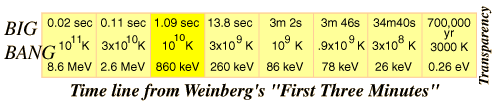
![]() Density 30,000,000 密度 30,000,000
Free neutrons decaying into protons, so there begins to be an excess of protons over neutrons. 62% protons, 38% neutrons 自由中子衰变成质子,于是质子数开始超过中子数。质子占62%,中子占38%。
???There is still plenty of energy to convert protons to neutrons (1.29 MeV), so I don't see how the judgement of relative rate is made ??? 仍有不少能量(1.29 MeV)可用于将质子转化为中子,因此我不明白如何判断相对速率。
|
Index Big Bang scenario Reference Weinberg, First Three Minutes 索引 大爆炸情景 参考 Weinberg,前三分钟 | ||
|
Go Back
返回 |
![]() Density 400,000 密度 400,000
Primeval fireball becomes transparent to neutrinos, so they are released. It is presumed that the universe is filled with a background of those neutrinos now in addition to the 3K microwave background of electromagnetic radiation. Since they were released earlier, the calculated temperature is lower, about 2K. The expanding matter is still opaque to light and electromagnetic radiation of all wavelengths, so they are contained. 原始火球变得对中微子透明,因此中微子被释放出来。假设宇宙中除了3K微波背景辐射外,还充满了这些中微子。由于它们更早被释放,计算出的温度更低,约为2K。膨胀的物质仍对光和所有波长的电磁辐射不透明,因此这些辐射被限制在内。
Electron-positron annilhilation now proceeding faster than pair-production. ?? A lot faster, I would think, since 1MeV is necessary for pair-production, so that is pretty far down the population tail for photons. ??? Probably using 3kT/2 for the thermal energy. 76% protons, 24% neutrons 电子-正电子湮灭现在进行得比产生对的过程快。我觉得快很多,因为产生对需要1MeV,所以对于光子来说,这在人口尾部相当低。可能使用3kT/2作为热能。76%是质子,24%是中子
|
Index Big Bang scenario Reference Weinberg, First Three Minutes 索引 大爆炸情景 参考 Weinberg,前三分钟 | ||
|
Go Back
返回 |
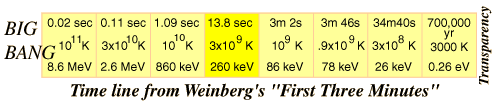
![]() Time:13.82 s, Temperature: 3x10⁹K 时间:13.82 s,温度: 3x10 9 K
Below pair-production threshold, numbers of electrons and positrons rapidly decreasing. Nuclei such as 4He could form, but don't because of "deuterium bottleneck" - deuterium is not stable at this temperature. 83% protons, 17% neutrons 在阈值以下,电子和正电子的数量迅速减少。像氦-4这样的核可以形成,但由于“氘瓶颈”,它们不会形成——因为在这一温度下氘不稳定。质子占83%,中子占17%。
|
Index Big Bang scenario Reference Weinberg, First Three Minutes 索引 大爆炸情景 参考 Weinberg,前三分钟 | ||
|
Go Back
返回 |
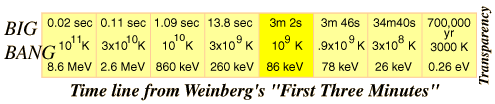
![]() Time:3 min 2 s, Temperature: 109 K 时间:3分2秒,温度:10 9 K Electrons and positrons nearly all gone. 电子和正电子几乎全部消失
Photons and neutrinos are main constituents of the universe. Neutron decay leaves 86% protons, 14% neutrons but these represent a small fraction of the energy of the universe. The hydrogen/helium abundance of the present universe is a reflection of the equilibrium of particle populations established at this early time. 光子和中微子是宇宙的主要组成部分。中子衰变后留下86%的质子和14%的中子,但这些仅占宇宙总能量的一小部分。目前宇宙中氢和氦的丰度反映了在这一早期时间建立的粒子种群平衡。
|
Index Big Bang scenario Reference Weinberg, First Three Minutes 索引 大爆炸情景 参考 Weinberg,前三分钟 | ||
|
Go Back
返回 |
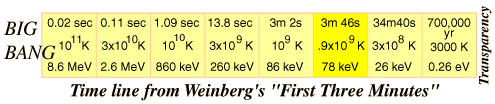
![]() Time: 3min46s Temperature: 0.9x10⁹ K 时间: 3分46秒 温度: 0.9×10⁹ K The deuteron is now stable, so all the neutrons quickly combine to form deuterium and then helium nuclei (the highly stable alpha particles). There is no more neutron decay since they are stable in nuclei. Helium about 26% by mass in the universe from this early time. Nothing heavier is formed since there is no stable product with mass 5. 氘核现在是稳定的,因此所有中子迅速结合形成氘并最终形成氦核(高度稳定的α粒子)。由于中子在核内稳定,不再发生中子衰变。从这个早期时期开始,宇宙中约有26%的质量是氦。由于没有质量为5的稳定产物,因此无法形成更重的元素。
Note that if the expansion process had proceeded more slowly, almost all of the neutrons would have decayed and the universe would not have been able to form atoms as we know them. 注意,如果膨胀过程进展得更缓慢,几乎所有的中子都会衰变,宇宙将无法形成我们所知的原子。
|
Index Big Bang scenario Reference Weinberg, First Three Minutes 索引 大爆炸情景 参考 Weinberg,前三分钟 | ||
|
Go Back
返回 |
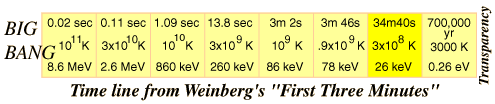
![]() Time:34min40s, Temperature: 3x10⁸ K Density 10 时间:34分40秒,温度:3×10⁸ K,密度10
Nuclear processes are stopped, expansion and cooling continues. About 1 in 109 electrons left because of slight excess of electrons over positrons in primeval fireball. The reason for the excess of matter over antimatter is a continuing investigation. Energy density is about 69% photons, 31% neutrinos. 核过程停止了,膨胀和冷却继续进行。由于原始火球中电子数略多于正电子数,大约有1/10^9的电子离开了。物质多于反物质的原因仍然是一个持续的研究课题。能量密度大约是69%的光子,31%的中微子。
|
Index Big Bang scenario Reference Weinberg, First Three Minutes 索引 大爆炸情景 参考 Weinberg,前三分钟 | ||
|
Go Back
返回 |
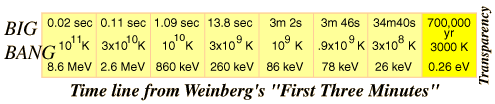
![]() Cool enough for hydrogen and helium nuclei to collect electrons and become stable atoms. Absence of ionized gas makes universe transparent to light for first time. At 3000 K, kT=0.26 eV so above this temperature atom formation is hindered. 当温度足够低,氢和氦核能够收集电子并形成稳定的原子时,宇宙首次变得对光透明。在3000 K时,kT=0.26 eV,因此在此温度以上,原子形成受到阻碍。
Trefil (p41-42) has a good discussion of the transparency point and radiation pressure. He makes the analogy to the air in a tire - the pressure exists because the molecules bounce back from the tire "the tire remains inflated because the rubber walls are very efficient at scattering air molecules." Before the 700,000 year point the ions and electrons of the plasma were efficient scatterers of light, but after they condense into atoms, they are very inefficient scatterers of light - you can easily see 100 miles through air on a clear day. Trefil(第41-42页)对透明点和辐射压力有很好的讨论。他将这一现象类比为轮胎中的空气——压力的存在是因为分子反弹回轮胎,“轮胎保持充气状态是因为橡胶墙壁非常高效地散射空气分子。”在70万年之前,等离子体中的离子和电子是光的高效散射体,但一旦它们凝结成原子后,它们就成为光的非常低效散射体——你可以在晴朗的日子里轻松看到十英里远。
From this point on, the radiation was decoupled from the particles and continued to cool as it was red-shifted by the cosmological expansion. With the discovery of the 3 K background radiation , we now observe the remnant of the radiation which was released at this transparency point. It is in fact the measurement of the characteristics of this cosmic background radiation which provided one of the key parts of the big bang model. 从这一点开始,辐射脱离了粒子,继续随着宇宙膨胀的红移而冷却。随着3 K背景辐射的发现,我们现在观测到的是在这一透明点释放的辐射的残余。事实上,对这种宇宙背景辐射特性的测量为大爆炸模型提供了关键的一部分。
|
Index Big Bang scenario Reference Weinberg, First Three Minutes Trefil 索引大爆炸情景参考Weinberg,前三分钟Trefil | ||
|
Go Back
返回 |