Bilingual edition: English is preserved and Chinese follows each unit. Terminology uses the confirmed v20260916 glossary; automated semantic review remains traceable.
中英双语版:英文原文完整保留,中文紧随对应单元;术语采用 v20260916 确认表,自动语义审校结果可追溯。

Digital Sampling

数字采样

For the purpose of storing audio information in digital form, like a compact disc, the normal continuous wave audio signal (analog) must be converted to digital form (analog-to-digital) conversion. Below is an example of a D/A conversion using digits 0-9, but practical schemes store the numbers in binary form. The number of bits in the binary sampler determines the accuracy with which the analog signal can be represented in digital form.
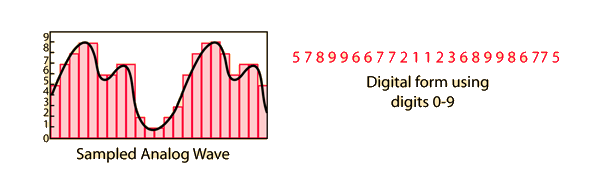
为了将音频信息以数字形式存储,例如在光盘中,正常的连续波音频信号(模拟信号)必须转换为数字形式(模拟到数字转换)。以下是一个使用数字0-9进行D/A转换的例子,但实际方案中数字是以二进制形式存储的。二进制采样器中的位数决定了 analog 信号以数字形式表示的精度。

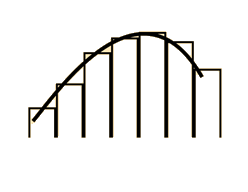
From this crude picture of digitizing in steps, perhaps you can appreciate the industry standard of 16 bit sampling in which the voltage is sampled into 65,536 steps. In addition to the number of steps, the rate of sampling also affects the fidelity of representation of the analog waveform. The standard sampling rate is 44.1 kHz, so the assignment of one of 65, 536 values to the signal is done 44,100 times per second. If this recorded data is read from the CD in real time, you are processing 1.4 million bits of information per second (1.4 Mbps).

从这种粗糙的分步数字化图像来看,也许你能理解行业标准的16位采样,其中电压被分成65,536个步骤。除了步数之外,采样率也会影响模拟波形的保真度。标准采样率是44.1 kHz,因此每秒将一个65,536个值之一分配给信号的次数是44,100次。如果从CD中实时读取这些记录的数据,你每秒处理1.4百万位的信息(1.4 Mbps)。
MP3 Digital
MP3 数字
Index

Traveling wave concepts

Sound reproduction concepts

Audio signal concepts
索引:行波概念、声音再现概念、音频信号概念
 
HyperPhysics***** Sound
HyperPhysics ***** 声音
R Nave
Go Back
返回


Implication of Number of Bits

比特数的含义

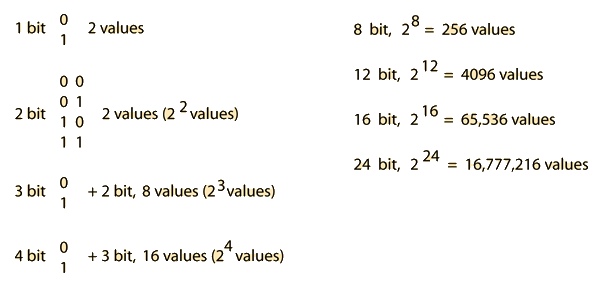
The number of bits used in a digital sampler determines the resolution of the "image" of the signal being represented. A one-bit sampler would be like a light switch, having two possible values, on and off. Samplers with multiple bits are representing a signal in terms of a binary number, and the number of bits determines the number of values which can be expressed, just as a 3 digit number in the usual 10-based number system can take more values than a 2 digit number. The number of bits determines the possible dynamic range.

数字采样器使用的位数决定了所表示信号的“图像”的分辨率。一个一位采样器就像一个开关,只有两个可能的值,开和关。具有多个位的采样器是通过二进制数来表示信号的,位数决定了可以表示的数值数量,就像通常的三位数在十进制系统中可以表示的数值比两位数更多一样。位数决定了可能的动态范围。
Index

Sound reproduction concepts

Audio signal concepts
索引 声学再现概念 音频信号概念
 
HyperPhysics***** Sound
HyperPhysics ***** 声音
R Nave
Go Back
返回


Bits and Dynamic Range

比特与动态范围

If you are doing a linear stair-step digitization of an analog waveform, the number of bits used in the sampling determines the maximum dynamic range you can faithfully represent with the sampling.

如果你对模拟波形进行线性阶梯量化,所用的位数决定了你能忠实表示的最大动态范围。

For example, an 8-bit sample can give you 256 possible values, so if the softest sound you sample is represented by a 1, then the loudest sound you can represent is a 256. The maximum range of amplitudes is then 256, and since the power is proportional to the amplitude squared, the power range is 256 squared or 1 to 65,536 in power. This corresponds to a dynamic range of 48 decibels whereas the dynamic range of an orchestra is about 40 to 100 dB, or 60 dB. By similar calculation, a 12 bit digitization can give you a dynamic range of 72 dB and 16 bits can give you 96 dB of dynamic range.

例如,一个8位采样可以给出256个可能的值,所以如果最轻的声音用1表示,那么最响的声音可以表示为256。幅度的最大范围是256,由于功率与幅度平方成正比,因此功率范围是256平方,即1到65,536。这对应于48分贝的动态范围,而交响乐团的动态范围大约是40到100分贝,或60分贝。通过类似的计算,12位数字化可以提供72分贝的动态范围,16位可以提供96分贝的动态范围。
Index

Sound reproduction concepts

Audio signal concepts
索引 声学再现概念 音频信号概念
 
HyperPhysics***** Sound
HyperPhysics ***** 声音
R Nave
Go Back
返回