Impedance Matching阻抗匹配
In the early days of high fidelity music systems, it was crucial to pay attention to the impedance matching of devices since loudspeakers were driven by output transformers and the input power of microphones to preamps was something that had to be optimized. The integrated solid state circuits of modern amplifiers have largely removed that problem, so this section just seeks to establish some perspective about when impedance matching is a valid concern. 在高保真音响系统发展的早期阶段,关注设备的阻抗匹配至关重要,因为扬声器是通过输出变压器驱动的,而麦克风输入到前置放大器的功率必须进行优化。现代放大器的集成固态电路已 largely 解决了这个问题,因此本节只是试图建立一些关于何时阻抗匹配仍是一个合理关注点的视角。
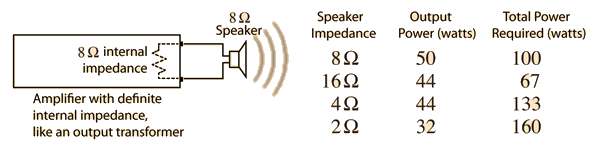
As a general rule, the maximum power transfer from an active device like an amplifier or antenna driver to an external device occurs when the impedance of the external device matches that of the source. That optimum power is 50% of the total power when the impedance of the amplifier is matched to that of the speaker. Improper impedance matching can lead to excessive power use, distortion, and noise problems. The most serious problems occur when the impedance of the load is too low, requiring too much power from the active device to drive the load at acceptable levels. On the other hand, the prime consideration for an audio reproduction circuit is high fidelity reproduction of the signal, and that does not require optimum power transfer. In modern electronics, the integrated circuits of an amplifier have at their disposal hundreds to thousands of active transistor elements which can with appropriate creative use of feedback make the performance of the amplifier almost independent of the impedances of the input and output devices within a reasonable range. 在现代电子学中,放大器的集成电路拥有数百到数千个主动晶体管元件,通过适当且富有创意地使用反馈,可以使放大器的性能几乎不依赖于输入和输出器件的阻抗,在合理范围内保持稳定。
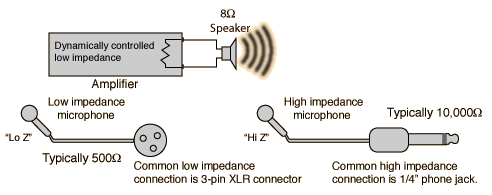
On the input side, the amplifier can be made to have almost arbitrarily high input impedance, so in practice a microphone sees an impedance considerably higher than its own impedance. Although that does not optimize power transfer from the microphone, that is no longer a big issue since the amplifier can take the input voltage and convert it to a larger voltage - the term currently used is "bridging" to a larger image of the input voltage pattern. 在输入端,放大器可以被设计成具有几乎任意高的输入阻抗,因此在实际应用中,麦克风会看到一个远高于其自身阻抗的阻抗。虽然这并不优化从麦克风传输的功率,但这种情况已不再是个大问题,因为放大器可以将输入电压转换为更大的电压——当前使用的术语是“桥接”到输入电压模式的更大影像。
On the output side, a loudspeaker may still have a nominal impedance of something like 8 ohms, which formerly would have required having an amplifier output stage carefully matched to 8 ohms. But now with the active output circuitry of audio amplifiers, the effective output impedance may be very low. The active circuitry controls the output voltage to the speaker so that the appropriate power is delivered. 在输出端,扬声器仍可能具有约8欧姆的额定阻抗,这以前需要放大器的输出级仔细匹配到8欧姆。但现在由于音频放大器的主动输出电路,有效输出阻抗可能非常低。主动电路控制输出电压以确保适当的功率传递。
![]()
通常情况下,从主动设备(如放大器或天线驱动器)向外部设备传输最大功率时,当外部设备的阻抗与源的阻抗相匹配时会发生。此时的最优功率是总功率的50%,当放大器的阻抗与扬声器的阻抗匹配时即为如此。不当的阻抗匹配可能导致过度的功率消耗、失真和噪声问题。最严重的问题出现在负载阻抗过低时,此时主动设备需要提供过多的功率才能在可接受的水平上驱动负载。另一方面,音频再现电路的主要考虑是信号的高保真再现,而这并不需要最优的功率传输。 |
Index Sound reproduction concepts 索引 声学再现概念 | ||
|
Go Back
返回 |
Matching Amplifier to Loudspeaker匹配放大器与扬声器
The maximum power transfer from an active device like an amplifier to an external device like a speaker occurs when the impedance of the external device matches that of the source. That optimum power is 50% of the total power when the impedance of the amplifier is matched to that of the speaker. 从放大器等主动设备向外部设备如扬声器等传输最大功率时,当外部设备的阻抗与源的阻抗相匹配时发生。此时最优功率是总功率的50%,当放大器的阻抗与扬声器的阻抗相匹配时。
But modern audio amplifiers are active control devices, and the impedance matching of the amplifier to the loudspeaker is no longer considered best practice. Modern solid state amplifiers are sometimes referred to as "bridging" devices which take an input voltage from an audio source and form an amplified image of that voltage at the output. The output impedance is low, and the output voltage and power are controlled dynamically. 但现代音频放大器是主动控制装置,放大器与扬声器之间的阻抗匹配不再被视为最佳实践。现代固态放大器有时被称为“桥接”设备,它们从音频源获取输入电压,并在输出端形成该电压的放大图像。输出阻抗较低,输出电压和功率会动态控制。
The implications of the simplified model for resistive amplifier outputs and speakers may nevertheless be instructive as a reference. For example, assume that the maximum distortion-free voltage from the amplifier is 40 volts: 尽管简化模型对电阻放大器输出和扬声器的 implications 可能仍然具有指导意义作为参考。例如,假设放大器的最大无失真电压为 40 伏:
![]() To emphasize the oversimplification involved in the above model, it should be noted that the loudspeaker is not a simple resistor - it contains a coil or coils with significant inductance, and is typically composed of two or three speakers with a crossover network that has capacitance and inductance. So the impedance of the loudspeaker will inevitably vary with frequency. The only present day amplifiers that would have a characteristic output impedance like that shown would be those designed to operate with "valve" or "vacuum tube" amplifiers. 为强调上述模型中的过度简化,应注意的是,扬声器并非简单的电阻——它包含一个或多个具有显著电感的线圈,并通常由两个或三个扬声器组成,配有包含电容和电感的均衡网络。因此,扬声器的阻抗必然随频率变化。目前唯一具有如图所示特征输出阻抗的放大器,将是那些设计用于“真空管”或“真空管”放大器的放大器。
Note that it is safer in terms of total power to go to higher impedance speakers (series speakers), but more typical practice is to put speakers in parallel, lowering the impedance. Note in the table above that lowering the impedance below the output impedance of the amplifier not only reduces the output power but increases the internally dissipated power in the amplifier. 注意,从总功率的角度来看,使用高阻抗扬声器(串联扬声器)更安全,但更常见的做法是将扬声器并联,从而降低阻抗。如上表所示,将阻抗降低到放大器的输出阻抗以下不仅会降低输出功率,还会增加放大器内部的耗散功率。
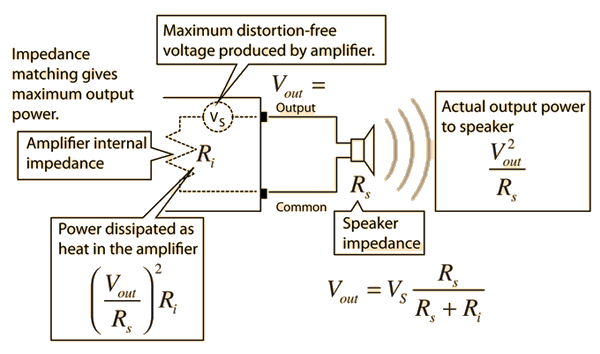
![]() This diagram shows the relationships used to obtain the power values in the table above. Note that it assumes a resistive nature of both the loudspeaker impedance and the internal impedance, neither of which is strictly true.
此图显示了用于获得上表中功率值的关系。请注意,它假设扬声器阻抗和内部阻抗均为电阻性,而这两种假设均不严格成立。 |
Index Sound reproduction concepts 索引 声学再现概念 | |||
|
Go Back
返回 |
Matching Microphone to Input麦克风与输入匹配
While impedance matching of a microphone to an audio amplifier is not the problem it was in the early days of high fidelity sound reproduction, there are some considerations that still apply. 尽管将麦克风与音频放大器进行阻抗匹配的问题已不像早期高保真声音再现时期那样突出,但仍有一些因素需要考虑。
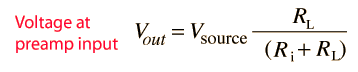
In practical terms, the modern microphone needs to deliver optimal voltage to the preamplifier, and not necessarily the optimum power that would require impedance matching. Considering the microphone as a voltage source, the voltage delivered to the input of the preamplifier is given by 实际上,现代麦克风需要向前置放大器提供最佳电压,而不一定需要最优的功率,这可能需要阻抗匹配。将麦克风视为电压源,输入前置放大器的电压由
![]() where Vsource is the signal generated by the microphone mechanism, Ri the impedance of the microphone and RL the input impedance of the preamplifier. The actual signal power delivered to the preamp can be expressed in decibels of loss compared to the microphone's generated signal . Assuming a resistive circuit so that the power if proportional to the square of the voltage: 其中 V source 是由麦克风机制产生的信号,R i 是麦克风的阻抗,R L 是前置放大器的输入阻抗。实际传递到前置放大器的信号功率可以表示为与麦克风产生的信号相比的分贝损耗。假设为电阻性电路,因此功率与电压平方成正比:
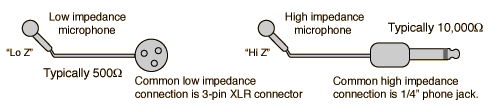
![]() As long as the microphone has enough signal strength to provide the minimum signal input to the mixer, it can be an advantage to connect a low impedance microphone to a moderately higher impedance input. From this point of view, current practice for "low impedance" inputs to audio mixers typically have impedances from 1000 to 2000 ohms according to the Shure Pro Audio website. They comment that as a rule of thumb, a signal loss of 6dB is acceptable. 只要麦克风有足够的信号强度能够为混音器提供最小的信号输入,将低阻抗麦克风连接到中等较高阻抗输入就具有优势。从这个角度看,音频混音器的“低阻抗”输入通常根据Shure Pro Audio网站的说法,其阻抗范围为1000至2000欧姆。他们评论说,通常认为6dB的信号损失是可以接受的。
![]()
对于阻抗为 R_i = Ω 的麦克风和输入阻抗为 R_L = Ω 的前置放大器,信号损失为 dB 中文译文中的待填/计算数值依次对应:1:r1 2:r2 3:pl。实际数值以上方原输入框为准。 |
Index Sound reproduction concepts 索引 声学再现概念 | ||
|
Go Back
返回 |