Nitrogen Fixation
固氮作用
 | Nitrogen fixation in the roots of plants such as legumes is the only biological pathway for providing nitrogen fo the essential life process such as making amino acids, the building blocks for proteins.
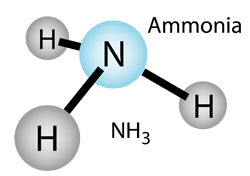
豆科植物根部的固氮作用是为生命过程如合成氨基酸(蛋白质的构成成分)提供氮的唯一生物途径。 The conversion of atmospheric N2 to ammonia, NH3, uses a process in the nodules on the roots of leguminous plants which involves enzymes with the metals iron and molybdenum (sometimes vanadium).
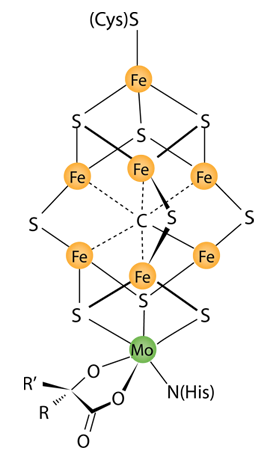
大气中的氮气转化为氨(NH₃)的过程发生在豆科植物根部的根瘤中,这一过程涉及含有铁和钼(有时是钒)的酶。 The diagram at left is to provide an example of the type of complexes in biology which make use of metal atoms. Iron is common in such applications, but in this case molybdenum is critical in the nitrogen fixation process. This complex is described as a MoFe cofactor in a MoFe protein.
左边的图例提供了一个生物学中利用金属原子的复合物的例子。铁在这样的应用中很常见,但在此情况下,钼是固氮过程中的关键成分。这种复合物被称为MoFe辅因子,在MoFe蛋白中存在。 |
The actual breaking of the strong N2 triple bond and production of NH3 and other nitrogen compounds is accomplished by bacteria in symbiotic relationship with plant groups such as legumes. The types of microorganisms are called diazotrophs. The enzymes involved are called nitrogenases.
Looser non-symbiotic relationships (called associations) occur between diazotrophs and plants such as rice where nitrogen fixation takes place on the roots.
较松散的非共生关系(称为关联)发生在固氮菌与水稻等植物之间,其中固氮作用发生在根部。 The overall reaction for the conversion to ammonia enabled by the nitrogenase enzyme may be written:
N2 + 16 ATP + 16 H2O + 8e- + 8H+ --> 2NH3 + H2 + 16ADP + 16Pi
由氮ase酶催化转化为氨的总反应可表示为:N₂ + 16 ATP + 16 H₂O + 8e⁻ + 8H⁺ → 2NH₃ + H₂ + 16ADP + 16P_i This can be seen to be an energy-intensive process by the requirement of 16 of the energy-rich ATP molecules. The conversion of N2 into ammonia occurs at a metal cluster called FeMoco, an abbreviation for the iron-molybdenum cofactor. The mechanism proceeds via a series of protonation and reduction steps wherein the FeMoco active site hydrogenates the N2 substrate.
这一过程需要大量的能量,因为需要16个能量丰富的ATP分子。氮气转化为氨的发生是在一种称为FeMoco的金属簇上,FeMoco是铁钼辅因子的缩写。该机制通过一系列质子化和还原步骤进行,其中FeMoco活性位点将氢原子加到氮气底物上。 Some plants that contribute to nitrogen fixation are members of the legume family: kudzu, clover, soybean, alfalfa, lupin and peanut. They contain the symbiotic rhizobia bacteria within nodules in their root systems. These nodules limit exposure to oxygen, which rapidly decomposes the nitrogenase enzymes. Nitrogen fixation can occur in decomposing wood by diazotrophic bacterial communities. This can enrich the nitrogen content of the wood, enabling deadwood decomposition by fungi.
一些参与固氮的植物属于豆科植物:紫藤、白三叶、大豆、苜蓿、 lupin 和花生。这些植物的根系中包含共生的根瘤菌。这些根瘤限制了氧气的接触,而氧气会迅速分解氮酶。固氮也可以在分解的木材中由固氮细菌群落发生。这可以增加木材中的氮含量,促进真菌对死木的分解。 A large amount of nitrogen fixation occurs in the oceans, perhaps half. The cyanobacteria in the seas are a major source of such production of nitrates.
海洋中发生大量的固氮作用,可能占一半。海洋中的蓝藻是硝酸盐生成的主要来源。
强N₂三键的实际断裂以及NH₃和其他氮化合物的生成是由与豆科植物等植物群共生的细菌完成的。参与这一过程的微生物被称为固氮菌,所涉及的酶称为氮ases。 |