Chemical Elements for Life
The chemical elements most prominent in building the structures of the molecules of life are carbon, hydrogen, oxygen, nitrogen, phosphorous and sulfur, sometimes represented mnemonically as CHONPS. These elements combine in a vast number of molecules involved in life processes. Their fitness for making these compounds is related to their relative electronegativities which contribute to their ease of combination.
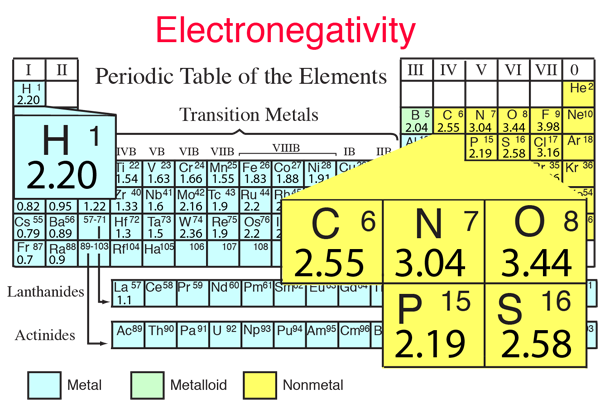
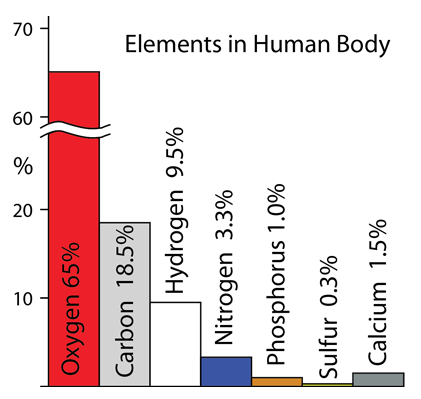 | These elements make up the bulk of the atoms in living organisms. The CHONPS elements are the most abundant in the body with the exception of calcium at 1.5%. 这些元素构成了生物体中大部分原子。CHONPS元素在体内是最丰富的,除了钙,其含量为1.5%。 In addition to these elements, a number of metal atoms play essential supporting roles in producing enzymes, contributing to communication pathways, and enabling specific processes in the body. 除了这些元素之外,一些金属原子在产生酶、参与细胞通讯途径以及实现体内特定过程方面起着至关重要的作用。 |
Carbon: Carbon is the foundational element for all life on Earth. It's capacity to form four bonds makes possible an almost limitless variety of compounds.
- Hydrocarbons contain only carbon and hydrogen.
烃类仅由碳和氢组成。
- Derivatives of Hydrocarbons add other elements to carbon and hydrogen.
烃类衍生物向碳和氢中添加其他元素。
- Aromatic Hydrocarbons contain one or more benzine rings.
芳香烃含有一个或多个苯环
Oxygen: Oxygen is the most abundant element in the human body at 65%. It is abundant partly because the body is up to 60% water, but is also a constituent of most large biological molecules and is continually being exchanged in the process of metabolism and respiration.
- Derivatives of Hydrocarbons mostly have oxygen as a constituent in addition to carbon and hydrogen.
烃的衍生物通常除了含有碳和氢外,还含有氧。
- Respiration continuously transports oxygen to cellular processes.
呼吸作用持续将氧气运输到细胞过程。
- Cellular Respiration oxidizes food in the metabolic process for energy.
细胞呼吸通过代谢过程将食物氧化以产生能量。
- Energy production in the electron transport chain makes ATP and forms water for removal.
电子传递链中的能量产生使ATP合成并形成水以供去除。
Hydrogen: Hydrogen with oxygen is abundant in the body because it is up to 60% water.
- Hydrocarbons and their derivatives contain carbon and hydrogen.
烃类及其衍生物含有碳和氢。
- Energy production in the electron transport chain transports hydrogen for making ATP .
电子传递链中的能量生产将氢转运以生成ATP。
Nitrogen: Nitrogen is not abundant on the Earth, but is crucial in life processes.
- Amino acids are the building blocks for proteins.
氨基酸是蛋白质的构建块。
- Nucleotides which make up nucleic acids are essential to life.
构成核酸的核苷酸对生命是必不可少的
- DNA is the master storage molecule for information for building proteins.
DNA是构建蛋白质信息的主存储分子。
- RNA is directly involved in transcribing information for building proteins and other parts of the translation process of building proteins.
RNA直接参与将信息转录为构建蛋白质和其他蛋白质合成过程部分的翻译过程。
Phosphorus: Phosphorus is not so abundant, but is crucial in the energy sources for life processes
- ATP is the phosphate compound which is the basic energy source for most molecular interactions in life.
ATP 是一种磷酸化合物,是生命中大多数分子相互作用的基本能量来源。
- Glycolysis uses ATP and NAD+ to convert glucose to pyruvate in the energy chain.
糖酵解利用ATP和NAD+将葡萄糖转化为丙酮酸在能量链中。
Sulfur: Sulfur has many structural roles in proteins.
- Amino acids cysteine and methionine contain sulfur and disulfide bonds in protein folding accomplish key tasks.
含硫氨酸和甲硫氨酸的氨基酸在蛋白质折叠中形成二硫键,完成关键任务。
Calcium: Calcium is a key component of bones and calcium ions also handle information in neural processes. As a chemical messenger, it has not only high speed but also the ability to bind to another molecule in the cell like a protein with high specificity to enact a conformational change. Calcium and magnesium can accomplish this, but calcium is superior for the role, binding many times more strongly than magnesium.
- Muscle fiber contraction is initiated by information transported by calcium ions.
肌肉纤维收缩是由钙离子传递的信息引发的
The Role of Metal Atoms in Body Chemistry
Although present in relatively small amounts, metal atoms play a surprisingly important role in the chemistry of life. About a third of the enzymes in the body involve a metal ion as an essential participant. From the electron transport chain to the maintaining of membrane potentials of cells, metals play essential supporting roles for the atoms involved in the major structures of life.

Sodium: Sodium binds weakly to organic compounds and sodium ions are small and highly mobile, ideally suited for moving electric charge at high speeds. Sodium and potassium are the only ions whose speed is unimpeded by a tendency to bind to organic compounds.
- Cell membrane transport: The ease and speed of movement across cell membranes helps to maintain proper electrical potentials. Sodium participates in active transport processes across cell membranes.
细胞膜运输:物质通过细胞膜的容易程度和速度有助于维持适当的电势。钠离子参与细胞膜上的主动运输过程。
- Action potentials: The mobility of sodium ions across membranes makes them useful for transmission of nerve impulses associated with nerve cells.
动作电位:钠离子跨膜的移动使它们成为传递神经冲动的神经细胞所必需的。
Magnesium is present in every cell type in every organism. Magnesium enyzmes are necessary for the catalytic action of more than 300 enzymes.
- Mg2+-ATP association: ATP, the main provider of cellular energy, is always associated with magnesium.
Mg²+ -ATP结合:ATP,细胞中主要的能量来源,总是与镁离子结合。
- Photosynthesis: Magnesium is a key component of chlorophyll and is essential to the efficiency of capturing light energy. Magnesium has been found to be far more efficient than any other metal ion, sometimes by a factor of thousands.
光合作用:镁是叶绿素的关键成分,对捕获光能的效率至关重要。镁的效率远高于任何其他金属离子,有时可达千倍之多。
Potassium: Potassium binds weakly to organic compounds and potassium ions are small and highly mobile, ideally suited for moving electric charge at high speeds. Potassium and sodium are the only ions whose speed is unimpeded by a tendency to bind to organic compounds.
- Cell membrane transport: The ease and speed of movement across cell membranes helps to maintain proper electrical potentials. Potassium participates in active transport processes across cell membranes.
细胞膜运输:物质通过细胞膜的容易程度和速度有助于维持适当的电势。钾参与细胞膜上的主动运输过程。
- Action potentials: The mobility of potassium ions across membranes makes them useful for transmission of nerve impulses associated with nerve cells.
动作电位:钾离子在膜上的移动使它们成为传递神经冲动的有用媒介。
Manganese: Manganese is important in plant photosynthesis.
- Splitting water in green plants is part of photosynthesis in photosystem-II. It involves manganese chemical reactions.
绿色植物中水分的分裂是光合作用中光系统-II的一部分。这一过程涉及锰的化学反应。
Iron: One of the most important metals in biological processes, iron is a key to oxygen transport by hemoglobin, to electron transport on the way to ATP production, and part of a catalyst for the fixation of nitrogen in plants.
-
Hemoglobin: Iron is a key component of hemoglobin, which transports oxygen to the cells inside red blood cells.
血红蛋白:铁是血红蛋白的重要组成部分,血红蛋白将氧气运输到红细胞内部的细胞中。 - Nitrogen fixation in the roots of plants is an essential process for life. An enzyme containing iron and molybdenum is used in the process of making NH3 from N2.
植物根部的固氮作用是生命过程中的一个关键步骤。一种含有铁和钼的酶被用于将N₂转化为NH₃的过程。
- Electron transport chain: Iron and copper are key constituents of Complex IV in the electron transport chain. They accomplish the transfer of electrons to oxygen to prepare for the final step of making a water molecule, and also transfer hydrogen ions to the intermembrane space of the mitochondria for the process of oxidative phosphorylation and making of ATP. Iron in the form of Fe-S complexes is a part of Complex I, Complex II, and Complex III of the electron transport chain as parts of the pathway of conducting the electrons through the chain.
电子传递链:铁和铜是电子传递链中复合物IV的关键组成部分。它们负责将电子传递到氧气,为最终形成水分子的步骤做准备,同时也将质子转移到线粒体的膜间空间,以进行氧化磷酸化过程和ATP的生成。以Fe-S复合物形式存在的铁是电子传递链中复合物I、II和III的一部分,作为电子通过链传导路径的组成部分。
Cobalt: Cobalt and nickel are sometimes referred to as evolutionary relics because of their frequent appearance in ancient anaerobic bacteria. Vitamin B12 has a single atom of cobalt. Current uses involve vitamin B12-dependent enzymes.
- Vitamin B12 is associated with a number of enzymes which contain cobalt. It is a cofactor in DNA synthesis, in both fatty acid and amino acid metabolism. It is important in the normal functioning of the nervous system via its role in the synthesis of myelin, and in the maturation of red blood cells in the bone marrow. One application is in the synthesis of high fructose corn syrup. In this and other cobalt applications, other metals may be substituted.
维生素B₁₂与许多含钴的酶有关。它在DNA合成、脂肪酸和氨基酸代谢中起辅因子作用。它通过参与髓鞘的合成,对神经系统正常功能至关重要,并在骨髓中促进红细胞的成熟。一个应用是高果糖玉米糖浆的合成。在这一及其他钴的应用中,其他金属可能被替代。
Copper: A key element in the electron transport chain which leads to the energy molecule ATP in the cell.
- Electron transport chain: Copper and iron are key constituents of Complex IV in the electron transport chain. They accomplish the transfer of electrons to oxygen to prepare for the final step of making a water molecule, and also transfer hydrogen ions to the intermembrane space of the mitochondria for the process of oxidative phosphorylation and making of ATP.
电子传递链:铜和铁是电子传递链中复合物IV的关键组成部分。它们负责将电子传递到氧气,为最终形成水分子的步骤做准备,同时也将氢离子转移到线粒体的膜间空间,以进行氧化磷酸化过程和ATP的合成。
Zinc: There is typically only about 3 grams of Zinc in the body, but it is present in over 300 enzymes. It has a crucial role in converting CO2 to H2CO3 for transport to the lungs.
- Carbonic Anhydrase is an enzyme with zinc as a key component. It is involved in converting the metabolic product CO2 to carbonic acid, H2CO3, in the red blood cells for transport to the lungs. When red blood cells reach the lungs, the same enzyme helps to convert the bicarbonate ions back to carbon dioxide, which we breathe out.
碳酸酐酶是一种含有锌的酶。它在红细胞中将代谢产物二氧化碳转化为碳酸(H₂CO₃),以便运输到肺部。当红细胞到达肺部时,同一种酶又帮助将碳酸氢根离子转化为二氧化碳,我们通过呼吸排出。
Molybdenum: Molybdenum is the key metal ion component in four important enzymes in our bodies. It is the key metal ion involved in nitrogen fixation in plants.
- Nitrogen fixation in the roots of plants is an essential process for life. An enzyme containing molybdenum is used in the process of making NH3 from N2.
植物根部的固氮作用是生命过程中的关键步骤。一种含有钼的酶被用于将N₂转化为NH₃的过程。
Chemistry of elements
References:
Denton Miracle of the Cell, Ch 6
Crichton
| HyperPhysics***** Chemistry
HyperPhysics ***** 化学 | R Nave |