Bilingual edition: English is preserved and Chinese follows each unit. Terminology uses the confirmed v20260916 glossary; automated semantic review remains traceable.
中英双语版:英文原文完整保留,中文紧随对应单元;术语采用 v20260916 确认表,自动语义审校结果可追溯。

The Nervous System

神经系统

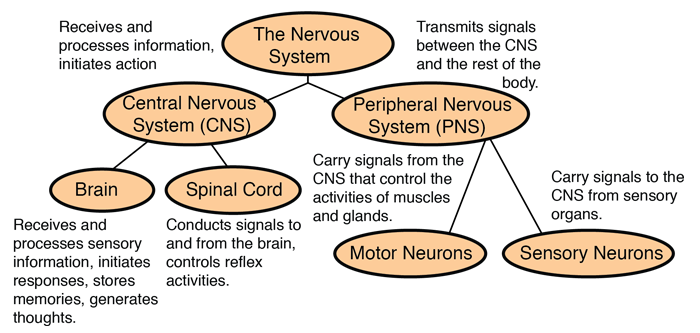
The nervous system is a complex collection of nerves and specialized cells known as neurons that transmit signals between different parts of the body. It can be considered to be made up of two parts: the central nervous system and the peripheral nervous system. The central nervous system is made up of the brain, spinal cord and nerves. The peripheral nervous system of sensory neurons and clusters of such neurons (ganglia) and nerves that connect to one another and to the central nervous system. The following outline follows the content of Audesirk & Audesirk.
神经系统是由神经和称为神经元的特殊细胞组成的复杂集合,用于在身体的不同部分之间传递信号。它可以被看作由两个部分组成:中枢神经系统和周围神经系统。中枢神经系统由大脑、脊髓和神经组成。周围神经系统由感觉神经元和这样的神经元簇(神经节)以及连接彼此和中枢神经系统的神经组成。以下大纲遵循Audesirk & Audesirk的内容。

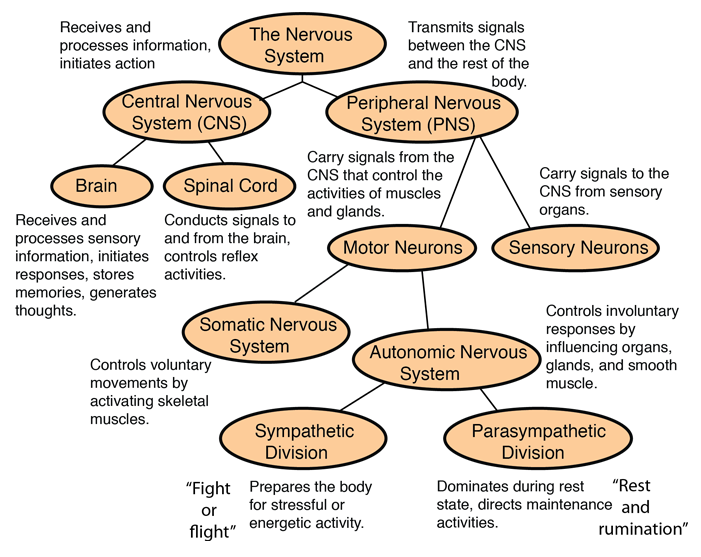
The nervous system has two main subdivision: the somatic, or voluntary, component, and the autonomic, or involuntary, component. The autonomic nervous system regulates many body process such as blood pressure and rate of breathing, that work without conscious effort. The somatic system consists of nerves that connect the brain and spinal cord with muscles and sensory receptors in the skin.

神经系统主要分为两个部分:躯体部分(或称自愿部分)和自主部分(或称非自愿部分)。自主神经系统调节许多身体过程,如血压和呼吸速率,这些过程在无意识的情况下进行。躯体系统由连接大脑和脊髓与皮肤肌肉和感觉受体的神经组成。

The primary function of the autonomic nervous system is homeostasis. It has two divisions: the sympathetic nervous system and the parasympathetic nervous system. The sympathetic nervous system accelerates heart rate, constricts blood vessels, and raises blood pressure, and other functions of a generally stimulating nature. The parasympathetic nervous system slows heart rate, increases intestinal and gland activity, and other inhibitory or calming functions.

This material is part of a brief overview of the topics studied in biology with the intent to highlight the connections to basic ideas in physics and physical science.
这部分内容是对生物学中研究主题的简要概述,旨在突出其与物理学和物理科学基本概念的联系。
自主神经系统的主要功能是维持内环境稳定。它分为两个部分:交感神经系统和副交感神经系统。交感神经系统加快心率,收缩血管,升高血压,以及其他具有普遍刺激性质的功能。副交感神经系统减慢心率,增加肠道和腺体活动,以及其他抑制或镇静的功能。
Index

Reference
Audesirk & Audesirk
Ch 33

Livescience
索引 参考 Audesirk & Audesirk 第33章 Livescience
 
HyperPhysics***** Biology
HyperPhysics ***** 生物学
R Nave
Go Back
返回


The Autonomic Nervous System

自主神经系统

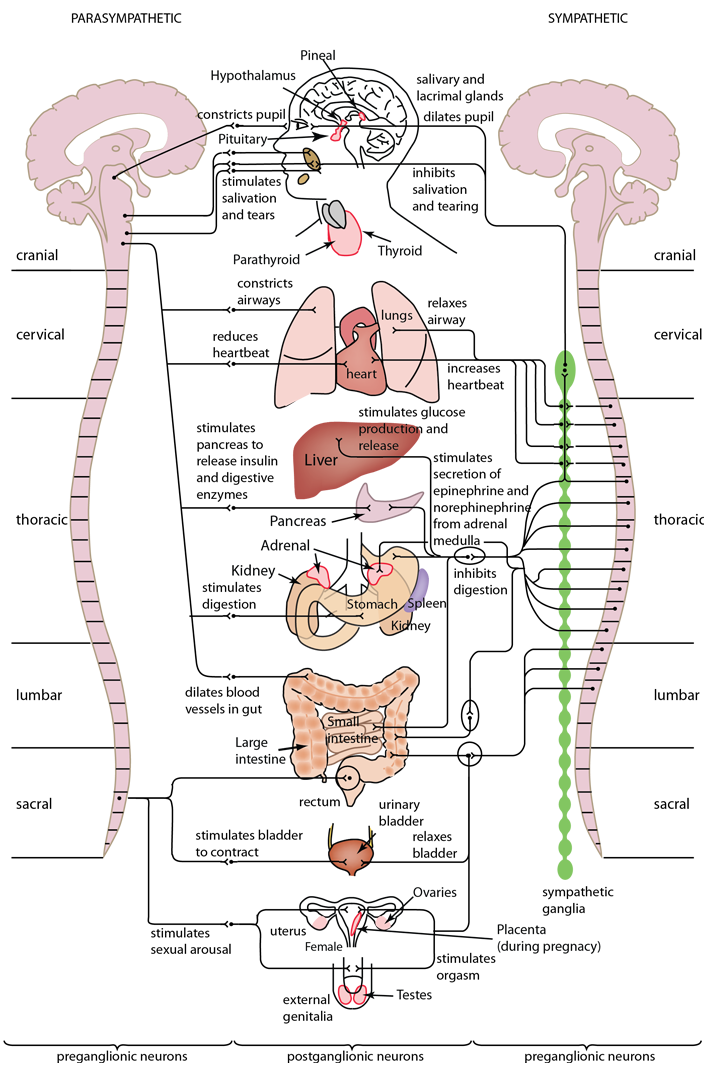
The autonomic nervous system regulates many body process such as blood pressure and rate of breathing, that work without conscious effort. The primary function of the autonomic nervous system is homeostasis. It has two divisions: the sympathetic nervous system and the parasympathetic nervous system. The sympathetic nervous system accelerates heart rate, constricts blood vessels, and raises blood pressure, and other functions of a generally stimulating nature. The parasympathetic nervous system slows heart rate, increases intestinal and gland activity, and other inhibitory or calming functions. The illustration of the pathways for the sympathetic and parasympathetic systems below follows the organization of Audesirk & Audesirk.

自主神经系统调节许多身体过程,如血压和呼吸速率,这些过程在无意识的情况下进行。自主神经系统的主要功能是维持内环境稳定。它分为两个部分:交感神经系统和副交感神经系统。交感神经系统加快心率,收缩血管,提高血压,以及其他具有普遍刺激性质的功能。副交感神经系统减慢心率,增加肠道和腺体活动,以及其他抑制或镇静的功能。下面关于交感和副交感系统的路径示意图遵循Audesirk & Audesirk的组织方式。
Index

Reference
Audesirk & Audesirk
Ch 33

Livescience
索引 参考 Audesirk & Audesirk 第33章 Livescience
 
HyperPhysics***** Biology
HyperPhysics ***** 生物学
R Nave
Go Back
返回


The Central Nervous System

中枢神经系统

The human nervous system can be considered to be made up of two parts: the central nervous system and the peripheral nervous system. The central nervous system is made up of the brain, spinal cord and nerves.

人类神经系统可以被认为由两个部分组成:中枢神经系统和周围神经系统。中枢神经系统由大脑、脊髓和神经组成。
Index

Reference
Thibideau & Patton
Ch 13-14

Livescience
索引 参考 Thibideau & Patton 第13-14章 Livescience
 
HyperPhysics***** Biology
HyperPhysics ***** 生物学
R Nave
Go Back
返回


The Somatic Nervous System

躯体神经系统

"The somatic motor nervous system includes all the voluntary motor pathways outside the CNS. That is, it involves the peripheral pathways to the skeletal muscles, which are the somatic effectors" (T&P) The somatic nervous system includes both sensory nerves (afferent nerves) which relay sensation from the muscles to the CNS and nerves which send out commands (efferent nerves) to stimulate muscle contraction.

躯体运动神经系统包括所有位于中枢神经系统以外的自愿运动通路。也就是说,它涉及通向骨骼肌的周围通路,这些是躯体效应器。 (T&P) 躯体神经系统包括两种神经:感觉神经(传入神经),它们将肌肉的感觉传送到中枢神经系统,以及运动神经(传出神经),它们发送命令以刺激肌肉收缩。

The somatic nerves can be considered as 43 segments, 31 in the spinal cord and 12 in the brain stem. The main neurons connect to thousands of other supporting nerves throughout the body. These segments will contain both sensory and motor neurons, with the sensory neurons providing feedback to facilitate control of the motor function. Part of these control frameworks are neural circuits called reflex arcs. These reflex arcs can involve interneurons connecting the sensory and motor neurons within the body. Perhaps the most familiar is the patellar reflex or "knee jerk" reaction where tapping the patellar tendon quickly activates the muscles of the thigh to produce a kick. Some of these contribute a protective function, like removing the hand after touching a hot surface.

躯体神经可以视为由43个节段组成,其中31个位于脊髓,12个位于脑干。主要神经元连接到全身数以千计的其他辅助神经元。这些节段将包含感觉神经和运动神经元,感觉神经元提供反馈以协助控制运动功能。这些控制体系中的一部分被称为反射弧的神经回路。这些反射弧可能涉及在体内连接感觉神经元和运动神经元的中间神经元。最熟悉的可能是膝跳反射或“膝跳反应”,即敲击髌骨韧带会迅速激活大腿肌肉产生踢腿动作。其中一些具有保护功能,例如在接触热表面后移除手。
Index

Reference
Thibideau & Patton
Ch 13-14

Somatic nervous system Wiki

Neuroanatomy, (NIH)
索引 参考 Thibideau & Patton 第13-14章 肌肉神经系统 Wikipedia 神经解剖学,(NIH)
 
HyperPhysics***** Biology
HyperPhysics ***** 生物学
R Nave
Go Back
返回