Muscle Fiber Action
The skeletal muscles of the body can act by contraction of the points of contact with the bones to produce forces in essentially any direction under voluntary control. This control uses the somatic nervous system. The typical muscle cell is 10 to 100 μm in diameter and over 100 mm in length and contains hundreds of nuclei. It is commonly referred to as a muscle fiber. A muscle is made up of hundreds of thin cylindrical strands called myofibrils. Each myofibril consists of a linear array of contractile units called sarcomeres. The sarcomeres contain an array of partially overlapping thin actin filaments and thicker myosin-containing filaments. The basic structure of a sarcomere is shown below, following the form from Karp's development and using his terminology to describe them.

The current understanding of muscle fiber contraction is called the sliding-filament model, which was developed by two groups of British investigators, Andrew Huxley and Rolf Niedergerke, and Hugh Huxley and Jean Hanson. Upon initiation of muscle contraction, the actin filaments are drawn into the framework of the Myosin-containing filament, shortening the fiber. With hundreds of sarcomeres in series, a substantial contraction of the muscle is obtained.
Upon initiation of muscle contraction, the myosin-II molecules in the thicker fiber are seen as the agents for moving the actin filaments toward the center of the sarcomere. The heads of the myosin molecules reach out and bind to the thinner actin filaments and move them by lever action by about 10nm. This is powered by the universal fuel molecule ATP, and within a collection of the filaments of a muscle fiber there are available mitochondria to produce the ATP.
Though this barely touches the surface of the large collection of phenomena taking place at the molecular level, the ability to voluntarily contract the muscle fibers of all the muscles of the body gives the ability to control the motion of the body. Such motions, like the lifting of a leg shown below, depend on the vector addition of many forces of contraction combined with the reaction forces of the bones.
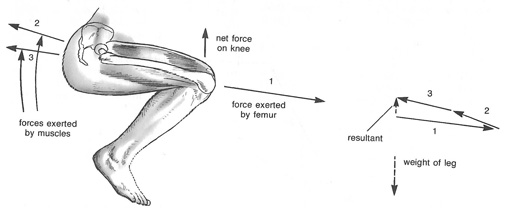 | A mechanical action of the body like lifting a leg is something we do without thinking. But it takes a vast number of nerve signals sent to muscle cells to control their contraction against reaction forces from bones and joints. 像抬腿这样的身体动作,我们通常是不假思索地完成的。但要控制肌肉收缩以对抗骨骼和关节的反作用力,需要发送大量神经信号到肌肉细胞。 |
| General muscle information
一般肌肉信息 |
Reference
Karp
Ch 9.6
Audesirk & Audesirk
Ch 34
| HyperPhysics***** Biology
HyperPhysics ***** 生物学 | R Nave |