The Microprocessor微处理器
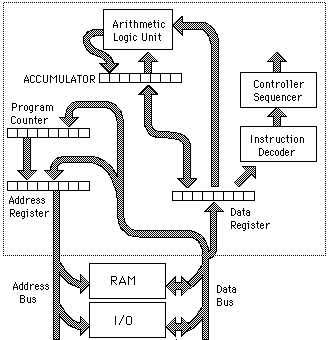
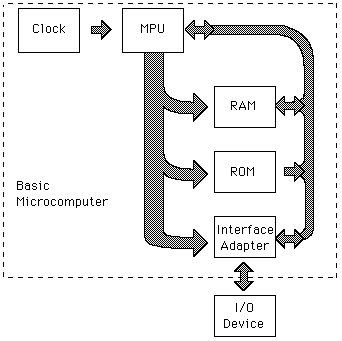
The term microprocessor typically refers to the central processing unit (CPU) of a microcomputer, containing the arithmetic logic unit (ALU) and the control units. It is typically implemented on a single LSI chip. This separates the "brains" of the operation from the other units of the computer. 微处理器通常指的是微计算机的中央处理单元(CPU),包含算术逻辑单元(ALU)和控制单元。它通常集成在一个LSI芯片上。这将计算机的“大脑”与其他单元分离开来。
|
Index Electronics concepts Digital circuits Sequential Operations 索引 电子学概念 数字电路 顺序操作 | ||
|
Go Back
返回 |
|
Index Electronics concepts Digital circuits Sequential Operations 索引 电子学概念 数字电路 顺序操作 | ||
|
Go Back
返回 |
Buses: The exchange of information.公交车:信息的交换。
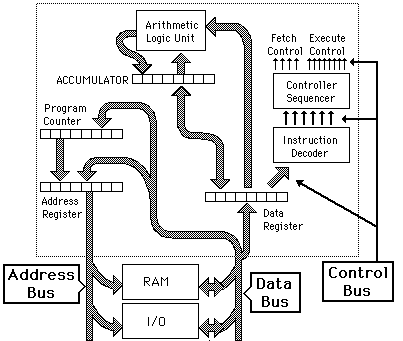
Information is transferred between units of the microcomputer by collections of conductors called buses. 微机的各个单元之间通过称为总线的导体集合进行信息传输。
There will be one conductor for each bit of information to be passed, e.g., 16 lines for a 16 bit address bus. There will be address, control, and data buses. 每个要传递的信息将对应一个导体,例如,16位地址总线需要16条导体。将有地址总线、控制总线和数据总线。
![]() |
Index Electronics concepts Digital circuits Sequential Operations 索引 电子学概念 数字电路 顺序操作 | ||
|
Go Back
返回 |
Arithmetic Logic Unit算术逻辑单元
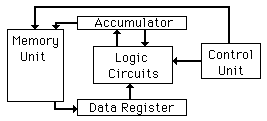
All the arithmetic operations of a microprocessor take place in the arithmetic logic unit (ALU). Using a combination of gates and flip-flops, numbers can be added in less than a microsecond, even in small personal computers. The operation to be performed is specified by signals from the control unit. The data upon which operations are performed can come from memory or an external input. The data may be combined in some way with the contents of the accumulator and the results are typically placed in the accumulator. From there they may be transferred to memory or to an output unit. 微处理器的所有算术操作都在算术逻辑单元(ALU)中进行。通过组合门和触发器,数字可以在不到微秒的时间内相加,即使是在小型个人计算机中也是如此。要执行的操作由控制单元的信号指定。操作所涉及的数据可以来自存储器或外部输入。数据可能以某种方式与累加器的内容结合,结果通常会被放置在累加器中。从那里,它们可能被传输到存储器或输出单元。
![]() |
Index Electronics concepts Digital circuits Sequential Operations Reference Tocci Digital Systems, Sec 6-9, 12-4 索引 电子概念 数字电路 顺序操作 参考 Tocci 数字系统,第6-9节,第12-4节 | ||
|
Go Back
返回 |
The Accumulator蓄能器
The accumulator is the principal register of the arithmetic logic unit of a microprocessor. Registers are sets of flip-flops which can hold data. The accumulator typically holds the first piece of data for a calculation. If a number from memory is added to that date, the sum replaces the original data in the accumulator. It is the repository for successive results of arithmetic operations, which may then be transferred to memory, to an output device, etc. 累加器是微处理器算术逻辑单元的主要寄存器。寄存器是一组触发器,可以存储数据。累加器通常用于存储计算的第一份数据。如果从存储器中取出一个数加到该数据上,和将替代累加器中的原始数据。它用于存储连续的算术运算结果,这些结果可能随后被传输到存储器、输出设备等。
|
Index Electronics concepts Digital circuits Sequential Operations 索引 电子学概念 数字电路 顺序操作 | ||
|
Go Back
返回 |
Control Unit of Microprocessor微处理器的控制单元
The control unit of a microprocessor directs the operation of the other units by providing timing and control signals. It is the function of the microcomputer to execute programs which are stored in memory in the form of instructions and data. The control unit contains the necessary logic to interpret instructions and to generate the signals necessary for the execution of those instructions. The descriptive words "fetch" and "execute" are used to describe the actions of the control unit. It fetches an instruction by sending and address and a read command to the memory unit. The instruction at that memory address is transferred to the control unit for decoding. It then generates the necessary signals to execute the instruction. 微处理器的控制单元通过提供时序和控制信号来指挥其他单元的操作。微计算机的功能是执行存储在存储器中的指令和数据。控制单元包含必要的逻辑,用于解释指令并生成执行这些指令所需的信号。描述控制单元操作的词语是“获取”和“执行”。它通过向存储器单元发送地址和读取命令来获取指令。该指令从内存地址中被传输到控制单元进行解码。然后它会生成执行该指令所需的信号。
|
Index Electronics concepts Digital circuits Sequential Operations 索引 电子学概念 数字电路 顺序操作 | ||
|
Go Back
返回 |