Bilingual edition: English is preserved and Chinese follows each unit. Terminology uses the confirmed v20260916 glossary; automated semantic review remains traceable.
中英双语版:英文原文完整保留,中文紧随对应单元;术语采用 v20260916 确认表,自动语义审校结果可追溯。

Savery Engine

萨维发动机

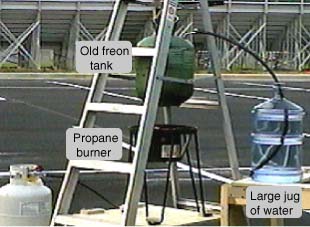
This model of the 17th century Savery engine was built by physics teacher Dan Stamm of Campbell High School, Smyrna, GA.

这个17世纪的萨维发动机模型是由乔治亚州斯myrna市坎贝尔高中物理老师丹·斯塔姆建造的。

Invented by Thomas Savery in the late 17th century, the Savery engine was the first commercially successful steam engine. It was used to pump water out of mines.

17世纪末由托马斯·塞弗里发明的塞弗里发动机是第一种商业上取得成功的蒸汽机。它被用于从矿井中抽水。

In this model, water is boiled in the metal tank to drive out air, and then when the tank is cooled, it pumps water from the large jug.

在这个模型中,水被加热到金属罐中以驱除空气,然后当罐子冷却时,它会从大水槽中泵水。
Savery movie
萨维电影

Index

Atmospheric pressure demos

Pressure concepts
索引:大气压演示 压力概念
 
HyperPhysics***** Mechanics ***** Fluids
HyperPhysics ***** 力学 ***** 流体
R Nave
Go Back
返回


The Savery Engine

萨维利发动机

See Demonstration Savery engine
参见演示萨维汽缸

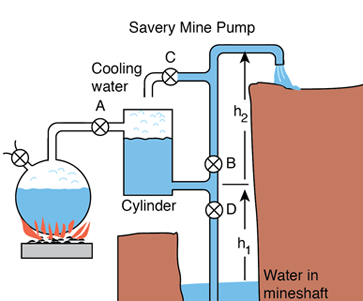
Water above the boiling point produces steam at a pressure greater than one atmosphere. If valves A and B are open but C and D closed, then the steam pressure can pump water to height h2. When the cylinder is full of steam, then valves A and B can be closed and D opened. If cooling water is supplied to the cylinder, then the steam will condense, precipitously dropping its vapor pressure. The resulting vacuum causes water to rise height h1 from the mine shaft provided that height is less than 34 ft. The process can be repeated to pump water from the mine. Thomas Savery patented his mine pump in 1698.

水在沸点以上会产生蒸汽,其压力大于一个大气压。如果阀门A和B打开但C和D关闭,那么蒸汽压力可以将水泵到高度h2。当气缸充满蒸汽时,可以关闭A和B,打开D。如果向气缸供应冷却水,蒸汽将冷凝,迅速降低蒸汽压力。由此产生的真空会将水从矿井中抽到高度h1,前提是该高度小于34英尺。这个过程可以重复进行,以从矿井中抽水。托马斯·塞弗于1698年获得了他的矿井水泵专利。
Savery movie
萨维电影

Index

Atmospheric pressure demos

Producing a vacuum by boiling water

Pressure concepts
索引:大气压演示 通过沸腾水产生真空 压力概念
 
HyperPhysics***** Mechanics ***** Fluids
HyperPhysics ***** 力学 ***** 流体
R Nave
Go Back
返回