Bilingual edition: English is preserved and Chinese follows each unit. Terminology uses the confirmed v20260916 glossary; automated semantic review remains traceable.
中英双语版:英文原文完整保留,中文紧随对应单元;术语采用 v20260916 确认表,自动语义审校结果可追溯。

Saturated Vapor Pressure

饱和蒸气压

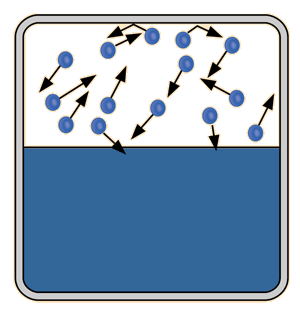
The process of evaporation in a closed container will proceed until there are as many molecules returning to the liquid as there are escaping. At this point the vapor is said to be saturated, and the pressure of that vapor (usually expressed in mmHg) is called the saturated vapor pressure.
Since the molecular kinetic energy is greater at higher temperature, more molecules can escape the surface and the saturated vapor pressure is correspondingly higher. If the liquid is open to the air, then the vapor pressure is seen as a partial pressure along with the other constituents of the air. The temperature at which the vapor pressure is equal to the atmospheric pressure is called the boiling point.
由于温度较高时分子的动能更大,更多分子可以逸出表面,因此饱和蒸气压相应更高。如果液体敞开在空气中,那么蒸汽压就与其他空气成分一起作为部分压力存在。当蒸汽压等于大气压时的温度称为沸点。

在封闭容器中,蒸发过程会进行到分子返回液体的数量与逃逸的数量相等时停止。此时蒸汽被称为饱和蒸汽,该蒸汽的压强(通常以mmHg表示)称为饱和蒸气压。
Table for water
水的表格
Graph for water
水的图表
Index


Kinetic theory concepts

Applications of kinetic theory

Vapor application concepts
索引 气体动理论概念 应用 of 气体动理论 蒸汽应用概念
 
HyperPhysics***** Thermodynamics
HyperPhysics ***** 热力学
R Nave
Go Back
返回


Evaporation

蒸发

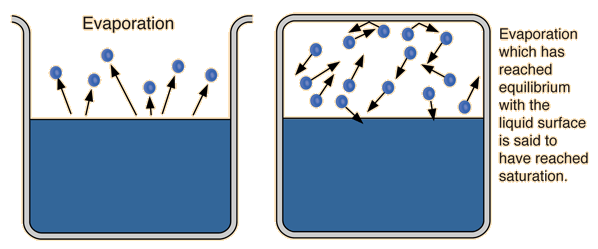
Ordinary evaporation is a surface phenomenon - some molecules have enough kinetic energy to escape. If the container is closed, an equilibrium is reached where an equal number of molecules return to the surface. The pressure of this equilibrium is called the saturation vapor pressure.

普通蒸发是一种表面现象——一些分子具有足够的动能以逃逸。如果容器是封闭的,将达到平衡状态,其中等量的分子返回到表面。这种平衡的压强称为饱和蒸气压。
In order to evaporate, a mass of water must collect the large heat of vaporization, so evaporation is a potent cooling mechanism. Evaporation heat loss is a major climatic factor and is crucial in the cooling of the human body.
Saturation vapor pressure
饱和蒸气压
Difference between evaporation and boiling
蒸发与沸腾的区别
为了汽化,水必须吸收大量的汽化热,因此蒸发是一种有效的冷却机制。蒸发散热是重要的气候因素,并在人体冷却中起关键作用。
Index


Kinetic theory concepts

Applications of kinetic theory

Vapor application concepts
索引 气体动理论概念 应用 of 气体动理论 蒸汽应用概念
 
HyperPhysics***** Thermodynamics
HyperPhysics ***** 热力学
R Nave
Go Back
返回


Evaporation vs Boiling

蒸发 vs 沸腾

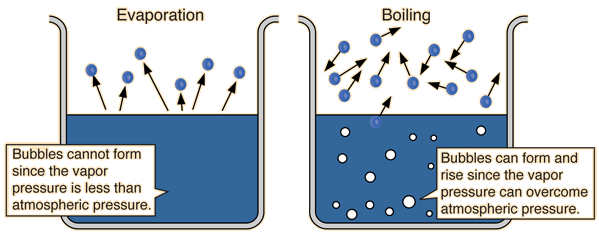
Ordinary evaporation is a surface phenomenon - since the vapor pressure is low and since the pressure inside the liquid is equal to atmospheric pressure plus the liquid pressure, bubbles of water vapor cannot form. But at the boiling point, the saturated vapor pressure is equal to atmospheric pressure, bubbles form, and the vaporization becomes a volume phenomenon.

普通蒸发是一种表面现象——因为蒸汽压较低,而且液体内部的压强等于大气压加上液体压强,因此水蒸气无法形成气泡。但在沸点时,饱和蒸气压等于大气压,气泡形成,蒸发变为体积现象。

Index

Kinetic theory concepts

Applications of kinetic theory

Vapor application concepts
索引 气体动理论概念 应用 of 气体动理论 蒸汽应用概念
 
HyperPhysics***** Thermodynamics
HyperPhysics ***** 热力学
R Nave
Go Back
返回


Boiling Point

沸点

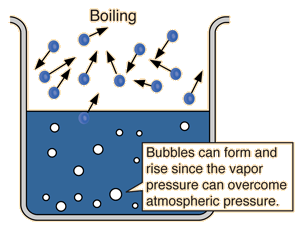
The boiling point is defined as the temperature at which the saturated vapor pressure of a liquid is equal to the surrounding atmospheric pressure. For water, the vapor pressure reaches the standard sea level atmospheric pressure of 760 mmHg at 100°C. Since the vapor pressure increases with temperature, it follows that for pressure greater than 760 mmHg (e.g., in a pressure cooker), the boiling point is above 100°C and for pressure less than 760 mmHg (e.g., at altitudes above sea level), the boiling point will be lower than 100°C. As long as a vessel of water is boiling at 760 mmHg, it will remain at 100°C until the phase change is complete. Rapidly boiling water is not at a higher temperature than slowly boiling water. The stability of the boiling point makes it a convenient calibration temperature for temperature scales.

沸点定义为液体的饱和蒸气压等于周围大气压时的温度。对于水来说,100°C时其蒸汽压达到标准海平面大气压760 mmHg。由于蒸汽压随温度升高而增加,因此对于大于760 mmHg的压力(例如在高压锅中),沸点将高于100°C;而对于小于760 mmHg的压力(例如在海拔高于海平面的地方),沸点将低于100°C。只要水的容器在760 mmHg下沸腾,它将保持在100°C直到相变完成。快速沸腾的水并不比缓慢沸腾的水温度更高。沸点的稳定性使其成为温度刻度的方便校准温度。

At the boiling point,
saturated vapor pressure
equals atmospheric pressure.

在沸点时,饱和蒸气压等于大气压
Boiling and evaporation
沸腾与蒸发
Boiling point variation with pressure
沸点与压力的关系
Boiling point elevation by dissolved matter
溶质对沸点的影响
Index


Kinetic theory concepts

Applications of kinetic theory

Vapor application concepts
索引 气体动理论概念 应用 of 气体动理论 蒸汽应用概念
 
HyperPhysics***** Thermodynamics
HyperPhysics ***** 热力学
R Nave
Go Back
返回


Boiling Point Variation

沸点变化

The standard boiling point for water at 100°C is for standard atmospheric pressure, 760 mmHg. It is the experience of high altitude hikers that it takes longer to cook food at altitude because the boiling point of water is lower. On the other hand, food cooks more quickly in a pressure cooker because the boiling point is elevated. Raising or lowering the pressure by about 28 mmHg will change the boiling point by 1°C.

水在100°C时的沸点是在标准大气压(760 mmHg)下的标准沸点。高海拔徒步者有体验,因为在高海拔处煮食物需要更长时间,因为水的沸点较低。另一方面,在压力锅中食物煮得更快,因为沸点升高。压力升高或降低约28 mmHg将使沸点变化1°C。

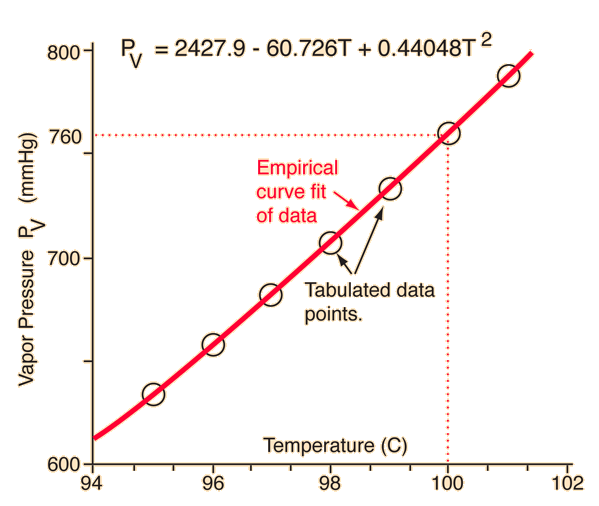
Although the vapor pressure variation with temperature is a non-linear one, the boiling point variation can be approximated near 100°C by an empirical fit of the available data. This can provide the following estimate of the boiling point:

尽管蒸汽压随温度的变化是非线性的,但近似在100°C附近,可以通过现有数据的实证拟合来近似表示沸点的变化。这可以提供以下对沸点的估计:
For a pressure of mmHg
the boiling point will be approximately °C.

For variations in atmospheric pressure with altitude according to the barometric formula, the boiling point at a height of m = ft above sea level (atmos. pressure mmHg)
would be approximately °C.

Any of the data values above may be changed. The empirical calculation is valid only for a few degrees above and below the normal boiling point.

上述任何数据值都可能被更改。经验计算仅在正常沸点上下几度范围内有效。
Notes: This calculation assumes an air temperature of 20°C and an average air molecule mass of 29 amu. The atmospheric pressure drops off a little faster with height when the air is colder, but the change is not large over the range of reasonable daytime temperatures. If you put in pressures above atmospheric pressure, you get reasonable boiling point values so long as you are within a few degrees of normal, but the negative altitude values you get are not valid.
Barometric formula
气压公式
Applications of increased pressure
增加压力的应用
Pressure Cooker
压力锅
Auto Cooling System
自动冷却系统
对于mmHg的压力,沸点将约为°C。根据气压公式,海拔m(即ft)以上的海平面高度(大气压mmHg)处的沸点约为°C。注:此计算假设空气温度为20°C,平均空气分子质量为29 amu。当空气较冷时,随着高度增加,气压下降得更快,但合理日间温度范围内变化不大。如果输入高于大气压的压强,只要在正常值几度范围内,就能得到合理的沸点值,但得到的负海拔值是不合理的。
中文译文中的待填/计算数值依次对应:1:p 2:b 3:h 4:hc 5:phg 6:bh。实际数值以上方原输入框为准。
Index


Kinetic theory concepts

Applications of kinetic theory

Vapor application concepts
索引 气体动理论概念 应用 of 气体动理论 蒸汽应用概念
 
HyperPhysics***** Thermodynamics
HyperPhysics ***** 热力学
R Nave
Go Back
返回


Boiling Point Variation Near 100 C

沸点近100摄氏度时的变化

Values were taken from the saturated vapor pressure table for water near 100 degrees Celsius. An empirical fit to these data values was made, and the formula obtained is shown on the diagram. It could be considered to be reasonably valid only for a few degrees above and below 100 °C since the curve is very non-linear.

数据来源于水在100摄氏度附近的饱和蒸气压表。对这些数据进行了经验拟合,得到的公式如图所示。该公式仅在100°C上下几个摄氏度范围内可以认为是合理的,因为曲线非常非线性。
Calculation based on this curve fit
基于此曲线拟合的计算
Index

Kinetic theory concepts

Applications of kinetic theory

Vapor application concepts
索引 气体动理论概念 应用 of 气体动理论 蒸汽应用概念
 
HyperPhysics***** Thermodynamics
HyperPhysics ***** 热力学
R Nave
Go Back
返回