Bilingual edition: English is preserved and Chinese follows each unit. Terminology uses the confirmed v20260916 glossary; automated semantic review remains traceable.
中英双语版:英文原文完整保留,中文紧随对应单元;术语采用 v20260916 确认表,自动语义审校结果可追溯。

Lagrange Points of the Earth-Moon System

地球-月球系统的拉格朗日点

A mechanical system with three objects, say the Earth, Moon and Sun, constitutes a three-body problem. The three-body problem is famous in both mathematics and physics circles, and mathematicians in the 1950s finally managed an elegant proof that it is impossible to solve. However, approximate solutions can be very useful, particularly when the masses of the three objects differ greatly.

一个包含三个物体的机械系统,例如地球、月球和太阳,构成了三体问题。三体问题在数学和物理学界都很著名,20世纪50年代的数学家最终找到了一个优雅的证明,证明它无法求解。然而,近似解却非常有用,特别是在三个物体的质量差异很大的情况下。

For the Sun-Earth-Moon system, the Sun's mass is so dominant that it can be treated as a fixed object and the Earth-Moon system treated as a two-body system from the point of view of a reference frame orbiting the Sun with that system. 18th century mathematicians Leonhard Euler and Joseph-Louis Lagrange discovered that there were five special points in this rotating reference frame where a gravitational equilibrium could be maintained. That is, an object placed at any one of these five points in the rotating frame would stay there, with the effective forces with respect to this frame canceling. Such an object would then orbit the Sun, maintaining the same relative position with respect to the Earth-Moon system. These five points were named Lagrange points and numbered from L1 to L5.
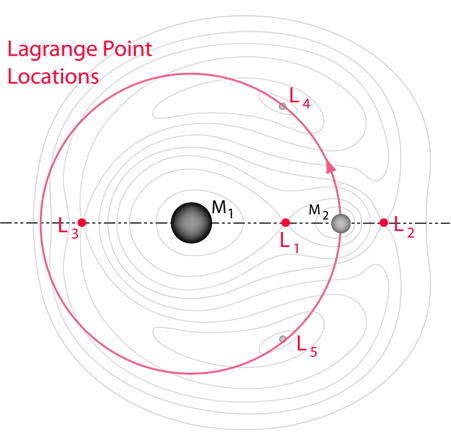
在太阳-地球-月球系统中,太阳的质量如此占主导地位,以至于可以将其视为一个固定物体,而将地球-月球系统视为一个双体系统,从以太阳为参考系的参考系角度来看。18世纪的数学家欧拉和拉格朗日发现,在这个旋转参考系中存在五个特殊的点,其中可以维持引力平衡。也就是说,如果将一个物体放置在这些五个点中的任何一个点上,在该参考系中,物体将保持在那里,相对于该参考系的有效力会相互抵消。这样的物体则会围绕太阳运动,保持相对于地球-月球系统的相对位置不变。这些五个点被命名为拉格朗日点,并按L1到L5编号。

The Lagrange points L4 and L5 constitute stable equilibrium points, so that an object placed there would be in a stable orbit with respect to the Earth and Moon. With small departures from L4 or L5, there would be an effective restoring force to bring a satellite back to the stable point.

拉格朗日点L4和L5构成稳定的平衡点,因此将物体放置在那里,它相对于地球和月球将处于稳定的轨道中。从L4或L5小范围偏离时,会有一个有效的恢复力将卫星带回稳定点。

The L5 point was the focus of a major proposal for a colony in "The High Frontier" by Gerard K. O'Neill and a major effort was made in the 1970's to work out the engineering details for creating such a colony. There was an active "L5 Society" that promoted the ideas of O'Neill. The L4 and L5 points make equilateral triangles with the Earth and Moon.

L5点是Gerard K. O'Neill在《The High Frontier》中提出建立殖民地的焦点,20世纪70年代曾大力努力研究实现此类殖民地的工程细节。当时有一个活跃的“L5协会”,推广O'Neill的想法。L4和L5点与地球和月球形成等边三角形。

The Lagrange points L1, L2 and L3 would not appear to be so useful because they are unstable equilibrium points. Like balancing a pencil on its point, keeping a satellite there is theoretically possible, but any perturbing influence will drive it out of equilibrium. However, in practice these Lagrange points have proven to be very useful indeed since a spacecraft can be made to execute a small orbit about one of these Lagrange points with a very small expenditure of energy. They have provided useful places to "park" a spacecraft for observations. These orbits around L1 and L2 are often called "halo orbits". L3 is on the opposite side of the Earth from the Moon, so is not so easy to use.

拉格朗日点L1、L2和L3似乎并不那么有用,因为它们是不稳定的平衡点。就像将铅笔尖顶在桌子上那样,理论上可以保持卫星停留在那里,但任何扰动都会使它离开平衡状态。然而,在实践中,这些拉格朗日点确实证明非常有用,因为可以将航天器绕这些拉格朗日点执行一个很小的轨道,而仅消耗极小的能量。这些轨道常被称为“晕轨道”。L3位于地球和月球的另一侧,因此不太容易使用。
Earth-Sun Lagrange Points
地球-太阳拉格朗日点
Index

Orbit concepts

Reference
Klarreich
索引轨道概念参考Klarreich
 
HyperPhysics***** Mechanics ***** Orbits
HyperPhysics ***** 力学 ***** 轨道
R Nave
Go Back
返回


Three-Body Equipotential Surfaces

三体等势面

A mechanical system with three objects, say the Earth, Moon and Sun, constitutes a three-body problem. The three-body problem is famous in both mathematics and physics circles, and mathematicians in the 1950s finally managed an elegant proof that it is impossible to solve. However, approximate solutions can be very useful, particularly when the masses of the three objects differ greatly.

一个包含三个物体的机械系统,例如地球、月球和太阳,构成了三体问题。三体问题在数学和物理学界都很著名,20世纪50年代的数学家最终找到了一个优雅的证明,证明它无法求解。然而,近似解却非常有用,特别是在三个物体的质量差异很大的情况下。

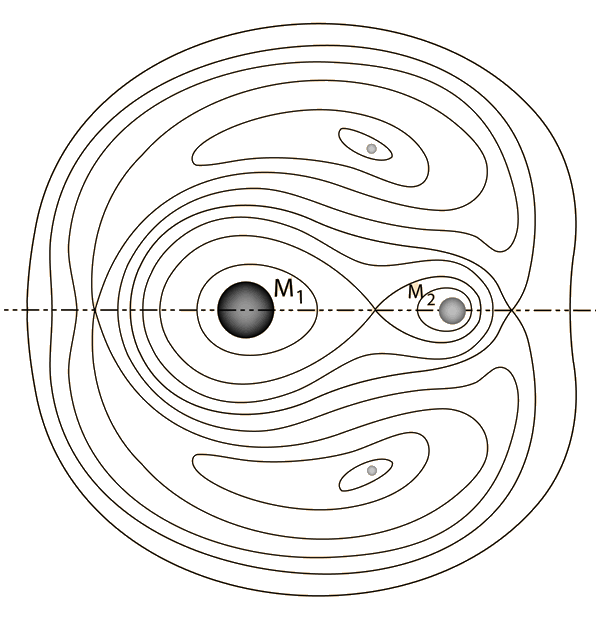
One of the contributions of Lagrange was to plot contours of equal gravitational potential energy for systems where the third mass was very small compared to the other two. Below is a sketch of such equipotential contours for a system like the Earth-Moon system. The equipotential contour that makes a figure-8 around both masses is important in assessing scenarios were one partner loses mass to the other. These equipotential loops form the basis for the concept of the Roche lobe.

拉格朗日的一个贡献是绘制出在第三质量远小于其他两个质量的系统中,等引力势能的等势线。下图展示了一个类似地球-月球系统的这样的等势线。围绕两个质量形成一个八字形的等势线对于评估一个伙伴失去质量给另一个伙伴的场景非常重要。这些等势线构成了罗奇洛布(Roche lobe)概念的基础。

Contours of Equal Gravitational Potential

等重力势线

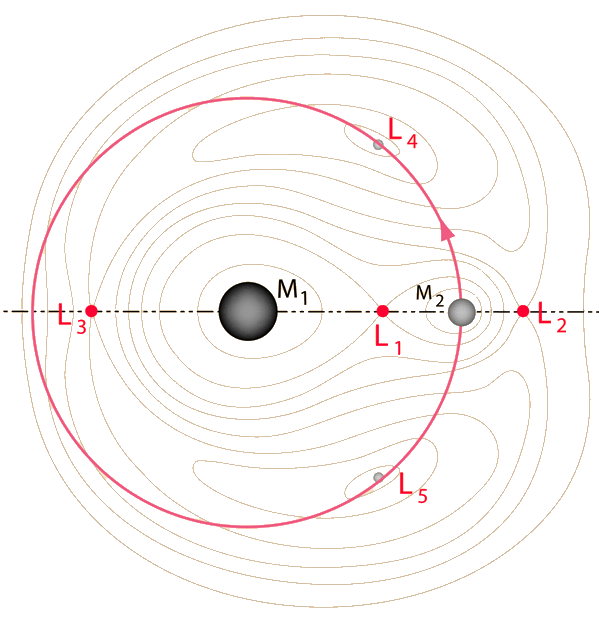
One of Lagrange's observations from the potential contours was that there were five points at which the third body could be at equilibrium, points which are now referred to as Lagrange points.

拉格朗日从势能等高线的观察中得出一个结论,即存在五个点,第三体可以在这些点上达到平衡,这些点现在被称为拉格朗日点。

The Lagrange Points for a system like the Earth-Moon system

地球-月球系统中的拉格朗日点

The Lagrange points L1, L2, and L3 are unstable equilibrium points. Like standing a pencil on its point, it is possible to achieve equilbrium, but any displacement away from that equilibrium would lead to forces that take it further away from equilibrium. Remarkably, the Lagrange points L4 and L5 are stable equilibrium points for the small mass in the three-body system and this three-body geometry could be maintained as M2 orbited about M1.

Earth-Moon Lagrange Points
地球-月球拉格朗日点
Trojan Asteroids at Lagrange points of Sun-Jupiter system
特洛伊小行星位于太阳-木星系统中的拉格朗日点
拉格朗日点L1、L2和L3是不稳定平衡点。就像将一支铅笔尖着地站立一样,可以实现平衡,但一旦发生任何偏离平衡的位移,就会产生使它进一步远离平衡的力。值得注意的是,在三体系统中,对于小质量物体来说,拉格朗日点L4和L5是稳定的平衡点,这种三体几何结构可以维持,当M2绕M1运动时。
Index

Orbit concepts

Reference
Kaufmann Ch 17
索引 轨道概念 参考文献 Kaufmann 第17章
 
HyperPhysics***** Mechanics ***** Orbits
HyperPhysics ***** 力学 ***** 轨道
R Nave
Go Back
返回


Joseph Louis Lagrange

约瑟夫·路易·拉格朗日

Lagrange was and 18th century mathematician who tackled the famous "three-body problem" in the late 1700s. The problem cannot be solved exactly, but he found that in the case where the third body is very small compared to the other two, some useful approximate solutions could be found.

拉格朗日是18世纪的数学家,他在1700年代末解决了著名的‘三体问题’。该问题无法精确求解,但他发现当第三个天体远小于其他两个时,可以找到一些有用的近似解。
Index

Orbit concepts

Reference
Kaufmann Ch 17
索引 轨道概念 参考文献 Kaufmann 第17章
 
HyperPhysics***** Mechanics ***** Orbits
HyperPhysics ***** 力学 ***** 轨道
R Nave
Go Back
返回