The Trojan Asteroids
The Trojan asteroids consist of the several hundred asteroids which are known to orbit the Sun at the distance of Jupiter. They travel in the vicinity of the two Lagrange points which are 60 degrees ahead of and behind Jupiter in orbit. The Lagrange points of Jupiter are regions where a body can orbit under the combined influence of Jupiter and the Sun.
 Image Credit: NASA/Lunar and Planetary Institute 图片版权:NASA/月球与行星研究所 |
This NASA diagram shows the relative locations of the main asteroid belt and the two regions of Trojan asteroids which orbit syncronously with Jupiter. 这张NASA图显示了主小行星带以及绕木星同步轨道运行的特洛伊小行星两个区域的相对位置。
|
French mathematician Joseph Louis Lagrange showed in 1772 that there are five points where a relatively small object could orbit the Sun under the influence of two other massive bodies such as the Sun and Jupiter. Three of those points are along the line joining the Sun and Jupiter, and lead to unstable orbits where the slightest disturbance could cause them to leave the orbit. The L4 and L5 points at 60° ahead and behind Jupiter in orbit are stable regions and have collected a large number of Trojan asteroids. 法国数学家约瑟夫·路易·拉格朗日于1772年证明,存在五个点,其中较小的天体可以在太阳和木星等两个大天体的引力作用下绕太阳轨道运动。这三个点位于太阳和木星连线上,导致不稳定的轨道, slightest disturbance( slightest disturbance 应译为“ slightest disturbance ”)可能导致它们脱离轨道。位于木星轨道前方和后方60°的L4和L5点是稳定的区域,已聚集了大量特洛伊小行星。 | 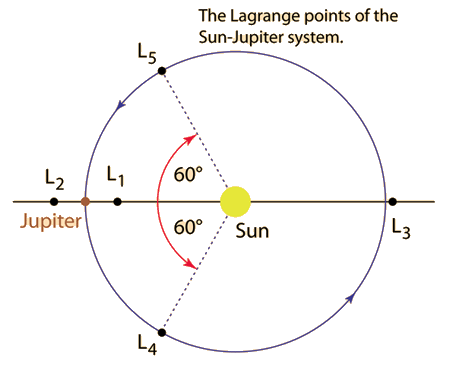 |
Solar System Illustration
Solar System Concepts
Reference
Chaisson and McMillan
Ch 14
| HyperPhysics********** Astrophysics
HyperPhysics ********** 天体物理学 | R Nave |