Air Friction空气摩擦
Air friction, or air drag, is an example of fluid friction. Unlike the standard model of surface friction, such friction forces are velocity dependent. The velocity dependence may be very complicated, and only special cases can be treated analytically. At very low speeds for small particles, air resistance is approximately proportional to velocity and can be expressed in the form 空气摩擦,或空气阻力,是流体摩擦的一个例子。与标准的表面摩擦模型不同,这种摩擦力与速度有关。速度的依赖关系可能非常复杂,只有特殊情况下才能进行解析处理。在非常低的速度下,对于小颗粒,空气阻力近似与速度成正比,可以表示为
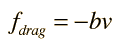
![]() where the negative sign implies that it is always directly opposite the velocity. For higher velocites and larger objects the frictional drag is approximately proportional to the square of the velocity: 其中负号表示它始终与速度方向相反。对于更高的速度和更大的物体,摩擦阻力近似与速度的平方成正比:
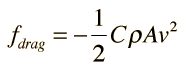
![]() where ρ is the air density, A the cross-sectional area, and C is a numerical drag coefficient. 其中ρ是空气密度,A是横截面积,C是一个数值化的阻力系数。
|
Index Fluid friction 索引流体摩擦 | ||
|
Go Back
返回 |
Linear Velocity Dependence线性速度依赖
For objects moving at relatively low speeds through a liquid, where turbulence is not a significant factor, then the viscous resistance to the object's motion is approximately proportional to its velocity. Even in gases there are circumstances where the frictional resistance is approximately proportional to the velocity - such as the motion of tiny dust particles through the air. More commonly, air friction has terms proportional to the square or even higher powers of the velocity. 对于在液体中以相对较低速度运动的物体,当湍流不是显著因素时,物体运动所受的粘滞阻力近似与其速度成正比。即使在气体中,也有某些情况下,摩擦阻力近似与速度成正比——例如微小的尘埃粒子在空气中运动。更常见的是,空气摩擦力包含与速度平方或更高次方成正比的项。
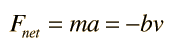
For linear velocity dependence the resistance force can be written 对于线性速度依赖性,阻力力可以表示为 f_resistance = -bv 。如果这是唯一的力,则牛顿第二定律变为
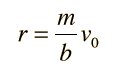
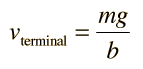
which will bring the object to rest in a distance 这将使物体在一定距离内停止 .If the weight W=mg of the object also acts, then the object approaches a terminal velocity : 如果物体的重量 W=mg 也作用,那么物体将接近终端速度:
![]() This terminal velocity is expressed in terms of an effective value of g if the buoyant force is significant. 这个终端速度是用一个有效的重力加速度来表示的,如果浮力显著的话。
|
Index Fluid friction 索引流体摩擦 | |||
|
Go Back
返回 |
Viscous Resistance粘性阻力
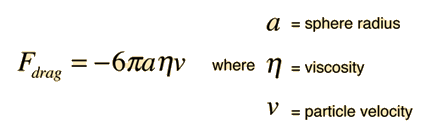
If an object moves slowly through a liquid, it will experience a viscous drag which is approximately proportional to the velocity. For a sphere falling through a liquid in a velocity regime where viscosity is the dominant effect and turbulence can be neglected, the viscous drag is 如果一个物体缓慢通过液体移动,它会经历一个粘滞阻力,该阻力近似与速度成正比。对于在液体中下落的球体,在粘滞力占主导且可以忽略湍流的 velocity regime 中,粘滞阻力为
![]() This resistance can be used to calculate penetration distance into a viscous medium, terminal velocity, and motion description for sinking objects. 这种电阻可以用来计算物体在粘性介质中的穿透距离、终端速度以及下沉物体的运动描述。
|
Index Fluid friction 索引流体摩擦 | ||
| Go Back
返回 |
Fluid Friction流体摩擦
The resistance to an object's motion through a fluid may be termed "fluid friction." It may take the form of viscous resistance in a liquid, or the rather different character of air friction when an object moves through a gas. 物体通过流体运动时的阻力可以称为‘流体摩擦’。它可能表现为液体中的粘滞阻力,或者当物体通过气体运动时所表现出的截然不同的空气摩擦。
|
Index Fluid friction concepts 索引 流体摩擦概念 | ||
|
Go Back
返回 |