Bilingual edition: English is preserved and Chinese follows each unit. Terminology uses the confirmed v20260916 glossary; automated semantic review remains traceable.
中英双语版:英文原文完整保留,中文紧随对应单元;术语采用 v20260916 确认表,自动语义审校结果可追溯。

Terminal Velocity

终端速度
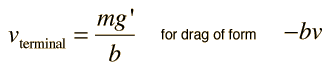
When an object which is falling under the influence of gravity or subject to some other constant driving force is subject to a resistance or drag force which increases with velocity, it will ultimately reach a maximum velocity where the drag force equals the driving force. This final, constant velocity of motion is called a "terminal velocity", a terminology made popular by skydivers. For objects moving through a fluid at low speeds so that turbulence is not a major factor, the terminal velocity is determined by viscous drag. The expression for the terminal velocity is of the form
Motion analysis
运动分析
Objects moving at high speeds through air encounter air drag proportional to the square of the velocity. This quadratic drag leads to a terminal velocity of the form
Examples
示例
当一个物体在重力作用下或受到某种其他恒定驱动力作用下,若其受到的阻力或阻力力随着速度增加而增加,则最终会达到一个最大速度,此时阻力力等于驱动力。这种最终的恒定速度称为‘终端速度’,这一术语由跳伞运动员推广开来。对于在流体中以低速运动的物体,湍流不是主要因素,终端速度由粘滞阻力决定。终端速度的表达形式为:物体以高速通过空气时,会遇到与速度平方成正比的空气阻力。这种二次方阻力导致终端速度的表达形式为:
Index

Fluid friction
索引流体摩擦
 
HyperPhysics***** Mechanics ***** Fluids
HyperPhysics ***** 力学 ***** 流体
R Nave
Go Back
返回


Quadratic Velocity Dependence

二次速度依赖性

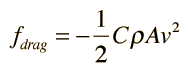
For large objects moving through air, the air resistance is approximately proportional to the square of the velocity. The form of the resistance is

对于通过空气运动的大型物体,空气阻力近似与速度的平方成正比。阻力的形式为

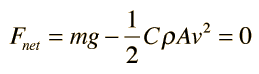
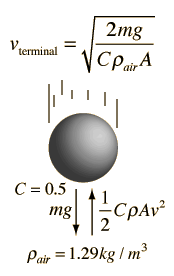
where ρ is the air density, A the crosssectional area, and C is a numerical drag coefficient. The drag coefficient C is 0.5 for a spherical object and can reach 2 for irregularly shaped objects according to Serway. An object falling through the air will reach a terminal velocity when the drag force is equal to the weight:

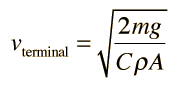
This gives a terminal velocity

这给出了终端速度
Examples
示例
Vertical trajectory with quadratic drag
二次阻力的垂直轨迹
Freefall velocity with quadratic drag
自由下落时的二次阻力速度
Freefall velocity with quadratic drag for given fall distance
考虑二次阻力的自由下落速度(给定下落距离)
Freefall velocity with quadratic drag as function of time
有二次阻力的自由落体速度随时间变化
Time to peak with quadratic drag
二次阻力下的峰值时间
Peak height with quadratic drag
峰值高度(二次阻力情况)
Upward velocity vs height
向上速度与高度
Fall velocity vs height
下落速度与高度
Impact velocity
冲击速度
其中ρ是空气密度,A是横截面积,C是一个数值阻力系数。根据Serway,球形物体的阻力系数C为0.5,不规则形状物体的C可达到2。一个物体在空气中下落时,当阻力力等于重量时,将达到终端速度:
Index

Fluid friction

Reference
Serwary & Beichner
Ch 6
索引 流体摩擦 参考 Serwary & Beichner 第6章
 
HyperPhysics***** Mechanics ***** Fluids
HyperPhysics ***** 力学 ***** 流体
R Nave
Go Back
返回


Terminal Velocity Examples

终端速度示例
Falling object
下落物体
Mass
质量
Area
面积
Terminal velocity
终端速度
Skydiver
跳伞者
75 kg 0.7 m260 m/s134 mi/hr
134英里每小时
Baseball (3.66cm radius)
棒球(半径3.66厘米)
145 gm
145 克
42 cm2
42平方厘米
33 m/s 74 mi/hr
74英里/小时
Golf ball (2.1 cm radius)
高尔夫球(半径2.1厘米)
46 gm
46 克
14 cm2
14平方厘米
32 m/s 72 mi/hr
72英里/小时
Hail stone (0.5 cm radius)
冰雹(半径0.5厘米)
.48 gm
.48 克
.79 cm2
.79 cm²
14 m/s 31 mi/hr
31英里/小时
Raindrop (0.2 cm radius)
雨滴(半径0.2厘米)
.034 gm .13 cm2
.13 平方厘米
9 m/s 20 mi/hr
20 英里/小时


Data from Serway, Physics for Scientists and Engineers, Table 6.1. A drag coefficient C=0.5 is assumed, falling through air.

Hailstone calculation

冰雹计算

Calculation for a sphere

球体的计算
数据来自Serway的《物理学:为科学家和工程师的物理学》表6.1。假设阻力系数C=0.5,物体在空气中下落。
Index

Fluid friction
索引流体摩擦
 
HyperPhysics***** Mechanics ***** Fluids
HyperPhysics ***** 力学 ***** 流体
R Nave
Go Back
返回


Hailstone Terminal Velocity

石块终端速度

Contributing to the danger of large hailstones is the fact that they fall faster than small ones. That is, the terminal velocity increases with the size of the hailstone. Assuming the hailstones to be spherical and using a drag coefficient of C = 0.5 gives the following :

促成大冰雹危险的因素之一是它们比小冰雹下落得更快。也就是说,终端速度随着冰雹大小的增加而增加。假设冰雹为球形,并使用阻力系数C = 0.5,可得到以下结果:
Radius (cm)
半径(厘米)
v (km/hr)
v (km/hr)(专名或术语)
v(m/s)v(mi/hr)
v(mi/hr)(专名或术语)
.0171.94.3
0.122 6.113.7
0.2 318.6 19.3
0.5 49 13.630.5
1.0 69.519.343.2
2.0 98.3 27.3 61
3.0 120 33.4 74.8
5.0 155 43.296.6
10.0 220 61136

General examples

一般例子

Calculation for a sphere

球体的计算


Index

Fluid friction
索引流体摩擦
 
HyperPhysics***** Mechanics ***** Fluids
HyperPhysics ***** 力学 ***** 流体
R Nave
Go Back
返回


Terminal Velocity Calculation

终端速度计算
For a spherical object falling through air, the terminal velocity for the case of quadratic drag can be calculated from

Hailstone calculation

冰雹计算

Other examples

其他例子

For a sphere of radius r = meters = cm

对于半径为 r = 米 = 厘米的球
中文译文中的待填/计算数值依次对应:1:r 2:rc。实际数值以上方原输入框为准。

and density ρ = kg/m3 = gm/cm3 ,

且密度 ρ = kg/m³ = g/cm³,
中文译文中的待填/计算数值依次对应:1:d 2:dg。实际数值以上方原输入框为准。

the mass is m = kg = gm,

质量是 m = 千克 = 克,
中文译文中的待填/计算数值依次对应:1:m 2:mg。实际数值以上方原输入框为准。

and the terminal velocity is

且终端速度是

vterminal = m/s = km/hr = mi/hr.

终端速度 v_terminal = m/s = km/hr = mi/hr。
中文译文中的待填/计算数值依次对应:1:v 2:vk 3:vm。实际数值以上方原输入框为准。
对于通过空气下落的球形物体,当采用二次阻力模型时,终端速度可由以下公式计算:
Index

Fluid friction concepts
索引 流体摩擦概念
 
HyperPhysics***** Mechanics ***** Fluids
HyperPhysics ***** 力学 ***** 流体
R Nave
Go Back
返回