Bilingual edition: English is preserved and Chinese follows each unit. Terminology uses the confirmed v20260916 glossary; automated semantic review remains traceable.
中英双语版:英文原文完整保留,中文紧随对应单元;术语采用 v20260916 确认表,自动语义审校结果可追溯。

Simple Machines

简单机械

It is traditional to point to a set of simple machines from which more complex machines can be fashioned. One way to characterize a "simple" machine is to say that it has no internal source of energy. It may nevertheless be very useful in that it multiply the input force to accomplish a task. The factor by which it multiplies the force is often called the "mechanical advantage". If you idealize the machine by neglecting friction, then you can state an "ideal mechanical advantage" or IMA for the machine. A typical grouping of simple machines is shown below.

传统上,人们会指出一组简单的机器,从这些机器可以制造出更复杂的机器。一种 characterization 一个“简单”的机器的方式是说它没有内部的能源来源。尽管如此,它可能非常有用,因为它可以放大输入的力以完成任务。它放大力的倍数通常被称为“机械优势”。如果你通过忽略摩擦来理想化机器,那么你可以为机器声明一个“理想机械优势”或 IMA。简单机器的典型分类如下所示。
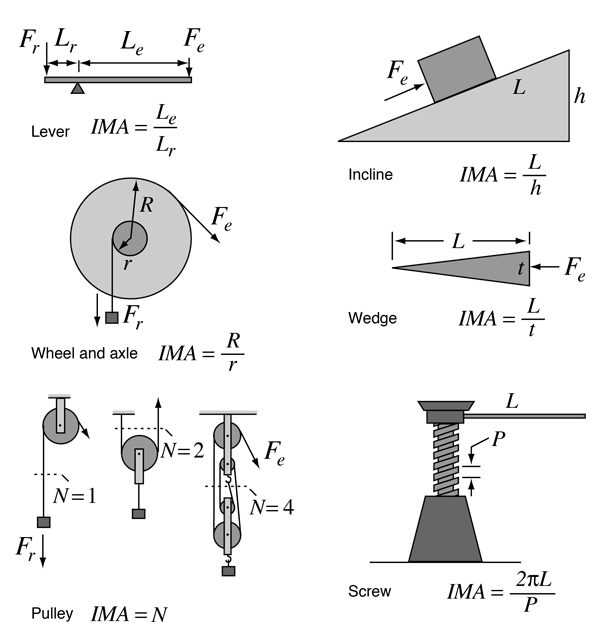
Click on any machine for further details.

Since we know by conservation of energy that no machine can output more energy than was put into it, the ideal case is represented by a machine in which the output energy is equal to the input energy. For simple geometries in which the forces are in the direction of the motion, we can characterize the ideal machine in terms of the work done as follows:

由于我们已知通过能量守恒定律可知,没有任何机器能够输出比输入更多的能量,因此理想情况由一个输出能量等于输入能量的机器来表示。对于简单几何形状,其中力的方向与运动方向一致的情况,我们可以用如下方式来描述理想机器:
Ideal Machine: Energy input = Energy output

Work input = Fedinput = Frdoutput = Work output

From this perspective it becomes evident that a simple machine may multiply force. That is, a small input force can accomplish a task requiring a large output force. But the constraint is that the small input force must be exerted through a larger distance so that the work input is equal to the work output. You are trading a small force acting through a large distance for a large force acting through a small distance. This is the nature of all the simple machines above as they are shown.

从这个角度来看,简单机械可以放大力。也就是说,一个小的输入力可以完成需要较大输出力的任务。但约束条件是,这个小的输入力必须通过较大的距离施加,使得输入的功等于输出的功。你是在用一个小力作用于大距离来换取一个大力作用于小距离。这正是上面所有简单机械的本质,如它们所展示的那样。

Of course it is also possible to trade a large input force through a small distance for a small output force acting through a large distance. This is also useful if what you want to achieve is a higher velocity. Many machines operate in this way.

当然,也可以通过小距离施加大的输入力,来换取小输出力通过大距离作用。如果希望实现更高的速度,这种方式也十分有用。许多机器都是以这种方式工作的。

The expressions for the ideal mechanical advantages of these simple machines were obtained by determining what forces are required to produce equilibrium, since to move the machine in the desired direction you must first produce equilibrium and then add to the input force to cause motion. Both force equilibrium and torque equilibrium are applied.

这些简单机械的理想机械优势的表达式是通过确定产生平衡所需的力来获得的,因为要使机械向所需方向运动,首先必须产生平衡,然后再加上输入力以引起运动。既应用了力的平衡,也应用了力矩的平衡。
Equilibrium
平衡
点击任何机器以获取更多细节。理想机器:能量输入 = 能量输出 功输入 = F e d 输入 = F r d 输出 = 功输出
Index

Torque Concepts
索引:力矩概念
 
HyperPhysics***** Mechanics
力学
R Nave
Go Back
返回