The Double Bass
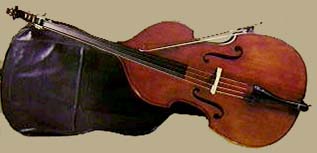
The double bass, also called bass Viol or contrabass, is the largest and lowest-pitched member of the orchestral string section. The standard double bass has four strings and a range from E just over an octave below the bass staff, upwards for nearly three octaves, although some instruments may have five strings in order to extend the range downward. The strings are tuned a fourth apart at E1(41.2 Hz), A1, D2, G2(98 Hz). For the double bass, the string tensions of the four strings are essentially equal, implying that the mass per unit length of the strings must be adjusted close to 9/16 ratios for successive strings. This is to achieve the musical fourth 4/3 pitch intervals since the string frequency is proportional to the inverse square root of the mass per unit length. Tables of string tension show tensions in the range 60 to 80 lbs for different compositions and manufacturers, but in all cases the tensions for the four strings are about the same. This is in contrast to the other members of the classical string family for which the tensions in the lowest pitch strings are significantly higher.
String instruments characteristically produce a fundamental resonance plus all the string harmonics.
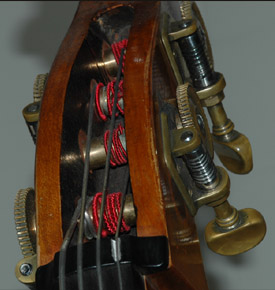 |
Because of the string mass and stiffness, a geared arrangement is used to adjust the string tension. 由于弦的质量和刚性,采用齿轮装置来调节弦的张力。
|
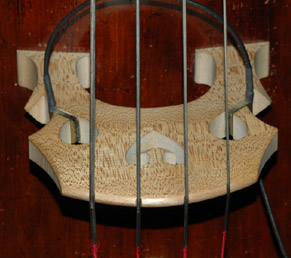
The large bridge on the bass instrument transfers a component of the string vibration to the top plate of the instrument. This bridge is fitted with piezoelectric pickups on the bridge to produce an electrical output that can be amplified. 大提琴上的桥将弦的振动传递到乐器的顶部板。该桥上装有压电拾音器,以产生可以放大电信号。 |
 |
A good description of the interaction of the
String instruments
Musical instruments
| HyperPhysics***** Sound
HyperPhysics ***** 声音 | R Nave |