Bilingual edition: English is preserved and Chinese follows each unit. Terminology uses the confirmed v20260916 glossary; automated semantic review remains traceable.
中英双语版:英文原文完整保留,中文紧随对应单元;术语采用 v20260916 确认表,自动语义审校结果可追溯。

Vibrating String

振动弦

The fundamental vibrational mode of a stretched string is such that the wavelength is twice the length of the string.

绷直的弦的基本振动模式是其波长是弦长的两倍。

Applying the basic wave relationship gives an expression for the fundamental frequency:

Calculation

计算

Since the wave velocity is given by
由于波速由
, the frequency expression
频率表达式

can be put in the form:

可以写成:

The string will also vibrate at all harmonics of the fundamental. Each of these harmonics will form a standing wave on the string.

弦也会在基频的各个谐波下振动。每个谐波将在弦上形成驻波。

This shows a resonant standing wave on a string. It is driven by a vibrator at 120 Hz.

这显示了一根弦上的共振驻波。它由120 Hz的振动器驱动。
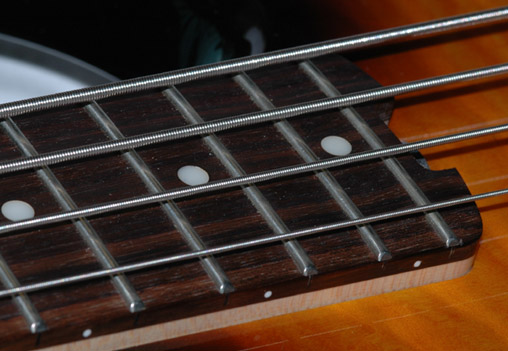
For strings of finite stiffness, the harmonic frequencies will depart progressively from the mathematical harmonics. To get the necessary mass for the strings of an electric bass as shown above, wire is wound around a solid core wire. This allows the addition of mass without producing excessive stiffness.

对于刚度有限的弦,谐振频率将逐渐偏离数学上的谐振频率。为了得到如上所示电低音提琴弦所需的质量,通常会将导线缠绕在实心芯线上。这样可以在不产生过度刚性的情况下增加质量。
Example measurements on a steel string
例测得数据为钢弦数据
String frequencies
弦的频率
String instruments
弦乐器
Illustration with a slinky
弹簧示意图
Mathematical form
数学形式
应用基本波关系可得到基频的表达式:
Index

Periodic motion concepts

Resonance concepts
索引 周期性运动概念 共振概念
 
HyperPhysics***** Sound
HyperPhysics ***** 声音
R Nave
Go Back
返回


Wave Velocity in String

弦波速度

The velocity of a traveling wave in a stretched string is determined by the tension and the mass per unit length of the string.

在绷紧的弦上行波的速度由张力和弦的单位长度质量决定。

The wave velocity is given by
波速由下式给出
Show
显示

When the wave relationship is applied to a stretched string, it is seen that resonant standing wave modes are produced. The lowest frequency mode for a stretched string is called the fundamental, and its frequency is given by

当波关系应用于绷紧的弦时,可以看到产生共振的驻波模式。绷紧弦的最低频率模式称为基频,其频率由

From

从
velocity = sqrt ( tension / mass per unit length )

the velocity = m/s
when the tension = N = lb
for a string of length cm and mass/length = gm/m.
For such a string, the fundamental frequency would be Hz.

当张力为牛时,弦的长度为厘米,质量/长度为克/米,其速度为米/秒。对于这样的弦,基频为赫兹。
中文译文中的待填/计算数值依次对应:1:v 2:t 3:tc 4:l 5:ml 6:f。实际数值以上方原输入框为准。

Any of the highlighted quantities can be calculated by clicking on them. If numerical values are not entered for any quantity, it will default to a string of 100 cm length tuned to 440 Hz. Default values will be entered for any quantity which has a zero value. Any quantities may be changed, but you must then click on the quantity you wish to calculate to reconcile the changes.

任何突出显示的量都可以通过点击它们来计算。如果未输入任何量的数值,它将默认设置为100厘米长,调谐至440赫兹。对于任何值为零的量,将输入默认值。任何量都可以更改,但您必须点击您想要计算的量以使更改生效。
Derivation of wave speed
波速的推导
速度 = sqrt ( 张力 / 单位长度的质量 )
Index

Periodic motion concepts

Resonance concepts

Arto's string calculator

D'Addario's Tension Pro
索引 周期性运动概念 共振概念 Arto的弦计算器 D'Addario的张力
 
HyperPhysics***** Sound
HyperPhysics ***** 声音
R Nave
Go Back
返回


Harmonics

谐波

An ideal vibrating string will vibrate with its fundamental frequency and all harmonics of that frequency. The position of nodes and antinodes is just the opposite of those for an open air column.

理想振动的弦将以基频及其所有谐波振动。节点和腹点的位置与开放空气柱的相反。

The fundamental frequency can be calculated from

基本频率可以从

where

其中

T = string tension
m = string mass
L = string length

and the harmonics are integer multiples.

谐波是整数倍的关系
T 是弦的张力,m 是弦的质量,L 是弦的长度
Illustration with a slinky
弹簧示意图
Index

Periodic motion concepts

Resonance concepts
索引 周期性运动概念 共振概念
 
HyperPhysics***** Sound
HyperPhysics ***** 声音
R Nave
Go Back
返回


Vibrating String Frequencies

振动弦的频率

If you pluck your guitar string, you don't have to tell it what pitch to produce - it knows! That is, its pitch is its resonant frequency, which is determined by the length, mass, and tension of the string. The pitch varies in different ways with these different parameters, as illustrated by the examples below:

如果你拨动吉他弦,你不需要告诉它要发出什么音调——它自己就知道!也就是说,它的音调是由它的共振频率决定的,而这个共振频率由弦的长度、质量和张力决定。这些不同参数对音调的影响方式如下面的例子所示:
If you have a string with
starting pitch:
如果你有一根起始音调为:
100 Hz
and change* to
并改变*
the pitch
will be
音调将为
double the length
长度的两倍
50 Hz
50赫兹
four times the tension
四倍的张力
200 Hz
four times the mass
四倍的质量
50 Hz
50赫兹
*with the other parameters reset to their
original values.
*其他参数重置为原始值。
If you want to raise the pitch of a string by increasing its tension:
Tension
张力
Frequency
频率
Original
原文
T0
f0
1 octave up
一个八度高
4T0
2f0
2 octaves up
两个八度升高
16T0
4f0
3 octaves up
三个八度升高
64T0
8f0
4 octaves up
四个八度升高
256T0
16f0
5 octaves up
五倍频上升
1024T0
32f0

You can see that it is not practical to tune a string over a large pitch range using the tension, since the tension goes up by the square of the pitch ratio.

你可以看到,用张力来调节弦在较大音调范围内的音高是不实际的,因为张力随音调比的平方增加。
如果你想通过增加张力来提高弦的音调:
Calculation
计算
Index

Periodic motion concepts

Resonance concepts
索引 周期性运动概念 共振概念
 
HyperPhysics***** Sound
HyperPhysics ***** 声音
R Nave
Go Back
返回