Musical Scales音乐音阶
Background Material for Tuning and Temperament 调谐与音律的背景材料 assumptions about the human hearing process:
音阶的构建基于两个关于人类听觉过程的假设: |
Index Temperament and musical scales 索引 音乐的音阶与音调 | ||
|
Go Back
返回 |
Musical Intervals音乐音程
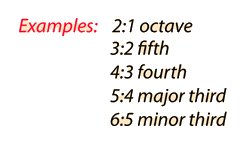
The term musical interval refers to a step up or down in pitch which is specified by the ratio of the frequencies involved. For example, an octave is a music interval defined by the ratio 2:1 regardless of the starting frequency. From 100 Hz to 200 Hz is an octave, as is the interval from 2000 Hz to 4000 Hz. The intervals which are generally the most consonant to the human ear are intervals represented by small integer ratios. Intervals represented by exact integer ratios are said to be Just intervals, and the temperament which keeps all intervals at exact whole number ratios is Just temperament. 音乐音程是指由涉及频率比指定的音高上升或下降的步骤。例如,八度是一个由比值2:1定义的音乐音程,无论起始频率如何。从100 Hz到200 Hz是一个八度,从2000 Hz到4000 Hz也是一个八度。通常最符合人耳的音程是由小整数比表示的。由精确整数比表示的音程称为纯音程,保持所有音程都处于精确整数比的调音方式称为纯律。
|
Index Temperament and musical scales 索引 音乐的音阶与音调 | |||||||||||
|
Go Back
返回 |
Consonance and Dissonance和谐与不和谐
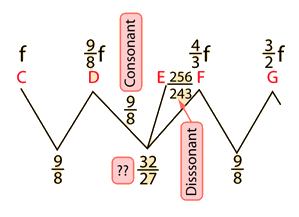
Two tones are said to be consonant if their combination is pleasing to the ear, and dissonant if displeasing. The simplest approach to quantifying consonance is to say that two tones are consonant if their frequencies are related by a small integer ratio. The ratio determines the musical interval. For example, the octave 2:1, fifth 3:2, and fourth 4:3 are presumed to be universally consonant musical intervals because most persons in any culture or period of history have considered them to be pleasing tone combinations and have built musical compositions around them. 如果两个音的组合听起来悦耳,就称为和谐;反之则称为不和谐。量化和谐的最简单方法是说,如果两个音的频率之间存在小整数比,那么它们就是和谐的。这个比值决定了音乐的音程。例如,八度2:1、五度3:2和四度4:3被认为是最普遍的和谐音程,因为几乎所有文化或历史时期的人都认为这些音程组合是悦耳的,并围绕这些音程构建了音乐作品。
When you define "consonance" as "pleasing to the ear", then of course you have to ask "whose ear?". You can get into such intense debate about what is "pleasing" that some have come to define music as "sounds organized by human beings" to accede the endless variety. The use of consonance here is limited to giving a suggestion of a simple rule that yields musical intervals that are pleasing to most people, i.e., "consonant". 当你将‘协和’定义为‘悦耳动听’时,当然必须问‘是哪个人的耳朵?’。你可能会陷入关于‘悦耳’的激烈争论,以至于有人将音乐定义为‘由人类组织的声音’,以承认其无限的多样性。在这里,‘协和’的使用仅限于给出一个简单的规则,产生大多数人认为悦耳的音乐音程,即‘协音’。
|
Index Temperament and musical scales 索引 音乐的音阶与音调 | ||
|
Go Back
返回 |
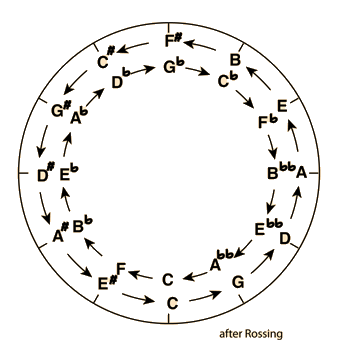
Circle of Fifths五度圆
|
Index Temperament and musical scales Reference Rossing Science of Sound, 2nd ed. 索引、音色与音乐音阶 参考 Rossing《声音的科学》第二版 | |||
|
Go Back
返回 |