Forming the Vowel Sounds
The vocal resonances are altered by the articulators to form distinguishable vowel sounds. The peaks in the vowel spectra are called vocal formants. Note the prominent role of the tongue in this process. The jaw position and lips also play a major part.
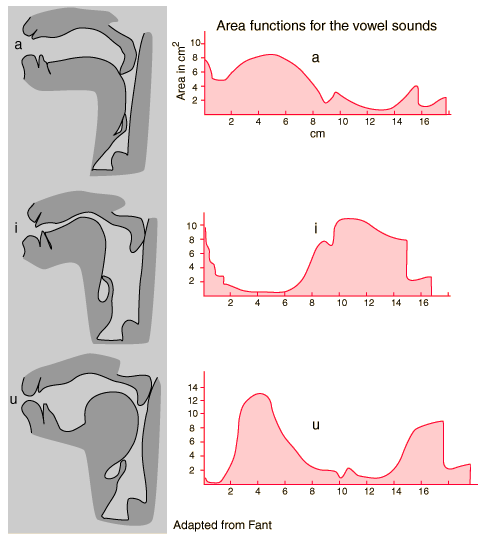
The sketches are adapted from Gunnar Fant's "Acoustic theory of speech production" and are reportedly sketches taken from x-rays of the head during the production of these sounds. These are the vowels classified as IPA [a], [i], and [u] and roughly correlate with the vowels represented in the vowel spectra from Benade.
Fant produced area functions for these vowels. The presumption is that if tubes were made with these area functions and were excited with a source with a rich harmonic content like the vocal folds, they would produce a sound similar to the vowel sounds. This has been demonstrated in an exhibit at the Exploratorium in San Francisco.
其他例子 |
Voice concepts
Musical instruments
References
Fant

Exploratorium
| HyperPhysics***** Sound
HyperPhysics ***** 声音 | R Nave |