Bilingual edition: English is preserved and Chinese follows each unit. Terminology uses the confirmed v20260916 glossary; automated semantic review remains traceable.
中英双语版:英文原文完整保留,中文紧随对应单元;术语采用 v20260916 确认表,自动语义审校结果可追溯。

Vocal Tract Resonance

声道共振

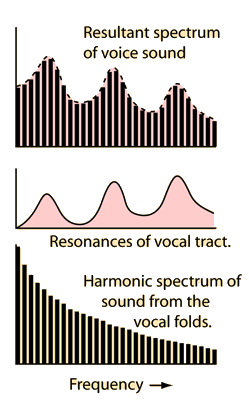
Sundberg models the vocal tract as a closed tube resonator, suggesting that the three prominent formants seen in vowel sounds correspond to the harmonics 1,3,5. These frequencies are then modified by the cavity resonance of the vocal tract as influenced by the articulators.

Sundberg将声 tract 模型化为一个封闭管共振腔,认为在元音声音中观察到的三个显著共振峰对应于谐波1、3、5。这些频率随后由声 tract 的腔体共振所修改,这种共振受到发音器官的影响。
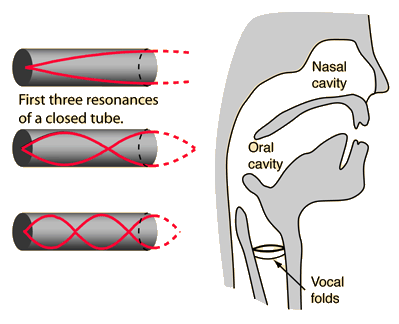
A typical length for the vocal tract is about 17-18 cm. This would give a fundamental frequency of about 500 Hz if it is treated as a closed cylinder. This would predict formant frequencies of 500, 1500 and 2500, which is in the range of observed frequencies. However, the articulators which provide differences in vowel sounds produce significant changes in these formant frequencies.

声带声道的典型长度约为17-18厘米。如果将其视为一个封闭的圆柱体,这将给出一个基频约为500 Hz。这会预测共振峰频率为500、1500和2500 Hz,这在观察到的频率范围内。然而,产生元音音色差异的发音器官会对这些共振峰频率产生显著影响。
Index

Voice concepts

Musical instruments

Reference
Sundberg
Scientific American, March 77
索引 声学概念 音乐乐器 参考 Sundberg 科学美国人,1977年3月
 
HyperPhysics***** Sound
HyperPhysics ***** 声音
R Nave
Go Back
返回


Voice Articulators

语音发音器官

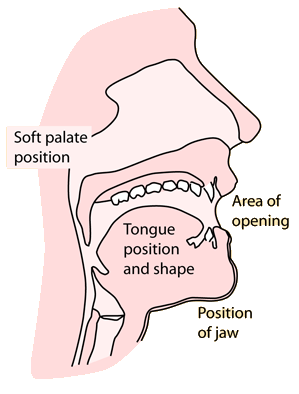
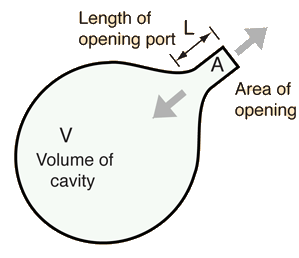
In order to produce distinguishable voice sounds, like vowel sounds, the vocal mechanism must control the resonances of the vocal tract which produce the characteristic vocal formants. If the vocal tract is considered to be a cavity resonator, then it can be seen that the position of the tongue, the area of opening of the mouth, and any changes which affect the volume of the cavity will retune the resonance.

为了产生可区分的语音,如元音,发声机制必须控制声道的共振,这些共振产生特征的音高共振峰。如果将声道视为一个腔体共振器,那么舌头的位置、口腔开合面积以及任何影响腔体容积的变化都会重新调谐共振。
More detail
更多内容
Examples
示例
Index

Voice concepts

Musical instruments
索引 声学概念 音乐乐器
 
HyperPhysics***** Sound
HyperPhysics ***** 声音
R Nave
Go Back
返回


Voice Articulators

语音发音器官

Voice articulation is seen as the changes in the resonances of the vocal tract, and the agents of such changes can be called articulators. Movement of the tongue, pharynx, palate, jaw, or lips can change the basic factors which determine the frequency of cavity resonance (volume of cavity, area of opening, and port length) .

声音的发音被视为声道共振的变化,这种变化的主体可以称为发音器官。舌头、咽部、软腭、下颌或嘴唇的运动可以改变决定腔体共振频率的基本因素(腔体体积、开口面积和通路长度)。

Voice articulation produces sounds which are called vowels, diphthongs, semivowels, and nasals. Such sounds can be considered to be modifications of the basic vocal tract resonance, a kind of filtering of the acoustic spectrum of the voice mechanism.

语音的发音会产生被称为元音、双元音、半元音和鼻音的声音。这些声音可以视为基本声道共振的修改,即对发声机制的声学频谱进行一种滤波。

While the resonances for most voiced sounds are in the pharyngeal and oral cavities, the nasal sounds /m/, /n/, and /ng/ require added resonance in the nasal cavity.

尽管大多数元音的共振发生在咽腔和口腔,但鼻音 /m/、/n/ 和 /ng/ 需要额外的鼻腔共振。
Examples
示例
Index

Voice concepts

Musical instruments
索引 声学概念 音乐乐器
 
HyperPhysics***** Sound
HyperPhysics ***** 声音
R Nave
Go Back
返回


The Voice Mechanism

声学机制

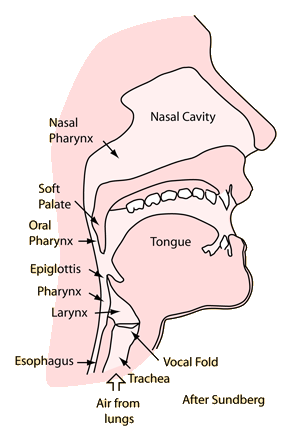
The voice mechanism involves the lungs and diaphragm as the power source, and the larynx, pharynx, mouth and nose. At the base of the short tubular larynx are the vocal folds, commonly called the vocal cords. The larynx opens into the pharynx during speech or singing, and is covered by the epiglottis during swallowing. The vocal tract acts as a resonator with frequencies which can be modulated by the articulators, forming the vocal formants which make vowel sounds recognizable.

发声机制涉及肺和横膈膜作为动力源,以及喉、咽、口和鼻。短管状喉的底部有声带,通常称为声带。在说话或歌唱时,喉部开口进入咽部,吞咽时则被会厌覆盖。声 tract 作为共鸣腔,其频率可由发音器官调节,形成声共振,使元音声音得以辨识。
Index

Voice concepts

Musical instruments

Reference
Sundberg
Scientific American, March 77
索引 声学概念 音乐乐器 参考 Sundberg 科学美国人,1977年3月
 
HyperPhysics***** Sound
HyperPhysics ***** 声音
R Nave
Go Back
返回