The French Horn
法国号
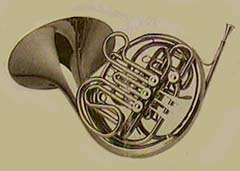
Though perhaps tracing its ancestry back to the use of animal horns by primitive man, the modern horn took a recognizable form in the 18th century. It was made with a flaring bell and one or two loops. It was made in the key of F with a length of about 12 ft and in a key of C with about 8ft of length. It became known in England about this time, and they called it the French horn. Starting in the 1710s, adding interchangeable extra crooks allowed a performer to change the length of the horn to alter its pitch. German hornist Anton Joseph Hampel discovered that hand stopping the horn allowed the player a few more notes. Modern French horns have three valves which lower the pitch a semitone, a tone, and three semitones (minor third). The valves of a horn are typically rotary valves. By the end of the 19th century, the horn in F had become standard. It is now typically combined with a shorter horn in B-flat to give a better high range. A fourth valve (thumb valve) is used to change between the F and the B-flat horn. Backus, as a horn player, comments that the F horn is usually used for low notes and the B-flat horn for high notes.
尽管可能追溯到原始人使用动物 horn 的历史,现代 horn 在18世纪末才呈现出可辨识的形态。它由扩大的喇叭口和一个或两个环形部分构成。它在F调时长约12英尺,在C调时长约8英尺。这种 horn 在此时期在英国流行起来,人们称它为法国 horn。从1710年代开始,加入可互换的额外管段使演奏者能够通过改变 horn 的长度来改变其音调。德国 horn 演奏家Anton Joseph Hampel发现,用手堵住 horn 可以让演奏者多演奏几个音符。现代法国 horn 有三个阀门,可以分别降低音高一个半音、一个全音和三个半音(小三度)。horn 的阀门通常是旋转阀门。到19世纪末,F调 horn 已成为标准。现在它通常与一个较短的B-flat调horn 结合使用,以获得更好的高音范围。一个第四阀门(拇指阀门)用于在F调和B-flat调horn 之间切换。Backus作为horn 演奏家评论说,F调horn 通常用于低音,而B-flat调horn 用于高音。
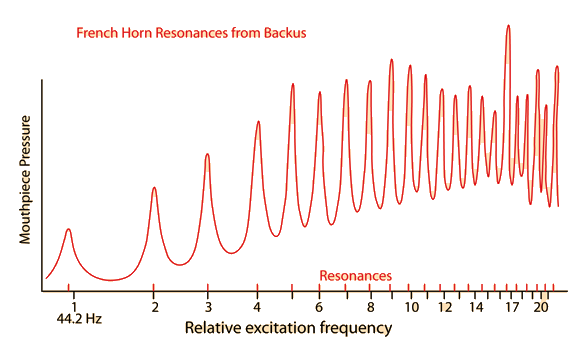
One characteristic of the French horn is the existence of well defined resonances up to the 22nd or beyond, playable up to at least the 16th harmonic, compared to about 9 playable resonances for the trumpet and trombone. Playing with the hand somewhat in the bell is also unique; it increases the acoustic mass of the air column and lowers the resonances. Backus comments that it helps with control of the tone quality and intonation. It also allows the instrument to produce resonant peaks out to about 1500 Hz, compared to about 750 Hz without hand closure.
法国号的一个特点是其共振峰可延伸至第22次或更高级别,可演奏至至少第16次泛音,这比小号和低音号的约9个可演奏共振峰要多。用手在喇叭口附近演奏也是其独特之处;这会增加空气柱的声学质量并降低共振频率。Backus指出,这种演奏方式有助于控制音色和音准。它还使乐器能够在约1500 Hz处产生共振峰,而不用手封闭时仅能达到约750 Hz。
|
Index
Brass concepts
Brass instruments
Musical instruments
Reference
Backus
Ch 12
索引 铝合金概念 铝合金乐器 音乐乐器 参考 Backus 第12章 |