Bilingual edition: English is preserved and Chinese follows each unit. Terminology uses the confirmed v20260916 glossary; automated semantic review remains traceable.
中英双语版:英文原文完整保留,中文紧随对应单元;术语采用 v20260916 确认表,自动语义审校结果可追溯。

The Trumpet

喇叭

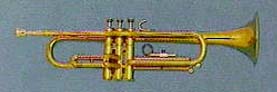
The modern trumpet has three valves and a bore that is partly cylindrical, partly conical. The standard orchestral trumpet, built in B-flat, has a range of about three octaves extending upward from the F-sharp be extending upward from the F-sharp below middle C(F3 sharp = 185 Hz). Models in D, C, and other pitches also exist.

现代小号有三个阀门,其管身部分为圆柱形,部分为圆锥形。标准的B小号小号的音域约为三个八度,从F小号音域向上延伸,F小号音域位于中央C以下(F3 sharp = 185 Hz)。也存在D、C及其他音高的型号。

Music for all models is written as if they were C trumpets (written C sounds B-flat for a B-flat trumpet). This allows players to switch instruments without learning new fingerings.

所有模型的乐谱都写成C调小号的音高(即C调小号的C音对应的是B调小号的B降音)。这使得演奏者可以在不同乐器之间切换而无需学习新的指法。
Those models other than the C are said to be transposing instruments.

The cornet is very similar to the trumpet except that it has a conical bore throughout its length while most of the trumpet's bore is cylindrical. Another relative of the trumpet is the flugelhorn , sometimes dubbed the "valved bugle" . It has a mellower sound than the trumpet.

小号与长号非常相似,只是小号的管身整体呈圆锥形,而长号的管身大部分是圆柱形。长号的另一个近亲是号角,有时被称为“有阀号角”。它的音色比小号更柔和。
Use of valves
使用阀门
Producing a harmonic series
产生谐波系列
Resonance curve
共振曲线
除C型以外的那些模型被称为转调乐器。
Index

Brass concepts

Brass instruments

Musical instruments
索引 铝合金概念 铝合金乐器 音乐乐器
 
HyperPhysics***** Sound
HyperPhysics ***** 声音
R Nave
Go Back
返回


Valves for Trumpet and Horn

小号和圆号的阀门

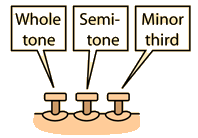
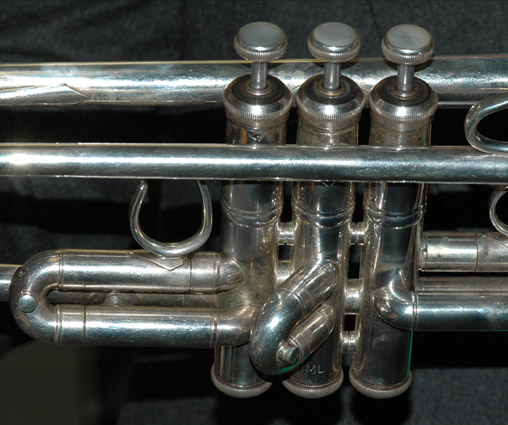
The three valves of the trumpet add lengths of tubing to the instrument to lower the pitch. The first valve lowers it by a whole tone, the second by a semitone, and the third by a minor third.

小号的三个阀门向乐器添加管段以降低音调。第一个阀门降低音调一个大二度,第二个降低一个半音,第三个降低一个小三度。

Based on a length of 148 cm, valve 1 would have to add 17.9cm, valve 2 8.6 cm, and valve 3 would need to add 27.8 cm. Note that valves 1 and 2 depressed together lengthen the tube by 26.5 cm and are not equivalent to a minor third.

基于长度为148厘米,阀1需要增加17.9厘米,阀2需要增加8.6厘米,阀3需要增加27.8厘米。注意,阀1和阀2同时按下会使管子延长26.5厘米,它们并不等同于一个小三度。

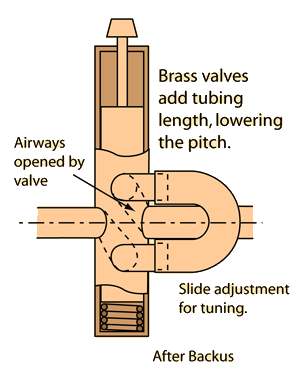
When a trumpet valve is up, the air goes straight through, and when it is depressed, a different air path is opened which adds a section of tubing. The length to add for the three valve intervals is calculated by using the fact that the frequency of an air column is inversely proportional to length.

当喇叭阀向上时,空气直接通过,而当它被按下时,会打开另一条空气路径,这条路径增加了管段。对于三个音阶区间,需要增加的长度是通过利用空气柱的频率与长度成反比这一事实来计算的。
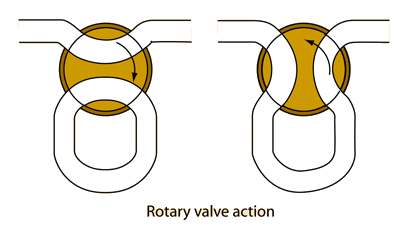
Horns may use rotary valves. The version at left is patterned after a sketch in Wolfe.
喇叭可能使用旋转阀。左边的版本是根据Wolfe的草图设计的。
Index

Brass concepts

Brass instruments

Musical instruments

Reference
Backus

Wolfe
索引 铜制乐器 铜管乐器 音乐乐器 参考 Backus Wolfe
 
HyperPhysics***** Sound
HyperPhysics ***** 声音
R Nave
Go Back
返回


Trumpet Resonance Curve

号角共振曲线

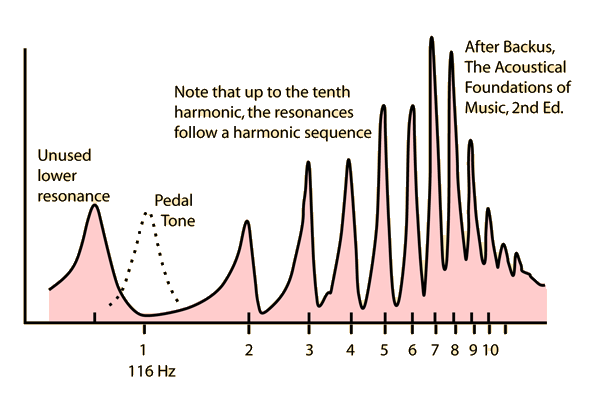
A trumpet exhibits natural resonant frequencies which follow a harmonic sequence fairly closely up to the tenth harmonic. This harmonic sequence is obtained with the help of the bell effect and the mouthpiece effect on the resonances. A unique pedal tone can be played in addition to the resonant frequencies.

小号具有自然的共振频率,这些频率在第十泛音以内大致遵循谐波序列。这种谐波序列是通过喇叭口效应和嘴唇效应共同作用于共振而获得的。此外,还可以演奏出一个独特的低音音调。

While the pedal tone of the trumpet can be demonstrated, it is much harder to play than with the trombone and other bass brass instruments and is not considered to be as useful, musically.

Trumpet resonance data
小号共振数据
虽然小号的踏板音可以演示,但用小号演奏起来比用低音铜管乐器如低音号更困难,且在音乐性上也不如后者有用。
Index

Brass concepts

Brass instruments

Musical instruments

Reference
Backus
索引 铝概念 铝乐器 音乐乐器 参考 Backus
 
HyperPhysics***** Sound
HyperPhysics ***** 声音
R Nave
Go Back
返回


Trumpet Resonance Data

小号共振数据

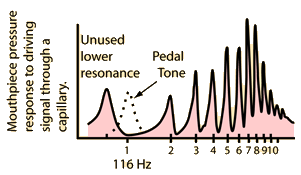
The data for the trumpet resonance curve reported by Backus were obtained by what he calls the capillary excitation method. The air column is excited by a loudspeaker type driver through a capillary tube into the air column near the mouthpiece end. The mouthpiece is closed off by a response microphone which measures the resulting mouthpiece pressure in response to the excitation. Note that the resonant peaks increase until about the 7th harmonic. This increase is attributed to approaching the helmholtz resonant frequency of the mouthpiece.
Above that peak, the amplitude diminishes rapidly. Backus attributes this to the fact that the wavelength of the 10th harmonic at about 1170 Hz is about equal to the circumference of the bell. Above that frequency, most of the wave energy is radiated rather than being reflected to contribute to the standing waves necessary for resonance.
在此峰值之上,振幅迅速减小。Backus认为这是因为第10泛音的波长约为1170 Hz,大约等于钟的周长。在此频率以上,大部分波的能量被辐射出去,而不是被反射以贡献给维持共振所需的驻波。

Backus报告的喇叭共振曲线数据是通过他称为毛细激发法获得的。通过毛细管将声音激发到喇叭管靠近喇叭口的一端,由扬声器类型驱动器激发空气柱。喇叭口被一个响应麦克风封闭,该麦克风测量激发后喇叭口处的压力。请注意,共振峰直到大约第七次谐波时才增加。这种增加归因于接近喇叭口的亥姆霍兹共振频率。

Trumpet resonance curve
小号共振曲线
Trumpet discussion
小号讨论
Index

Brass concepts

Brass instruments

Musical instruments

Reference
Backus
索引 铝概念 铝乐器 音乐乐器 参考 Backus
 
HyperPhysics***** Sound
HyperPhysics ***** 声音
R Nave
Go Back
返回