The Upper Register of the Oboe
Since the oboe has the form of a conical air column, it will produce the same fundamental frequency as an open cylinder of the same length and will also produce all harmonics. The first upper register is then an octave above the fundamental (the second harmonic) for a given length of air column.
|
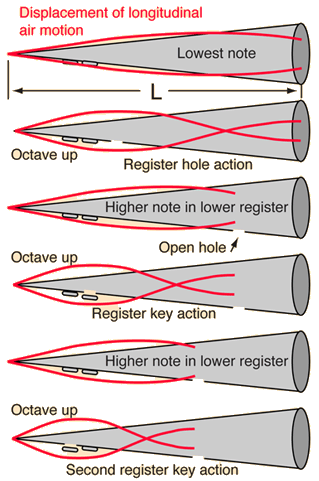
The upper register is achieved by opening a hole in the side of the air column close to the mouthpiece. Opening a hole releases excess air pressure and destroys the fundamental vibrational mode. If properly positioned, the hole favors the second harmonic mode which has a pressure node (displacement antinode) in the region near the mouthpiece. 通过在空气柱侧面靠近吹口的位置开一个孔,可以实现高音区。开孔会释放多余的空气压力并破坏基本振动模式。如果位置恰当,该孔会促进第二泛音模式,该模式在靠近吹口的区域有一个压力节点(位移抗节点)。
Achieving the upper register with the oboe is complicated by the fact that the optimum placement for the hole differs significantly for different ranges of the instrument. Higher notes in the lower register of the instrument require opening holes along the column to shorten it. This means that the hole for achieving the higher register for that note should be closer to the mouthpiece. In fact, each note of the lower register would have a different optimum position for the register hole, but this is not practical. As an operational compromise, the design of the oboe incorporates three different holes for achieving the upper register. 使巴洛克管乐器达到高音区是复杂的,因为该乐器不同音域的孔的最佳位置差异显著。在乐器的低音区,较高音需要沿管列打开孔以缩短管列。这意味着为了达到该音的高音区,孔应更靠近吹嘴。事实上,低音区的每个音都有不同的最佳孔位置,但这在实践中不可行。作为操作上的折中,巴洛克管乐器的设计采用了三个不同的孔来实现高音区。
|
 |
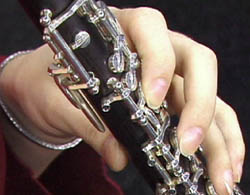 Lower register 低音区 | 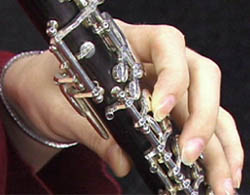 Upper register 高音区 |
| Video example of register change
注册变化的视频示例 |
The first of these holes is in the form of a key with a hole in it which is kept covered with a finger of the left hand when playing notes in the lower register. For the lower notes of the fundamental register, the upper register can be achieved by lifting the finger from this hole as demonstrated above.
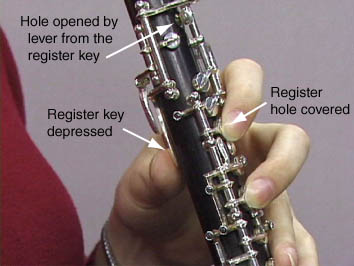 Register key action 注册键动作 |
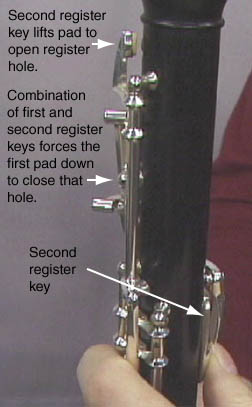
For notes higher in the fundamental register, corresponding to shorter overall column lengths, a hole closer to the mouthpiece is needed to induce the jump to the upper register. This is achieved by a register key which uses a lever to lift a pad to open the needed hole. 对于位于基音区较高的音符,对应更短的整体管柱长度,需要在靠近哨片的位置开一个孔以引发跃迁到高音区。这通过一个注册键实现,该键利用杠杆抬起一个垫片以打开所需的孔。
|
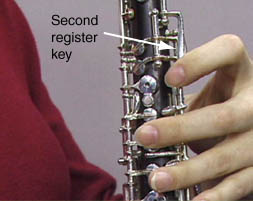 Second register key For still higher notes, a second register key is used in addition to the first register key. By a rather complicated compound lever action, it closes the previous register hole and opens one still closer to the mouthpiece to excite the second harmonic of the shorter conical column. 对于更高的音阶,除了第一组按键外,还会使用第二组按键。通过一种相当复杂的复合杠杆作用,它会关闭先前的气孔,并打开一个更接近吹嘴的气孔,以激发短圆柱管的第二泛音。
第二寄存器键 |
 |
Thanks to Liz McKeown for helping to demonstrate the instrument.
Woodwind instruments
Musical instruments
| HyperPhysics***** Sound
HyperPhysics ***** 声音 | R Nave |