Bilingual edition: English is preserved and Chinese follows each unit. Terminology uses the confirmed v20260916 glossary; automated semantic review remains traceable.
中英双语版:英文原文完整保留,中文紧随对应单元;术语采用 v20260916 确认表,自动语义审校结果可追溯。

Airplane in Wind: Desired Heading and Resultant Speed

有风时飞机的期望航向和实际速度

Velocity unit
Your aircraft can maintain an airspeed of:
你的飞机可以保持空速为:
=.
For wind velocity
对于风速
= at °,
= 在 ° 时,
中文译文中的待填/计算数值依次对应:1:b 2:u3 3:ab。实际数值以上方原输入框为准。
if you wish to maintain a bearing in the compass direction°
then you should take a heading in the compass direction °
This will give you a ground speed of
这将给你一个地面速度
=
in the chosen direction.
在所选方向上。

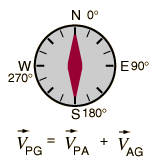
Note: The wind direction in this calculation is the direction of air motion, not the direction from which the wind is coming. So if you call a wind from the north a "north wind", then the air motion direction is south and you would enter 180° for the wind angle.

注意:本计算中的风向是指空气的运动方向,而不是风的来源方向。所以如果你把从北边吹来的风称为“北风”,那么空气的运动方向是南,你应该将风向角输入为180°。

Details about calculation

计算详情
Alternate calculations:
其他计算方法:
Ground Velocity
接地速度
Wind Velocity
风速
如果你想保持罗盘方向的航向°,则应采用罗盘方向的航向°。
中文译文中的待填/计算数值依次对应:1:u1 2:a 3:u2 4:ac 5:aa 6:c 7:u4。实际数值以上方原输入框为准。
Index

Relative velocity
索引 相对速度
 
HyperPhysics***** Mechanics
力学
R Nave
Go Back
返回


Calculating Aircraft Heading

计算飞机航向

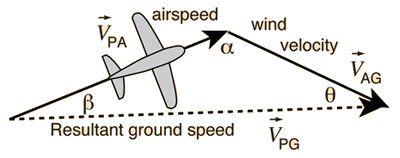
Calculating the necessary heading to counter a wind velocity and proceed along a desired bearing with respect to the earth is a classic problem in aircraft navigation.
计算以抵消风速并沿预定航向(相对于地球)前进所需的航向,是航空导航中的经典问题。
This calculation makes good use of both the law of sines and the law of cosines. Known are wind velocity , airspeed, and the desired bearing angle. This gives a value for the angle θ as the difference in wind direction and bearing. Use of the law of sines with wind velocity and airspeed gives the angle of offset for the aircraft, β. Then using the law of cosines with the third angle gives the magnitude of the resultant ground speed of the aircraft along the chosen bearing direction.

More detail on calculation

计算细节
这个计算充分利用了正弦定律和余弦定律。已知风速、空速和期望的航向角。这给出了角度θ的值,即风向与航向的差。利用正弦定律结合风速和空速,可以得到飞机的偏航角β。然后利用余弦定律结合第三个角,得到飞机沿选定航向的地面速度的大小。
Index

Relative velocity
索引 相对速度
 
HyperPhysics***** Mechanics
力学
R Nave
Go Back
返回