Bilingual edition: English is preserved and Chinese follows each unit. Terminology uses the confirmed v20260916 glossary; automated semantic review remains traceable.
中英双语版:英文原文完整保留,中文紧随对应单元;术语采用 v20260916 确认表,自动语义审校结果可追溯。

Law of Cosines

余弦定律
The law of cosines for calculating one side of a triangle when the angle opposite and the other two sides are known. Can be used in conjunction with the law of sines to find all sides and angles.
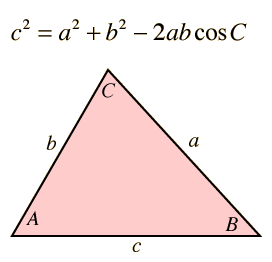
Click on the highlighted text for either side c or angle C to initiate calculation.
点击突出显示的文本以启动计算。
Side a
侧面a
=
Side b
侧面b
=
Side c
边c
=
Angle C
角C
= degrees
度数
中文译文中的待填/计算数值依次对应:1:ac。实际数值以上方原输入框为准。
Enter data for sides a and b and either side c or angle C. Then click on the active text for the unknown quantity you wish to calculate.
Calculation of side c is straightforward, but calculation of sides a or b is more involved since changing either side c or angle C forces changes in both a and b. To calculate a or b, first use the law of sines to find the angle opposite the side you wish to calculate. Then use the law of cosines to find the unknown side length.
输入边a和b以及边c或角C的数据。然后点击您希望计算的未知量的活动文本。计算边c是直接的,但计算边a或边b则更为复杂,因为改变边c或角C会迫使a和b都发生变化。要计算a或b,首先使用正弦定律找到您希望计算的边所对的角。然后使用余弦定律来找到未知的边长。
中文译文中的待填/计算数值依次对应:1:a 2:b 3:c。实际数值以上方原输入框为准。

Applications

应用
已知三角形一个角的对边及另外两边时,利用余弦定理计算该边。可与正弦定理结合使用,以求出所有边和角。
Index
索引
 
HyperPhysics*****HyperMath*****Trigonometry
HyperPhysics ***** HyperMath ***** 三角学
R Nave
Go Back
返回


Applications, Law of Cosines

应用,余弦定律
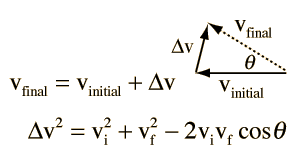
The law of cosines has application to vector quantities:
To find the difference between two vectors, as in a glancing collision.
为了找到两个向量的差异,如在一次斜碰中

It has application along with the law of sines to the problem of the heading angle for an aircraft in the wind.

Other applications:

其他应用:
Lande' g-factor
兰德因子
余弦定律适用于矢量:它与正弦定律一起用于解决飞机在风中的航向角问题。
Index
索引
 
HyperPhysics*****HyperMath*****Geometry
HyperPhysics ***** HyperMath ***** 几何
R Nave
Go Back
返回


Aircraft Heading to Counter Wind

飞机迎风飞行
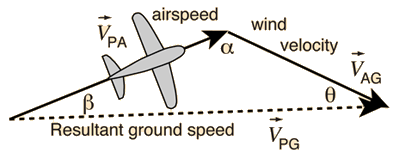
Calculating the necessary aircraft heading to counter a wind velocity and proceed along a desired bearing to a destination is a classic problem in aircraft navigation. It makes good use of the law of sines and the law of cosines.

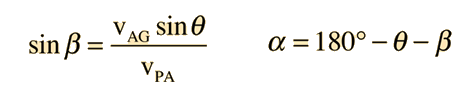
The angle θ is just the difference between the wind direction and the desired bearing. With that angle and the law of sines, the offset angle β for the aircraft is obtained:

角度θ仅仅是风向与期望航向之间的差值。利用这个角度和正弦定律,可以得到飞机的偏移角β:

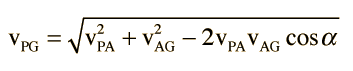
Then the law of cosines is applied to get the resultant ground speed:

然后应用余弦定理计算 resultant 速率:
计算抵消风速以沿期望航向飞向目的地所需的飞机航向是航空导航中的经典问题。它充分利用了正弦定律和余弦定律。
Index
索引
 
HyperPhysics*****HyperMath*****Geometry
HyperPhysics ***** HyperMath ***** 几何
R Nave
Go Back
返回