A 22° halo from the equator
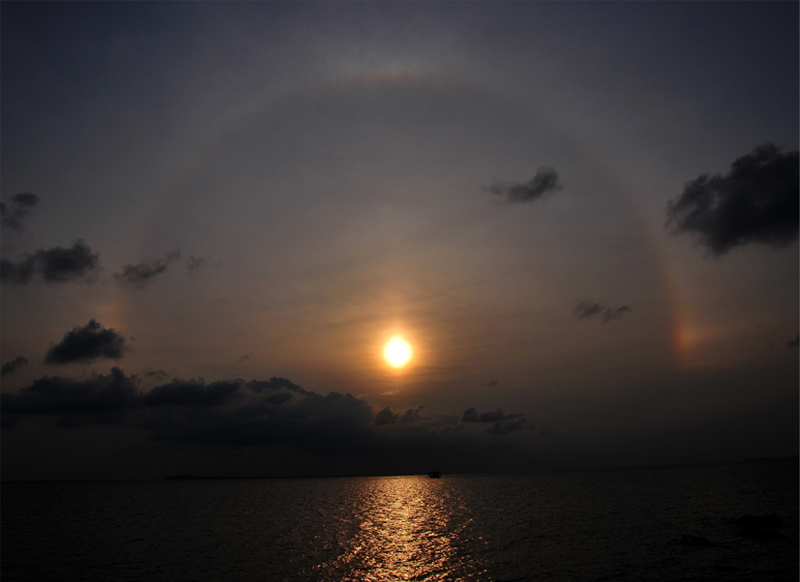
This photo of the 22° halo around the sun was shot by Frank Starmer on January 22, 2011 on the island of Bintan in Indonesia. The location is Telubakau, Kepulauan Riau, Indonesia. The photo was shot just after sunrise at about 7am local time. It was shot at f8 and 1/1000 sec with a 70-300mm Nikon lens. The location is only one degree away from the Equator. It is remarkable that this phenomenon, which involves refraction in ice crystals, can be seen at the Equator. (Photo used by permission, all rights reserved to Frank.)
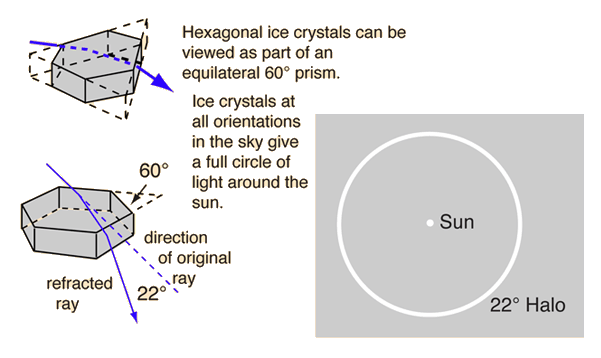
One would expect that the halo is caused by very high altitude ice crystals. 人们会预期晕现象是由极高海拔的冰晶引起的。 The familiar 22° halo around the Sun or Moon occurs because of refraction in tiny hexagonal ice crystals in the air. With the 60° apex angle of the prism formed by extending the sides of the crystal and the index of refraction of ice (n=1.31) one can calculate the angle of minium deviation to be 21.84°. 人们熟悉的围绕太阳或月亮的22°晕现象,是由于空气中的微小六边形冰晶的折射造成的。通过将晶体的边延长形成棱镜,其顶角为60°,以及冰的折射率(n=1.31),可以计算出最小偏向角为21.84°。 |
 |
The presence of a definitely visible parhelion or "sun dog" on a line horizontal from the sun suggests flat hexagonal ice crystals, but the visibility of the entire halo suggests small ice crystals at all orientations. 太阳正上方水平线上出现明显的日晕或‘太阳狗’,表明可能存在六边形的冰晶,但整个光环的可见性则表明在所有取向下都存在较小的冰晶。 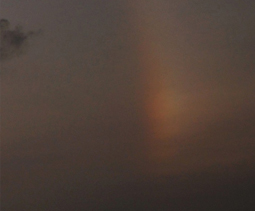 This is a GPS track of the journey from Singapore to the southeast coast of Bintan where the photo was taken. 这是一段从新加坡到宾坦东南海岸的GPS轨迹,照片就是在此处拍摄的。 |  |
| Origin of "sundogs"
“ sundogs ”的起源 | Other halo phenomena
其他晕现象 |
| Moon halo
月晕 |
Halo formation
Atmospheric optics concepts
References
Greenler
Schaaf
| HyperPhysics***** Light and Vision
HyperPhysics ***** 光与视觉 | R Nave |