Bilingual edition: English is preserved and Chinese follows each unit. Terminology uses the confirmed v20260916 glossary; automated semantic review remains traceable.
中英双语版:英文原文完整保留,中文紧随对应单元;术语采用 v20260916 确认表,自动语义审校结果可追溯。

The 22° Halo

22° Halo

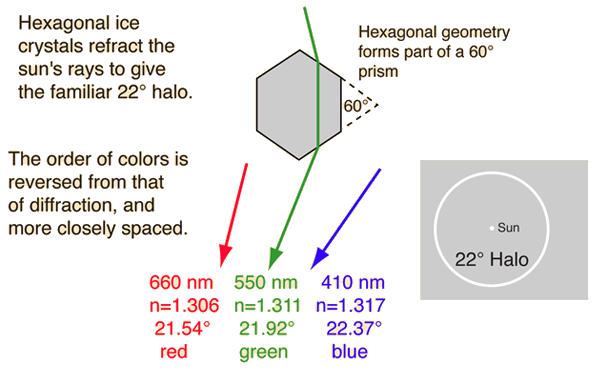
The familiar 22° halo around the Sun or Moon occurs because of refraction in tiny hexagonal ice crystals in the air. With the 60° apex angle of the prism formed by extending the sides of the crystal and the index of refraction of ice (n=1.31) one can calculate the angle of minium deviation to be 21.84°.
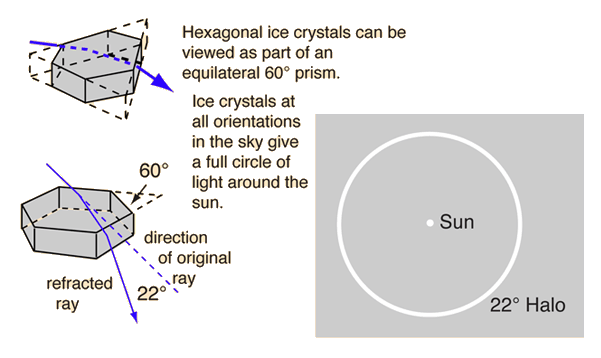
人们熟悉的围绕太阳或月亮的22°晕现象,是由于空气中的微小六边形冰晶的折射造成的。通过将晶体的边延长形成棱镜,其顶角为60°,以及冰的折射率(n=1.31),可以计算出最小偏向角为21.84°。

Photo by Clay S. Turner. Used by permission.

照片由Clay S. Turner拍摄。获许可使用。

Further refinement using n=1.306 for red and n=1.317 for blue gives angles of 21.54° and 22.37° for red and blue respectively. The inner edge of the halo is sharp and appears reddened - the angle of minimum deviation for red is less and you see it from crystals closer to the Sun or Moon direction. The out edge of the halo is blue in appearance but less saturated because other wavelengths can refract at that angle.

Calculation
计算
Can you have diffraction at this angle?
你能在这个角度有衍射吗?
Can you see a 22° halo from the equator?
你能从赤道看到22°的 halo 吗?
Origin of "sundogs"
“ sundogs ”的起源
Other halo phenomena
其他晕现象
Moon halo
月晕
使用n=1.306计算红光和n=1.317计算蓝光进一步细化,得到红光和蓝光的折射角分别为21.54°和22.37°。光环的内边缘是清晰的,并且呈现红色调——红光的最小偏向角更小,因此你看到它来自更接近太阳或月亮方向的晶体。光环的外边缘看起来是蓝色的,但饱和度较低,因为其他波长的光可以在该角度发生折射。
Index

Halo formation

Atmospheric optics concepts

References
Greenler

Schaaf
索引 群星形成 大气光学概念 参考文献 Greenler Schaaf
 
HyperPhysics***** Light and Vision
HyperPhysics ***** 光与视觉
R Nave
Go Back
返回


Details of 22° Halo

22° Halo 详情

The familiar separation of the colors of white light in a prism is a result of dispersion, the variation of the index of refraction of light with wavelength. Since hexagonal ice crystals make up a section of a a 60° prism, they separate the colors of white light. This gives the rainbow hues of the parhelia.

白光通过棱镜时颜色的分离现象是由于色散,即光的折射率随波长的变化。由于六边形冰晶构成了一个60°棱镜的一部分,它们能够将白光分解为不同颜色。这产生了日晕的彩色效果。

Description of 22° halo
22° halo 的描述
Minimum deviation calculation
最小偏差计算
Index

Halo formation

Atmospheric optics concepts

References
Greenler

Schaaf
索引 群星形成 大气光学概念 参考文献 Greenler Schaaf
 
HyperPhysics***** Light and Vision
HyperPhysics ***** 光与视觉
R Nave
Go Back
返回


Sun Dogs (Parhelia)

太阳犬(Parhelia)

Photo by Clay S. Turner. Used by permission.

照片由Clay S. Turner拍摄。获许可使用。

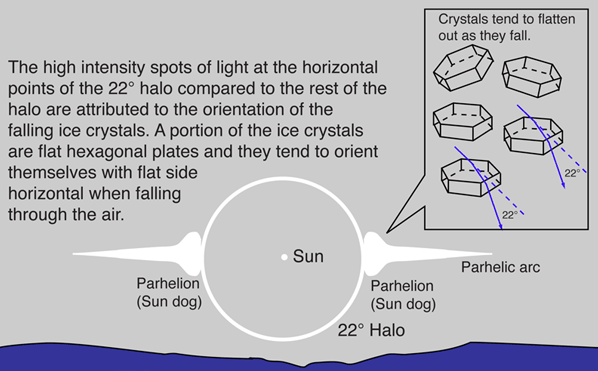
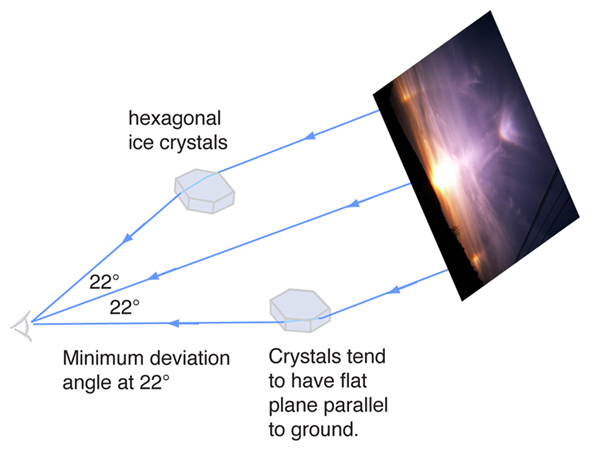
At the points on the 22° halo which are on a horizontal line with the sun, the arc commonly broadens to two bright spots, reputedly referred to by artic people as the sun's dogs. The refracted light at these points is so much more intense than the remainder of the 22° halo that they are often seen when the remainder of the arc is not. The parhelia often show rainbow colors from the dispersion in the ice crystals. While appearing on the 22° halo when the sun is at the horizon, they appear to be slightly outside it at higher altitudes and will flare into a white tail leading away from the 22° halo. Under appropriate conditions the tail may extend far outward on the horizontal "parhelic circle". This extension of the sun dogs is reflection from the vertical sides of the flat hexagonal ice crystals.

在22°晕中位于太阳水平线上的点,弧形通常会扩展成两个明亮的斑点,据阿塔瓦拉人称,这些被称为太阳的狗。在这些点上的折射光比22°晕的其余部分强得多,因此在其余部分尚未显现时,它们常常被看到。而出现的太阳狗通常会显示出由于冰晶折射产生的彩虹色。当太阳位于地平线时,它们出现在22°晕上,但在更高的高度上则似乎略在晕的外面,并会形成一条向远离22°晕延伸的白色尾部。在适当的条件下,这条尾部可能延伸到水平的“太阳圈”很远的地方。太阳狗的这种延伸是由于冰晶的垂直面反射产生的。

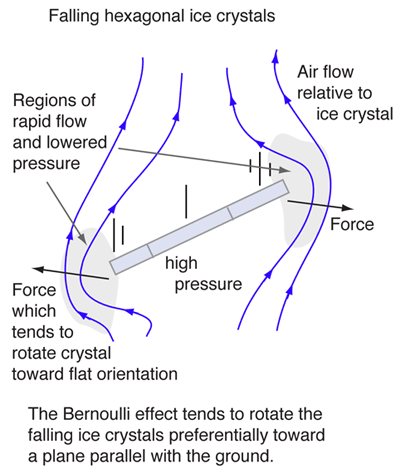
The accentuated light at the intersection of a horizontal line through the Sun's position is attributed to the preferential orientation of the hexagonal ice crystals. Ron Edge models the tendency toward this flat orientation of the crystals in terms of the Bernoulli effect.

在太阳位置处水平线交点处的强光现象,归因于六边形冰晶的优先取向。Ron Edge 用伯努利效应来解释这些晶体倾向于这种扁平取向的倾向。
Antarctic sundog example
南极日光例
Index

Halo formation

Atmospheric optics concepts

References
Greenler

Schaaf

Edge
索引晕现象 大气光学概念 参考文献 Greenler Schaaf Edge
 
HyperPhysics***** Light and Vision
HyperPhysics ***** 光与视觉
R Nave
Go Back
返回