Sundogs in Antarctica
The parhelia or "sun dogs" are more readily visible in the cold of the antarctic and artic regions.
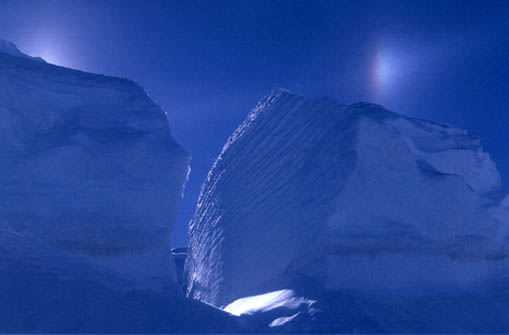
Photos by Dr. Richard Sadleir. Used by permission. All rights reserved.
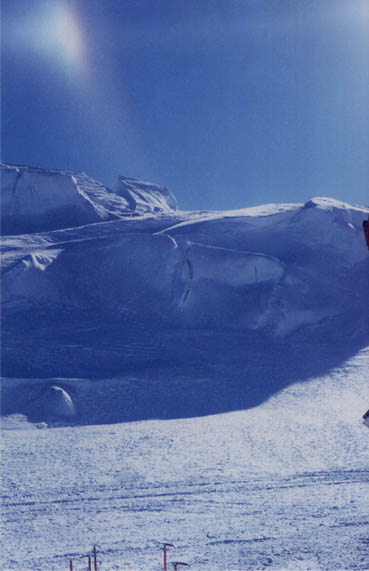 |
In the photo of the large split ice cliff above, the sun is to the left behind the cliff, which allowed this striking image of the right sun dog to be photographed. The left sun dog was photographed by hiding the sun behind the building to the right of the lower photo. 在上方的大型裂开的冰崖照片中,太阳位于 cliff 左侧后方,这使得这张右太阳狗的令人印象深刻的照片得以拍摄。左太阳狗则是通过将太阳藏在下方照片右侧建筑后方来拍摄的。
The photographs were made by Dr. Sadleir on Ross Island, Antarctica in November of 1987 when he was there for a snow survival course. In the course of his employment with the Department of Conservation of the New Zealand government, this opportunity came as a part of a study of the Adelie penquins. 这些照片是1987年11月在南极洲罗斯岛由萨德利博士拍摄的,当时他正在参加一个雪地生存课程。在担任新西兰政府 conservation 部门员工期间,他有机会参与对阿德利企鹅的研究。
He describes the preconditions as follows: "It was a brilliant sunny day but there was a high upper wind off Mount Erebus, filling the air with falling ice crystals." 他描述了前提条件如下:‘那天天气晴朗明媚,但埃雷布斯山上有强劲的高空风,吹起大量冰晶,弥漫在空气中。’
|
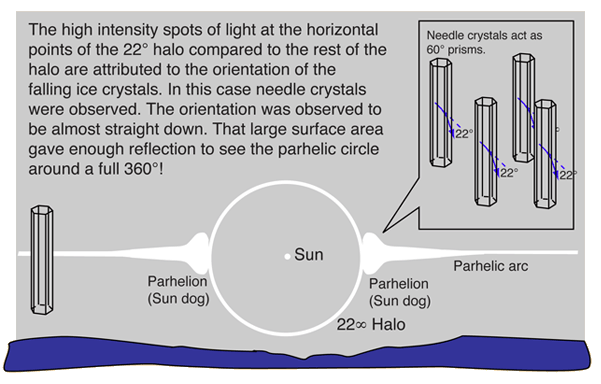
One of the remarkable things about Dr. Sadleir's experience was the observation of a parhelic circle which made a full 360° around the sky. "Over a period of 3/4 of an hour a complete ... 360° parhelic curcle developed at the same time as the usual sun halo [the 22° halo]. At the intersection of the two rings there were brilliant sun dogs with rainbow colouration. On the opposite side of the parhelic circle developed mirror sun dogs which were not rainbow coloured but just white light." Dr. Sadleir 的经历中有一个引人注目的现象,就是观察到一个围绕天空完整旋转360°的parhelic circle。在1/4小时左右的时间内,一个完整的360° parhelic circle逐渐形成,同时伴随着通常的太阳日晕[22°日晕]。两个环的交点处出现了明亮的太阳狗,呈现出彩虹般的色彩。在parhelic circle的另一侧则发展出了镜像太阳狗,它们不是彩虹色,只是白光。 |
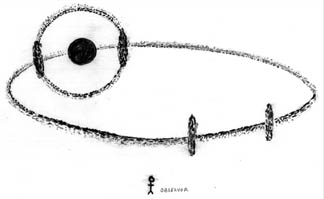 Hut Point Peninsula, Ross Island, Antarctica, November 19, 1987. 1987年11月19日,南极洲罗斯岛的胡特点半岛。 |
"I also noticed something I had not seen in previous sun haloes, perhaps because this was in perfect conditions. The light ring of the halo was very intense on the sun side of the halo and then faded outwards. "
"After the whole phenomena faded, the cloud of ice crystals actually fell around us for a short time. They were elongated crystals about 8 to 12 mm long. I remember them as falling vertically (the air was absolutely still)."
The coloration of the sundogs arises from dispersion in the ice crystals, which act as 60° prisms to separate the colors of sunlight. The prism calculation using n=1.306 for red and n=1.317 for blue gives angles of 21.54° and 22.37° for red and blue respectively. The inner edge of the halo is sharp and appears reddened - the angle of minimum deviation for red is less and you see it from crystals closer to the Sun or Moon direction. The out edge of the halo is blue in appearance but less saturated because other wavelengths can refract at that angle.
| Origin of "sundogs"
“ sundogs ”的起源 | Other halo phenomena
其他晕现象 |
Halo formation
Atmospheric optics concepts
References
Greenler
Schaaf
| HyperPhysics***** Light and Vision
HyperPhysics ***** 光与视觉 | R Nave |