Boomerang as Vector Rotation Example作为矢量旋转示例的回旋
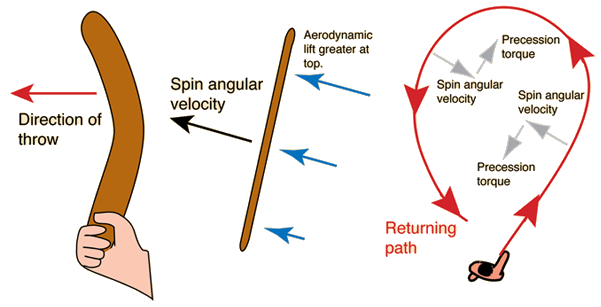
The returning trajectory of a boomerang involves the aerodynamic lift of its airfoil shape plus the gyroscopic precession associated with its rapid spin. The precession redirects the airfoil so that it "flys" around the returning path.
The three diagrams above address the nature of the boomerang's flight. Click on one of the diagrams for further details about the boomerang. 飞盘返回轨迹涉及其机翼形状的空气动力学升力以及与其快速自旋相关的陀螺效应。这种预cession使机翼方向发生偏转,使其沿着返回路径“飞行”。上方的三个图展示了飞盘飞行的性质。点击其中一个图以获取更多关于飞盘的详细信息。 |
Index Vector rotation examples 索引矢量旋转示例 | ||
| Go Back
返回 |
Boomerang回旋镖
|
Index Vector rotation examples 索引矢量旋转示例 | ||
|
Go Back
返回 |
Boomerang回旋镖
|
Index Vector rotation examples 索引矢量旋转示例 | ||
| Go Back
返回 |
Boomerang回旋镖
|
Index
索引 | ||
| Go Back
返回 |
Boomerang Structure回旋结构
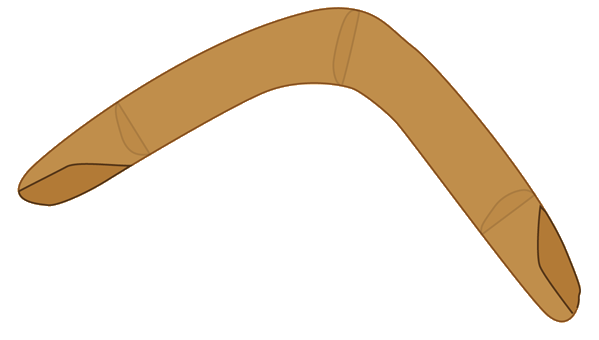
The structure of a boomerang is such that each end forms an airfoil heading into the wind when it is at the top of its motion. Therefore the sideways "lift" force is always greater on the top of the spinning structure.![]() A boomerang is an example of gyroscopic precession. The throw of the boomerang gives it an angular velocity perpendicular to its path. The cross-section of the boomerang is an airfoil which gives it more lift on the top, leading edge than on the bottom. This gives it a torque , which always acts to precess the boomerang counterclockwise as seen from above. Since it will tend to "fly" in the direction of the airfoil, the precession causes it to fly in a curved path, circling back toward the thrower. 回旋飞盘的结构是这样的,当它处于运动的最高点时,每个端部都形成一个迎风的机翼。因此,飞盘在旋转结构的顶部总是产生更大的侧向“升力”力。回旋飞盘是陀螺效应预旋的一个例子。投掷飞盘使其获得一个垂直于其运动路径的角速度。飞盘的横截面是一个机翼形状,使其在上缘产生比下缘更大的升力。这会产生一个力矩,总是使飞盘逆时针旋转(从上方看)。由于它倾向于“飞”向机翼的方向,预旋使其沿曲线路径飞行,最终返回给投掷者。 |
Index
索引 | ||
|
Go Back
返回 |