Bernoulli Equation伯努利方程
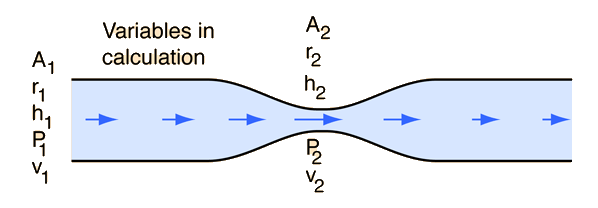
The Bernoulli Equation can be considered to be a statement of the conservation of energy principle appropriate for flowing fluids. The qualitative behavior that is usually labeled with the term "Bernoulli effect" is the lowering of fluid pressure in regions where the flow velocity is increased. This lowering of pressure in a constriction of a flow path may seem counterintuitive, but seems less so when you consider pressure to be energy density. In the high velocity flow through the constriction, kinetic energy must increase at the expense of pressure energy. 伯努利方程可以被视为适用于流动流体的能量守恒原理的陈述。通常被称为‘伯努利效应’的定性行为是,在流速增加的区域,流体压力降低。在流体流动路径的狭窄处,压力降低似乎有些反直觉,但当你将压力视为能量密度时,这种现象就显得不那么奇怪了。在狭窄处的高速流动中,动能必须增加,而以压力能为代价。
Steady-state flow caveat: While the Bernoulli equation is stated in terms of universally valid ideas like conservation of energy and the ideas of pressure, kinetic energy and potential energy, its application in the above form is limited to cases of steady flow. For flow through a tube, such flow can be visualized as laminar flow, which is still an idealization, but if the flow is to a good approximation laminar, then the kinetic energy of flow at any point of the fluid can be modeled and calculated. The kinetic energy per unit volume term in the equation is the one which requires strict constraints for the Bernoulli equation to apply - it basically is the assumption that all the kinetic energy of the fluid is contributing directly to the forward flow process of the fluid. That should make it evident that the existence of turbulence or any chaotic fluid motion would involve some kinetic energy which is not contributing to the advancement of the fluid through the tube. 稳态流动注意事项:虽然伯努利方程是基于普遍有效的概念如能量守恒和压力、动能与势能的概念来表述的,但其在上述形式中的应用仅限于稳态流动的情况。对于通过管子的流动,这种流动可以被可视化为层流,这仍然是一个理想化的情况,但如果流动近似为层流,则可以对流体中任一点的动能进行建模和计算。方程中的单位体积动能项是伯努利方程适用所必需的严格约束条件——它基本上是假设流体的所有动能都直接贡献于流体通过管子的前进过程。这应该清楚地表明,湍流或任何混沌的流体运动都会涉及一些不贡献于流体通过管子前进的动能。 It should also be said that while conservation of energy always applies, this form of parsing out that energy certainly does not describe how that energy is distributed under transient conditions. A good visualization of the Bernoulli effect is the flow through a constriction, but that neat picture does not describe the fluid when you first turn on the flow. 还应指出,虽然能量守恒总是成立的,但这种将能量分解的方式 certainly 并不描述在瞬态条件下能量的分布情况。伯努利效应的一个良好可视化示例是流体通过狭窄区域的流动,但这种清晰的图像在你第一次开启流动时,并不能准确描述流体的状态。 Another approximation involved in the statement of the Bernoulli equation above is the neglect of losses from fluid friction. Idealized laminar flow through a pipe can be modeled by Poiseuille's law, which does include viscous losses resulting in a lowering of the pressure as you progress along the pipe. The statement of the Bernoulli equation above would lead to the expectation that the pressure would return to the value P1 past the constriction since the radius returns to its original value. This is not the case because of the loss of some energy from the active flow process by friction into disordered molecular motion (thermal energy). More accurate modeling can be done by combining the Bernoulli equation with Poiseuille's law. A real example which might help visualize the process is the pressure monitoring of the flow through a constricted tube. Bernoulli calculation伯努利计算 另一个涉及伯努利方程陈述的近似是忽略了流体摩擦造成的损失。理想化的层流通过管道可以由泊肃叶定律来建模,该定律确实包含了粘性损失,导致压力随着在管道中前进而降低。上述伯努利方程的陈述会让人预期,在通过狭窄部分后,压力会恢复到原来的P₁值,因为半径又回到了原始值。但这并不成立,因为部分能量会通过摩擦损失到无序的分子运动(热能)中。通过将伯努利方程与泊肃叶定律结合,可以进行更准确的建模。一个有助于理解这一过程的现实例子是通过狭窄管路的流体压力监测。 |
Index Bernoulli concepts 索引伯努利概念 | ||
|
Go Back
返回 |
Bernoulli Calculation伯努利计算
The calculation of the "real world" pressure in a constriction of a tube is difficult to do because of viscous losses, turbulence, and the assumptions which must be made about the velocity profile (which affect the calculated kinetic energy). The model calculation here assumes laminar flow (no turbulence), assumes that the distance from the larger diameter to the smaller is short enough that viscous losses can be neglected, and assumes that the velocity profile follows that of theoretical laminar flow. Specifically, this involves assuming that the effective flow velocity is one half of the maximum velocity, and that the average kinetic energy density is given by one third of the maximum kinetic energy density.
在管子的狭窄处计算“真实世界”中的压力是困难的,因为粘滞损失、湍流以及对速度分布的假设(这些假设影响计算出的动能)。此处的模型计算假设为层流(无湍流),假设从较大直径到较小直径的距离足够短,可以忽略粘滞损失,并假设速度分布遵循理论层流的速度分布。具体来说,这包括假设有效流速是最大流速的一半,且平均动能密度是最大动能密度的三分之一。现在如果你能接受所有这些假设,就可以对管子中的流体流动进行建模*,其中体积流量率为 cm³/s,流体密度为 ρ = g/cm³。对于入口管面积 A₁ = cm²(半径 r₁ = cm),流体的几何结构导致有效流体速度为 v₁ = cm/s。由于伯努利方程还包括流体的势能,因此入口管的高度被指定为 h₁ = cm。当管子面积被收缩到 A₂ = cm²(半径 r₂ = cm)时,如果不做进一步假设,狭窄处的有效流体速度必须为 v₂ = cm/s。狭窄管的高度被指定为 h₂ = cm。现在可以计算管子两个位置的动能密度,并应用伯努利方程以确保能量守恒,从而得到狭窄处的压力值。首先,指定入口管的压力:入口压力 = P₁ = kPa = psi = mmHg = 大气压。现在可以计算能量密度。所用CGS单位的能量单位是erg。现在可以将狭窄管中的压力能量密度最终转换为更常规的压力单位,以观察狭窄流动对流体压力的影响:计算出的狭窄处压力 = P₂ = kPa = psi = mmHg = 大气压。这种计算可以提供一些关于流体流动中能量的视角,但其准确性总是存疑,因为假设了层流。对于典型的入口条件,与压力相关的能量密度在输入侧占主导地位;毕竟,我们生活在大气海洋的底部,这会带来大量的压力能量。如果使用足够大的半径减少来产生狭窄处的压力低于大气压,那么流体进入该狭窄处时很可能涉及湍流。尽管如此,这种计算仍可以解释为什么我们可以通过高压力水龙头上的“吸气器”获得显著的吸力(压力低于大气压)。这些设备由一个逐渐变细的金属管和一个进入狭窄区域的侧管组成,用于吸力。*注意:在开始探索计算时,一些值将被输入默认值。所有这些值都可以在你的计算过程中进行更改。 中文译文中的待填/计算数值依次对应:1:f 2:d 3:a1 4:r1 5:v1 6:h1 7:a2 8:r2 9:v2 10:h2 11:p1 12:pc 13:pm 14:pa 15:p2 16:pc2 17:pm2 18:pa2。实际数值以上方原输入框为准。 |
Index Bernoulli concepts 索引伯努利概念 | ||
|
Go Back
返回 |
Curve of a Baseball棒球的曲线
A non-spinning baseball or a stationary baseball in an airstream exhibits symmetric flow. A baseball which is thrown with spin will curve because one side of the ball will experience a reduced pressure. This is commonly interpreted as an application of the Bernoulli principle and involves the viscosity of the air and the boundary layer of air at the surface of the ball. 一个不自转的棒球或在气流中静止的棒球会表现出对称的流动。当棒球被投掷并带有自旋时,它会弯曲,因为球的一侧会经历较低的气压。这通常被解释为伯努利原理的应用,涉及空气的粘性和球表面的边界层。
There are some difficulties with this picture of the curving baseball. The Bernoulli equation cannot really be used to predict the amount of curve of the ball; the flow of the air is compressible, and you can't track the density changes to quantify the change in effective pressure. The experimental work of Watts and Ferrer with baseballs in a wind tunnel suggests another model which gives prominent attention to the spinning boundary layer of air around the baseball. On the side of the ball where the boundary layer is moving in the same direction as the free stream air speed, the boundary layer carries further around the ball before it separates into turbulent flow. On the side where the boundary layer is opposed by the free stream flow, it tends to separate prematurely. This gives a net deflection of the airstream in one direction behind the ball, and therefore a Newton's 3rd law reaction force on the ball in the opposite direction. This gives an effective force in the same direction indicated above. 这个曲球图像存在一些困难。伯努利方程无法真正用来预测球的曲度;空气流动是可压缩的,你无法追踪密度变化来量化有效压力的变化。Watts和Ferrer对风洞中棒球的实验工作提出了另一种模型,该模型着重于棒球周围空气的旋涡边界层。在球的某一侧,边界层与自由流空气速度方向相同,因此边界层在分离为湍流之前会绕球更远地流动。而在另一侧,边界层受到自由流速度的阻碍,容易提前分离。这导致气流在球后方某一方向发生净偏转,因此对球产生一个方向相反的牛顿第三定律的反作用力。这产生了与上述方向相同的有效力。
Similar issues arise in the treatment of a spinning cylinder in an airstream, which has been shown to experience lift. This is the subject of the Kutta-Joukowski theorem. It is also invoked in the discussion of airfoil lift. 在气流中处理旋转圆柱体时,也会出现类似的问题,这种现象已被证明会产生升力。这是库塔-儒可夫斯基定理的内容。该定理也常用于讨论机翼升力的问题。
|
Index Bernoulli Equation Bernoulli concepts Reference Watts and Ferrer 索引 伯努利方程 伯努利概念 参考 瓦特和费雷尔 | ||
|
Go Back
返回 |
Airfoil机翼
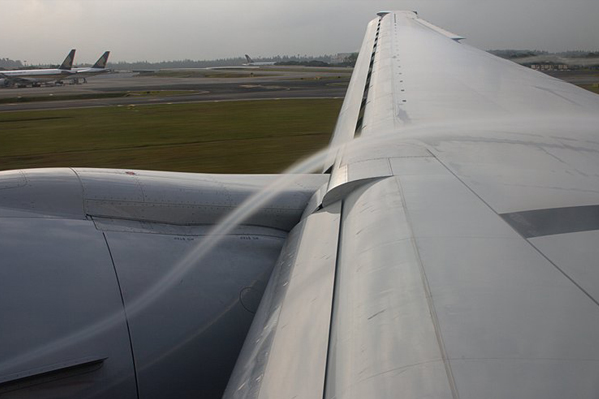
The air across the top of a conventional airfoil experiences constricted flow lines and increased air speed relative to the wing. This causes a decrease in pressure on the top according to the Bernoulli equation and provides a lift force. Aerodynamicists (see Eastlake) use the Bernoulli model to correlate with pressure measurements made in wind tunnels, and assert that when pressure measurements are made at multiple locations around the airfoil and summed, they do agree reasonably with the observed lift. 常规机翼上方的空气流线受到约束,相对于机翼的空气速度增加。根据伯努利方程,这会导致上方压力降低,并产生升力。气动学家(见Eastlake)使用伯努利模型与风洞中的压力测量结果相关联,并断言当在机翼周围多个位置进行压力测量并求和时,它们与观察到的升力大致相符。
![]() A vapor trail over the wing helps visualize the air flow. Photo by Frank Starmer, used by permission. 机翼上方的雾状痕迹有助于可视化气流。照片由Frank Starmer提供,经许可使用。
|
Index Bernoulli Equation References Eastlake ![]() NASA Aerodynamics 索引伯努利方程参考东lake NASA空气动力学 | |||||
|
Go Back
返回 |