Flame Colors as Chemical Indicators
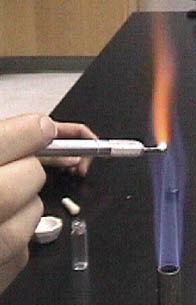 |
Though not as definitive as the spectral fingerprints from atomic spectra, the colors produced by chemicals when inserted into a flame can be used to identify some constituents of minerals. One procedure used was to put a small amount of the chemical on a small loop of platinum wire and place it into the open flame from a laboratory burner. 虽然不如原子光谱的特征光谱 definitive,但将化学物质放入火焰中产生的颜色可以用来识别矿物的一些成分。一种使用的方法是将少量化学物质放在一小段铂丝上,然后放入实验室燃烧器的开放火焰中。
Several types of wire were tried, but all produced prominent colors of their own. Platinum was the only one tried which would glow red hot without producing any appreciable plume of color in the flame. If the platinum wire were touched with your fingers, then you would get a colored plume, notably sodium presumed to come from our hands. After that burned off, just the bright tip of the wire loop was visible. 尝试了多种类型的导线,但所有导线本身都会产生明显的颜色。铂是唯一一种在不产生火焰中明显颜色的情况下能红热发光的导线。如果将铂导线触碰手指,就会产生一种颜色,明显是来自我们手上的钠。燃烧过后,只可见导线环的明亮尖端。
|
 |
 SrCl₂ |
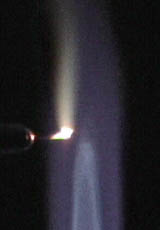 |
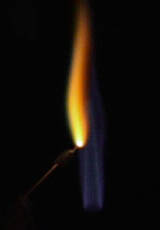
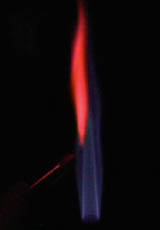
Sodium chloride at left gave the brightest light, much brighter than the blue flame of the burner. The color is visually the same as other sodium lights, coming mainly from the sodium d-lines. The brilliant red of strontium is the most dramatic of the flame colors. At right above is a sample of barium sulfate (barite) mineral, which gave only a small amount of light which was almost white.
 |
 |
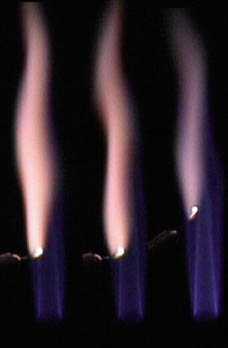 |
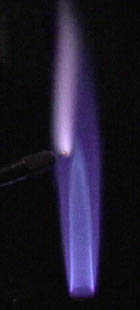
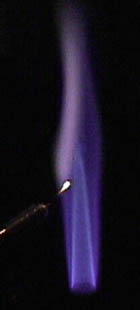
All of the above flames were obtained from a natural potassium chloride (sylvite) sample. The two at left are more like the classical textbook colors for potassium. But the variety of colors at right makes it clear why the students argue over whether the color is pink or violet. The flames at right are much brighter, as you can see by comparing their brightness to that of the flame from the burner. It may be that there is some contaminant in those at right, like sodium?
 |
 |
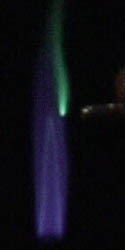 |
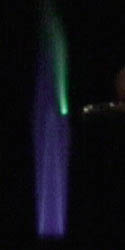
These are flame colors from azurite, a copper-containing mineral. It gave better copper color than malachite, to our surprise.
 |
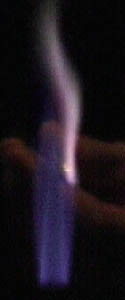 |
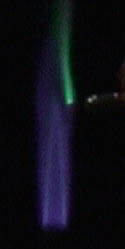
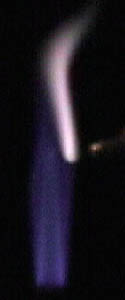
Potassium chloride in mineral form gave the distinctive potassium color.
| Flame colors from solutions
溶液的火焰颜色 |
| Flame colors by CO2 Transport
由CO₂传输引起的火焰颜色 |
Chemistry concepts
| HyperPhysics | R Nave |