Bilingual edition: English is preserved and Chinese follows each unit. Terminology uses the confirmed v20260916 glossary; automated semantic review remains traceable.
中英双语版:英文原文完整保留,中文紧随对应单元;术语采用 v20260916 确认表,自动语义审校结果可追溯。

LaPlace's and Poisson's Equations

拉普拉斯方程和泊松方程

A useful approach to the calculation of electric potentials is to relate that potential to the charge density which gives rise to it. The electric field is related to the charge density by the divergence relationship
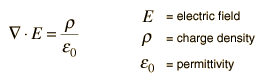
计算电势的一个有用方法是将其与产生它的电荷密度联系起来。电场与电荷密度之间通过散度关系相关联。

and the electric field is related to the electric potential by a gradient relationship

电场与电势之间存在梯度关系

Therefore the potential is related to the charge density by Poisson's equation
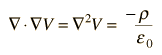
因此,电势与电荷密度之间由泊松方程相关联

In a charge-free region of space, this becomes LaPlace's equation

在空间无电荷的区域中,这变为拉普拉斯方程

This mathematical operation, the divergence of the gradient of a function, is called the LaPlacian. Expressing the LaPlacian in different coordinate systems to take advantage of the symmetry of a charge distribution helps in the solution for the electric potential V. For example, if the charge distribution has spherical symmetry, you use the LaPlacian in spherical polar coordinates.

这个数学运算,即一个函数梯度的散度,称为拉普拉斯算子。用不同坐标系表达拉普拉斯算子,以利用电荷分布的对称性,有助于求解电势V。例如,如果电荷分布具有球对称性,就使用球坐标系中的拉普拉斯算子。

Since the potential is a scalar function, this approach has advantages over trying to calculate the electric field directly. Once the potential has been calculated, the electric field can be computed by taking the gradient of the potential.

由于电势是一个标量函数,这种方法在直接计算电场时具有优势。一旦电势被计算出来,电场就可以通过取电势的梯度来计算。
Example: sphere of uniform charge
均匀带电的球体
Index

Electric field concepts
索引 电场概念
 
HyperPhysics***** Electricity and Magnetism
HyperPhysics ***** 电学和磁学
R Nave
Go Back
返回


Potential of a Uniform Sphere of Charge

均匀带电球体的电势

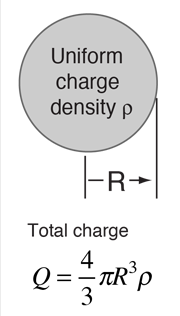
The use of Poisson's and Laplace's equations will be explored for a uniform sphere of charge. In spherical polar coordinates, Poisson's equation takes the form:

将探讨泊松方程和拉普拉斯方程在均匀带电球体中的应用。在球坐标中,泊松方程的形式为:

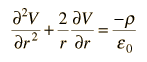
but since there is full spherical symmetry here, the derivatives with respect to θ and φ must be zero, leaving the form

但由于这里存在完全的球对称性,因此对θ和φ的导数必须为零,只剩下形式

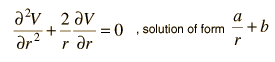
Examining first the region outside the sphere, Laplace's law applies.

先考察球体外的区域,拉普拉斯定律适用。

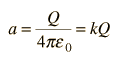
Since the zero of potential is arbitrary, it is reasonable to choose the zero of potential at infinity, the standard practice with localized charges. This gives the value b=0. Since the sphere of charge will look like a point charge at large distances, we may conclude that

由于零势点是任意的,因此合理地将零势点选在无穷远处,这是处理局部电荷的标准做法。这给出了b=0。由于远处的带电球体看起来像点电荷,我们可以得出结论:

so the solution to LaPlace's law outside the sphere is

因此,拉普拉斯定律在球体外的解是

Now examining the potential inside the sphere, the potential must have a term of order r2 to give a constant on the left side of the equation, so the solution is of the form

现在考察球体内部的势,为了使方程左边得到一个常数项,势必须包含一个与 r² 成正比的项,因此解的形式为

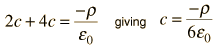
Substituting into Poisson's equation gives

将此代入泊松方程得

Now to meet the boundary conditions at the surface of the sphere, r=R

为满足球面表面的边界条件,r=R

The full solution for the potential inside the sphere from Poisson's equation is

从泊松方程求解球体内电势的完整解为
Index

Electric field concepts
索引 电场概念
 
HyperPhysics***** Electricity and Magnetism
HyperPhysics ***** 电学和磁学
R Nave
Go Back
返回