Fresnel Lens
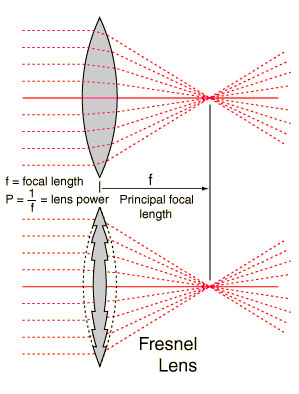 |
Faced with the need to construct a large lens for a lighthouse of appropriate focal length, but unable to support the large weight of a double convex lens of that size, French physicist Augustin Fresnel (1788-1827) reasoned that it was the surface curvature which gave the focusing power. He reproduced the surface curvature of the thick lens in sections, maintaining the same focal length with a fraction of the weight. The lens strength in diopters is defined as the inverse of the focal length in meters. 面对需要构造一个具有适当焦距的大型透镜,但无法支撑如此大尺寸的双凸透镜的重量,法国物理学家阿方斯·斐涅耳(1788-1827)认为是透镜的曲率表面赋予了聚焦能力。他将厚透镜的表面曲率在截面中再现,保持相同的焦距但仅用一小部分重量。以米为单位的焦距的倒数定义为透镜的度数。
Besides the glass Fresnel lenses you see in old lighthouses, large Fresnel lenses made from molded plastic are used for certain focusing tasks. The optical quality is not sufficient for good imaging because of the scattering you get at the junctions between the curved segments, resulting in rings of light in the image plane. 除了你能在旧灯塔中看到的玻璃弗雷斯nel透镜外,某些聚焦任务中也使用由模压塑料制成的大型弗雷斯nel透镜。由于曲面段之间的接缝处会产生散射,光学质量不足以实现良好的成像,导致像平面上出现光环。
|
The principal focal length of a lens is determined by the index of refraction of the glass, the radii of curvature of the surfaces, and the medium in which the lens resides. It can be calculated from the lens-maker's formula for thin lenses.
Lens concepts
| HyperPhysics***** Light and Vision
HyperPhysics ***** 光与视觉 | R Nave |