 |
Microscope Approximations显微镜近似
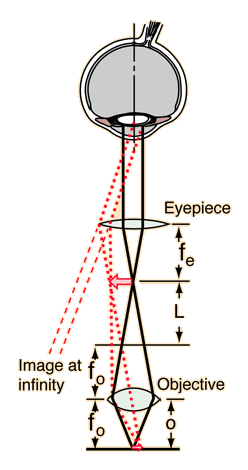
The commonly stated expressions for microscope magnification are based on the assumption is that the length of the tube L is large compared to either fo or fe so that the following relationships hold. 显微镜的常用放大率表达式基于一个假设,即物镜焦距f_o和目镜焦距f_e相比管长L都小很多,因此以下关系式成立。
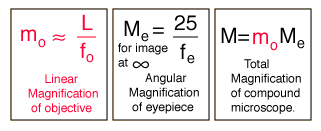 |
The tube length and the objective and eyepiece focal lengths may be changed. This calculation is the standard form which is usually quoted for microscopes, but it is an approximation which may not be a good one under certain circumstances. Obtaining precise magnifications for the assessment of the standard approximations requires application of the lens equation. Forcing the final image to be at infinity requires the real image formed by the objective to be at the focal length of the eyepiece. This means that the image distance for the objective is the tube length minus the eyepiece focal length. Under these constraints, the magnifications become:
|
Linear magnification of objective 物镜的线性放大率 m o =
中文译文中的待填/计算数值依次对应:1:mo2。实际数值以上方原输入框为准。 Angular magnification of eyepiece 目镜的角放大率 = M_e =
中文译文中的待填/计算数值依次对应:1:me2。实际数值以上方原输入框为准。 Total magnification 总放大率 = M = 中文译文中的待填/计算数值依次对应:1:mic2。实际数值以上方原输入框为准。 |
Precise magnifications for compound microscope image at infinity. 复合显微镜在无限远处的精确放大率
|
You can get more magnification from the microscope by adjusting the eyepiece to forming its virtual image closer to the user's eye. If you bring it in to the standard close-focus distance of 25 cm, then applying the lens equation to both objective and eyepiece images gives the following magnifications:
|
Linear magnification of objective 物镜的线性放大率 m o =
中文译文中的待填/计算数值依次对应:1:mo3。实际数值以上方原输入框为准。 Angular magnification of eyepiece 目镜的角放大率 = M_e =
中文译文中的待填/计算数值依次对应:1:me3。实际数值以上方原输入框为准。 Total magnification 总放大率 = M =
中文译文中的待填/计算数值依次对应:1:mic3。实际数值以上方原输入框为准。 |
Precise magnifications for compound microscope image at 25 cm. 复合显微镜在25厘米处的精确放大率。
|
You can get more magnification from the microscope by focusing it so that the virtual image is at 25 cm rather than infinity, but it is not a good idea because it puts the eye of the viewer under strain to accommodate the eye to that close distance. The relaxed eye is focused at infinity, so if you are going to use a microscope all day, you had better focus it at infinity. Focusing the image close to the eye just because the image is slightly larger is the common mistake made by newcomers in the biology lab, which results in a very fatigued eye after an hour of viewing.
Lens concepts
Optical instruments
| HyperPhysics***** Light and Vision
HyperPhysics ***** 光与视觉 | R Nave |