Bilingual edition: English is preserved and Chinese follows each unit. Terminology uses the confirmed v20260916 glossary; automated semantic review remains traceable.
中英双语版:英文原文完整保留,中文紧随对应单元;术语采用 v20260916 确认表,自动语义审校结果可追溯。

Stops

停止

The limiting effect on the imaging process by the size of the unobstructed clear diameter in an optical system depends upon the location of that "stop", or limiting diameter. The limiting diameter which determines the amount of light which reaches the imaging area is called the aperture stop, typified by the adjustable diaphragm near the front of a compound camera lens. The limiting diameter which controls the size object which can be imaged is called the field stop.

光学系统中,由未被遮挡的清晰直径大小对成像过程的限制作用,取决于该‘孔径’或限制直径的位置。决定到达成像区域的光量的限制直径称为孔径光阑,通常由照相机镜头前端的可调光圈片来体现。而控制可成像物体大小的限制直径称为视场光阑。

Adjustable stops are commonly created from thin metallic leaf structures to determine the amount of light which reaches a film or CCD detector. Shown at left is a laboratory stop which determines the amount of light that reaches an adjustable slit for diffraction studies. It was used to produce the single slit diffraction patterns shown to demonstrate the diffraction phenomenon. Such structures are also used in cameras to set the f-stops for exposure adjustment.

可调节的遮光片通常由薄金属片结构制成,用于确定到达胶片或CCD探测器的光量。图中左侧展示的是一个实验室遮光片,用于确定到达可调节狭缝的光量,用于衍射研究。它被用来产生单缝衍射图样,以展示衍射现象。此类结构也用于相机中,用于设置光圈值以进行曝光调整。
Index

Stops and Pupils

Camera concepts

Optical instruments
索引、光圈和视差摄影概念光学仪器
 
HyperPhysics***** Light and Vision
HyperPhysics ***** 光与视觉
R Nave
Go Back
返回


Apertures and f-stops

孔径和光圈值

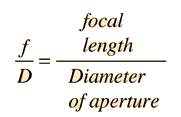
An adjustable metallic leaf structure is typically used behind the first few elements of a compound camera lens to control the amount of light which reaches the film or CCD detector. It is common practices to denote the size of the opening in this aperture stop in terms of the "f-stop" or "f-number". The f-stop is defined by

一种可调节的金属叶片结构通常用在复合相机镜头前几个元件之后,用于控制到达底片或CCD探测器的光量。通常习惯用“光圈值”或“f数”来表示这个光圈孔径的大小。光圈值由

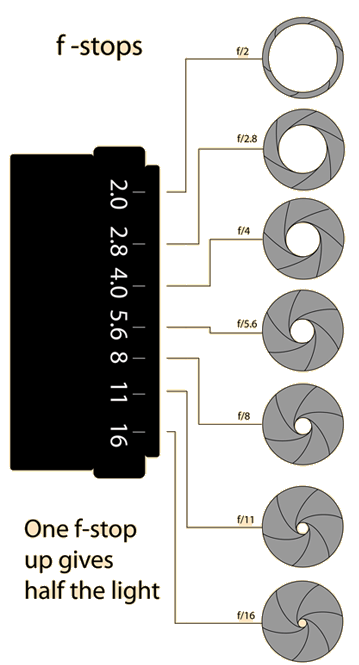
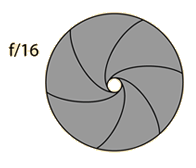
It is evident from this relationship that a higher f-number implies a smaller diameter stop for a given focal-length lens. Since a circular stop has area A = πr2, doubling the aperture diameter and therefore halving the f-number will admit four times as much light into the system. The usual practice is to designate a stop whose diameter D is half the focal length f as f/2. The illustration shows that f/4 at left has half the diameter of f/2, and therefore admits 1/4 as much light. For cameras, you have set "stops" that progress so that "1 stop" wider will admit twice as much light, and that requires a diameter increase by a factor of 1.414 or the square root of 2. That gives the typical number sequence seen on camera lenses:

f/2 2.8 4 5.6 8 11 16
从这种关系可以看出,对于给定的焦距镜头,较高的f数意味着较小的光圈直径。由于圆形光圈的面积A = πr²,因此将光圈直径加倍,从而将f数减半,将会使进入系统的光量增加四倍。通常的做法是将直径D等于焦距f一半的光圈称为f/2。图中显示,左图的f/4光圈直径是f/2的一半,因此允许的光量仅为1/4。对于相机来说,你有设置“光圈”使得“1档”更宽的光圈会允许两倍的光量,这需要光圈直径增加一个因子为1.414(即√2)。这给出了相机镜头上通常看到的典型光圈序列:f/2 2.8 4 5.6 8 11 16

Increasing the f-number of a camera lens decreases the amount of light entering a camera by decreasing the aperture size. Increasing by one f-stop halves the light and therefore requires double the exposure time (half the shutter speed). Increasing the f-number has the benefit of increasing the "depth of field" of the image, so photographers must continually judge the proper balance between shutter speed and f-number to minimize motion-blur for the image while achieving acceptable depth of field.

增大相机镜头的f值会减少进入相机的光量,这是通过减小光圈孔径实现的。增大一档f-stop会使光量减半,因此需要双倍的曝光时间(半速的快门速度)。增大f值的好处是增加图像的景深,因此摄影师必须不断判断快门速度和f值之间的适当平衡,以在获得可接受的景深的同时最小化运动模糊。

Since the opening up of the aperture by one f-stop or increasing the exposure time by a factor of two would both double the light collection, it is common practice to refer to both of these as increasing the exposure by 1 "stop".

由于开孔量增加一个光圈或曝光时间增加一倍,都会使光的收集量加倍,因此通常将这两种情况都称为曝光增加1 'stop'。
Index

Stops and Pupils

Camera concepts

Optical instruments
索引、光圈和视差摄影概念光学仪器
 
HyperPhysics***** Light and Vision
HyperPhysics ***** 光与视觉
R Nave
Go Back
返回


f-stops and Depth of Field

f-stops 和 焦深

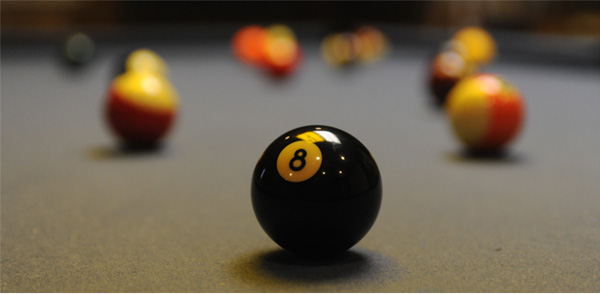
Increasing the f-stop by one stop has the disadvantage of requiring you to slow down the shutter speed to one-half, but has the advantage of increasing the depth of field of the formed image. By "depth of field" we practically mean the depth of the image where it appears to be sharply focused. While "sharpness of focus" is a relative term, there is a practical depth over which the image appears to be in focus. That depth of field increases with f-number.

提高一档光圈值的缺点是需要将快门速度减慢到一半,但其优点是能增加成像的景深。所谓‘景深’实际上是指图像中看起来清晰的区域深度。虽然‘清晰度’是一个相对术语,但存在一个实际的景深范围,其中图像看起来是清晰的。这个景深随着光圈数的增加而增大。

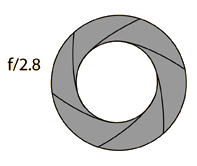
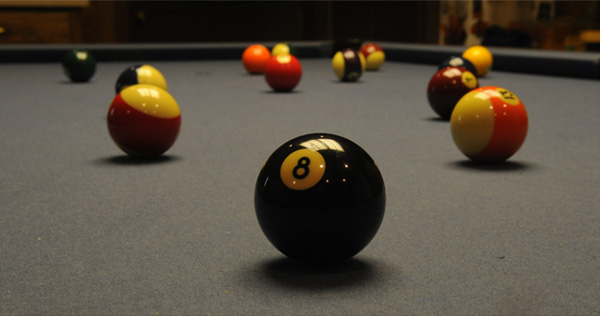
f/2.8
At f/2.8 you can shoot at a faster shutter speed, but with very shallow depth of field. There are times when you would deliberately choose this condition, for example to shoot a picture of a rose where the leaves behind it soften progressively in focus.
在f/2.8光圈下,你可以使用更快的快门速度,但景深非常浅。有时你会有意选择这种条件,例如拍摄一朵玫瑰,其背后的叶子逐渐失去清晰度。

f/16
At f/16 you get much greater depth of field, but it is five stops up in f-number, each of which costs you a factor of two in light. So the shutter speed has to be 25 = 32 times longer for this view. The practical depth of field diminishes with increasing focal length, so that long telephoto shots tend to have shallow depth of field. It is good to use as high an f-number as practicable for telephoto shots to increase that depth of field.
在f/16时,可以获得更大的景深,但f数值增加了五个档位,每档会损失一半的光线。因此,为了获得这个视角,快门速度必须延长32倍。景深随着焦距的增加而减小,所以长焦镜头往往具有较浅的景深。对于长焦镜头,尽可能使用较高的f数值以增加景深是明智的。

Close-up photography is quite demanding in terms of depth of field. The objects of interest (e.g., flowers, butterflies) have greater depth compared the distance to the object than most more distant objects. It is therefore desirable to use high f-numbers for closeup photography.

特写摄影在景深方面要求较高。感兴趣的物体(例如花朵、蝴蝶)与物体的距离相比,其深度更大。因此,特写摄影应使用较高的f值。

There is a limit to how high you can make the effective f-number. If the aperture becomes too small, then aperture diffraction will begin to affect the image sharpness. Particularly with small CCD detectors, one has to experiment to find out the optimum f-number for sharpness. For too high an f-number, the resolution may be diffraction limited.

有效光圈数有一个上限。如果光圈变得过小,光圈衍射将开始影响图像的清晰度。特别是对于小尺寸的CCD探测器,必须通过实验来确定获得最佳清晰度的光圈数。对于过高的光圈数,分辨率可能会受到衍射的限制。
Index

Stops and Pupils

Camera concepts

Optical instruments
索引、光圈和视差摄影概念光学仪器
 
HyperPhysics***** Light and Vision
HyperPhysics ***** 光与视觉
R Nave
Go Back
返回


Aperture Stops

孔径停止

An aperture stop is the opening which limits the amount of light which passes through an optical system. For example, the adjustable diaphragm near the front of a compound camera lens is the aperture stop for the lens. The amount of light admitted is controlled by the diameter of the diaphragm opening which is indicated on the camera by the "f number" or "f-stop number". Making the aperture smaller reduces the light, but increases the depth of focus.

孔径光阑是限制通过光学系统光量的开口。例如,复式相机镜头前端的可调节光圈就是该镜头的光阑。通过光圈的光量由光圈开口的直径控制,该直径在相机上用'f 数'或'光圈数'表示。使光圈变小会减少光量,但会增加景深。

Adjustable stops are commonly created from thin metallic leaf structures to determine the amount of light which reaches a film, CCD detector, or whatever plays the role of the final image plane.

可调节的止挡通常由薄金属片结构制成,以确定到达胶片、CCD探测器或 whatever 扮演最终像平面的物体的光量。
Index

Stops and Pupils

Camera concepts

Optical instruments
索引、光圈和视差摄影概念光学仪器
 
HyperPhysics***** Light and Vision
HyperPhysics ***** 光与视觉
R Nave
Go Back
返回


Field Stops

场止

The element that limits the size or angular breadth of an object that can be imaged by the system is called the field stop. For cameras, the size of the film or CCD detector determines the maximum image size and serves as the field stop.

限制系统所能成像物体大小或角视场的元件称为光阑。对于相机来说,胶片或CCD探测器的尺寸决定了最大图像尺寸,并充当光阑。
Index

Stops and Pupils

Camera concepts

Optical instruments

Reference

Hecht, 2nd Ed.
Ch 5
索引、光圈和视差 摄像概念 光学仪器 参考 Hecht,第二版 第五章
 
HyperPhysics***** Light and Vision
HyperPhysics ***** 光与视觉
R Nave
Go Back
返回


Pupils

瞳孔

The idea of a pupil is that the effective size of a stop may be larger or smaller than its physical size because of the refractive action of a lens. Formally, a pupil is an image of the aperture stop. The entrance pupil is defined as the image of the aperture stop as seen from an axial point on the object through those elements of the lens which precede the stop. The exit pupil is the image of the aperture stop as seen from an axial point in the image plane. This discussion follows the treatment in Hecht.

透镜的概念是,由于透镜的折射作用,光圈停止的有效尺寸可能比其实际尺寸大或小。正式来说,瞳孔是光圈停止的像。入瞳是作为从物体轴向点通过光圈停止前的透镜元件所看到的光圈停止的像。出瞳是作为从像平面轴向点所看到的光圈停止的像。本讨论遵循Hecht的论述。
Index

Stops and Pupils

Camera concepts

Optical instruments

Reference

Hecht, 2nd Ed.
Ch 5
索引、光圈和视差 摄像概念 光学仪器 参考 Hecht,第二版 第五章
 
HyperPhysics***** Light and Vision
HyperPhysics ***** 光与视觉
R Nave
Go Back
返回


Entrance Pupil

入射孔

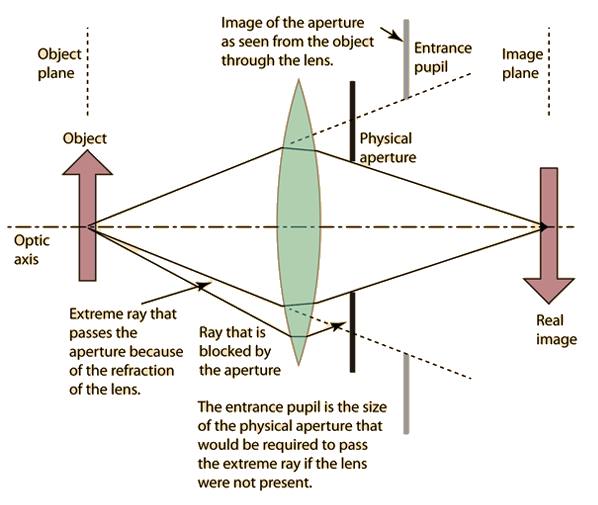
The entrance pupil of a system is the image of the aperture stop as seen from a point on the optic axis in the object plane.

系统的入射孔径是作为从物面光轴上一点看到的孔径光阑的像。

In the illustration, the physical aperture is behind the lens. You can see that more light will get through the physical aperture behind the lens than would have if the lens were not present. The extreme ray is one that is refracted by the lens so that it just passes through the aperture. Tracing the projected path of that extreme ray without the lens, you can see that the entrance pupil is the size aperture that would be required to pass that extreme ray in the absence of the lens.

在示意图中,物理孔径位于透镜之后。你可以看到,如果透镜不存在的话,更多的光会通过透镜后面的物理孔径。极端光线是指被透镜折射后刚好通过孔径的光线。追踪该极端光线在没有透镜时的投影路径,你可以看到入射孔径是不需要透镜时所需通过该极端光线的孔径大小。

In this example, the physical aperture is the exit pupil because there is no intervening lens between the image and the aperture.

在这个例子中,物理孔径是出瞳,因为图像和孔径之间没有透镜。

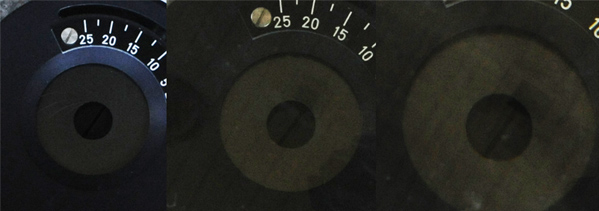
The images of the same laboratory aperture above were taken from the same object point. The image on the left is of the aperture directly, the middle image is through a single lens, and the right image was taken through a two-lens system. This shows a case where the same aperture can have three different sized pupils.

上面同一实验室孔径的图像均来自同一物点。左边的图像直接显示孔径,中间的图像通过一个透镜获取,右边的图像则通过两个透镜系统获得。这展示了同一孔径可以有三种不同大小的瞳孔。
Index

Stops and Pupils

Camera concepts

Optical instruments

Reference

Hecht, 2nd Ed.
Ch 5
索引、光圈和视差 摄像概念 光学仪器 参考 Hecht,第二版 第五章
 
HyperPhysics***** Light and Vision
HyperPhysics ***** 光与视觉
R Nave
Go Back
返回


Exit Pupil

出瞳

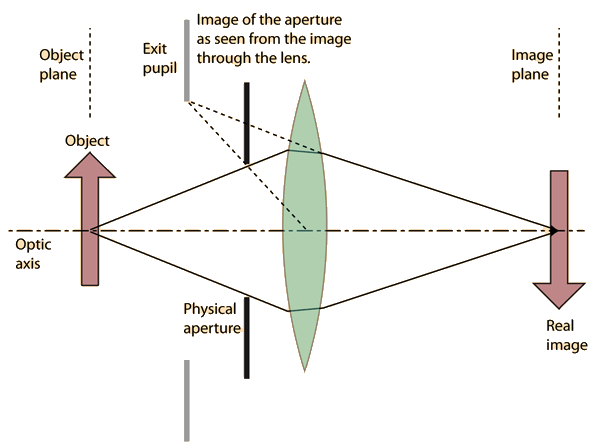
The exit pupil of a system is the image of the aperture stop as seen from a point on the optic axis in the image plane.

系统的出瞳是作为光阑止光孔在像平面内光轴上一点所成的像。

In this case where the physical aperture stop is in front of the lens, the exit pupil is the image of that aperture stop as seen from the optic axis in the image plane, looking back through the lens. In this case the entrance pupil is just the physical aperture since there is no lens intervening from the standpoint of the object.

在这种情况下,当物理孔径光阑位于透镜前方时,出瞳是作为从光轴在像面上观察到的该孔径光阑的像,即通过透镜向后看时所见的像。在这种情况下,入瞳就是物理孔径,因为从物体角度来看,没有透镜位于其与孔径之间。
Index

Stops and Pupils

Camera concepts

Optical instruments

Reference

Hecht, 2nd Ed.
Ch 5
索引、光圈和视差 摄像概念 光学仪器 参考 Hecht,第二版 第五章
 
HyperPhysics***** Light and Vision
HyperPhysics ***** 光与视觉
R Nave
Go Back
返回