Diffraction-Limited Imaging
If an image is made through a small aperture, there is a point at which the resolution of the image is limited by the aperture diffraction. As a matter of general practice in photographic optics, the use of a smaller aperture (larger f-number) will give greater depth of field and a generally sharper image. But if the aperture is made too small, the effects of the diffraction will be large enough to begin to reduce that sharpness, and you have reached the point of diffraction-limited imaging.
If you are imaging two points of light, then the smallest separation at which you could discern that there are two could reasonably be used as the limit of resolution of the imaging process. Presuming that diffraction is the determining factor, then the generally accepted criterion for the minimum resolvable detail is the Rayleigh criterion.
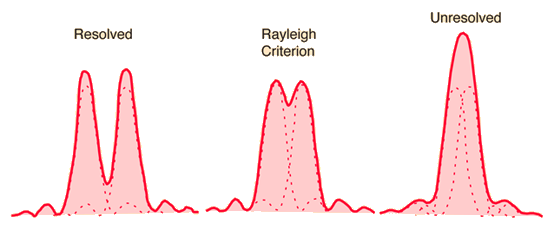
This shows the intensity curves for the radial distribution of the diffracted light for different separations. Your eye sees the characteristic bullseye distribution of light as illustrated below.
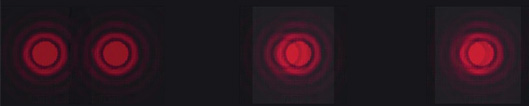
While perfect imaging of the source would be smaller perfect circles of light, this shows the smearing of the light by diffraction into the bullseye patterns.
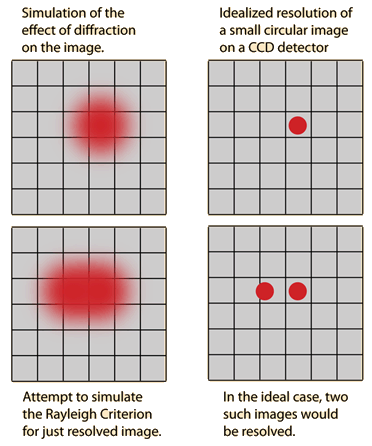 | For modern digital photography where the images are projected onto a CCD, the information is collected on pixels of the digital detector. At left is an attempt to show the effect of diffraction on such imaging in cases where the diffraction is the phenomenon that limits the resolution. If the image is in focus and free of visible affects of lens aberrations, then it may be that it will fit on one pixel. But if the aperture is small enough, then diffraction can spread the image onto neighboring pixels and constitute the limit on the resolution of the image. 在现代数码摄影中,图像被投射到CCD上,信息由数字探测器的像素收集。左图试图展示在衍射是限制分辨率现象的情况下,这种成像的衍射效应。如果图像清晰且没有可见的镜头像差,则可能刚好能落在一个像素上。但如果孔径足够小,衍射会使图像扩散到相邻像素,从而成为图像分辨率的限制因素。 |
References:
The Cambridge in Colour site has calculations and demonstrations of diffraction spreading at different f-numbers.
| HyperPhysics***** Light and Vision
HyperPhysics ***** 光与视觉 | R Nave |