Circular Aperture Diffraction
圆孔衍射
 |

|
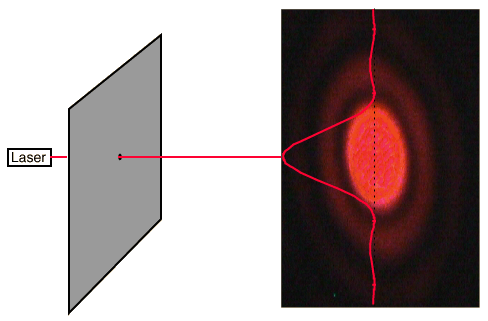
When light from a point source passes through a small circular aperture, it does not produce a bright dot as an image, but rather a diffuse circular disc known as Airy's disc surrounded by much fainter concentric circular rings. This example of diffraction is of great importance because the eye and many optical instruments have circular apertures. If this smearing of the image of the point source is larger that that produced by the aberrations of the system, the imaging process is said to be diffraction-limited, and that is the best that can be done with that size aperture. This limitation on the resolution of images is quantified in terms of the Rayleigh criterion so that the limiting resolution of a system can be calculated.
当来自点光源的光通过一个小的圆形孔径时,它不会产生一个明亮的点作为图像,而是产生一个模糊的圆形盘,称为阿贝-图斯盘(Airy's disc),周围有许多更暗的同心圆环。这个衍射的例子非常重要,因为眼睛和许多光学仪器都有圆形孔径。如果这种点光源图像的模糊程度大于系统本身的像差所引起的模糊程度,那么成像过程被称为衍射受限(diffraction-limited),这是在该孔径大小下所能达到的最好效果。这种对图像分辨率的限制可以通过瑞利判据(Rayleigh criterion)来量化,从而可以计算系统的极限分辨率。 |
孔径衍射的数学描述 |
从雾蒙的眼镜产生的电晕 |
Diffraction concepts
Fraunhofer diffraction
索引衍射概念 夫琅禾费衍射
| HyperPhysics***** Light and Vision
HyperPhysics ***** 光与视觉 | R Nave |
返回