Bowen's Reaction Series
In the early part of the 20th century, N. L. Bowen carried out experiments to characterize the process of crystallization of igneous rocks from magma. The illustration below is patterned after Lutgens and Tarbuck's perspective of that reaction series.

The difference in crystallization temperature for the different kinds of minerals plays a major role in the differentiation of rock composition as the magma cools.
Another instructive illustration of the Bowen Reaction Series can be found in Chapter 4 of Marshak's Essentials of Geology. The illustration below is patterned after his version. Marshak describes the original experiments of Norman L. Bowen in the 1920s when he heated powdered mafic igneous rock to 1,280°C to melt it. By sequential quenching by sudden cooling, he could identify the temperatures at which different types of minerals would crystalize from the melt. In the temperature range 650°C to 850°C only about 10% of the sample remained melted, and it had a high silica content. At the final stage of crystallization, the felsic materials quartz, K-feldspar and muscovite were formed.
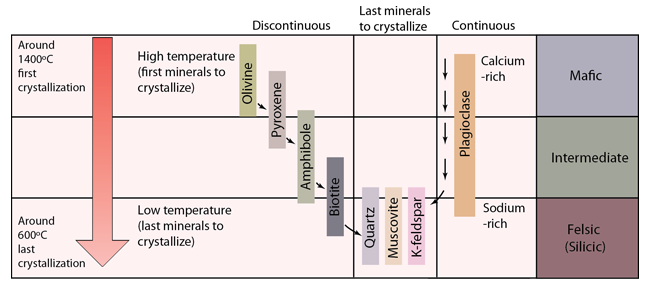
Note that the range of crystallization temperatures in these illustrations is characteristic of the environment of rock that contains these minerals, as in magma beneath the Earth's surface. The melting temperatures of pure minerals may be quite different. For example, in the Bowen reaction series, quartz is crystallizing around 650°C, but pure quartz at one atmosphere pressure does not melt until about 1700°C. (See Quartz Wiki, 1670°C for β-tridymite and 1713°C for β-cristobalite)
Igneous rock concepts
Reference
Lutgens & Tarbuck
Marshak
Sec 4.4
| HyperPhysics***** Geophysics
HyperPhysics ***** 地球物理学 | R Nave |