Bilingual edition: English is preserved and Chinese follows each unit. Terminology uses the confirmed v20260916 glossary; automated semantic review remains traceable.
中英双语版:英文原文完整保留,中文紧随对应单元;术语采用 v20260916 确认表,自动语义审校结果可追溯。

Hall Effect

霍尔效应

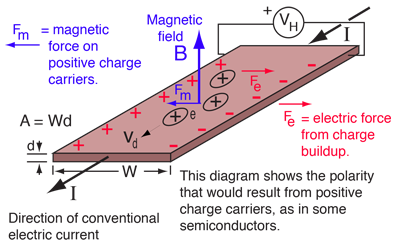
If an electric current flows through a conductor in a magnetic field, the magnetic field exerts a transverse force on the moving charge carriers which tends to push them to one side of the conductor. This is most evident in a thin flat conductor as illustrated. A buildup of charge at the sides of the conductors will balance this magnetic influence, producing a measurable voltage between the two sides of the conductor. The presence of this measurable transverse voltage is called the Hall effect after E. H. Hall who discovered it in 1879.

当电流通过导体中的磁场时,磁场会对运动的电荷载体施加一个横向的力,使它们倾向于被推到导体的一侧。这种现象在薄而扁的导体中尤为明显,如图所示。导体两侧的电荷积累会平衡这种磁力影响,产生可测量的电压,存在于导体的两侧之间。这种可测量的横向电压的存在称为霍尔效应,以E. H. Hall命名,他于1879年发现了这一现象。

Note that the direction of the current I in the diagram is that of conventional current, so that the motion of electrons is in the opposite direction. That further confuses all the "right-hand rule" manipulations you have to go through to get the direction of the forces.
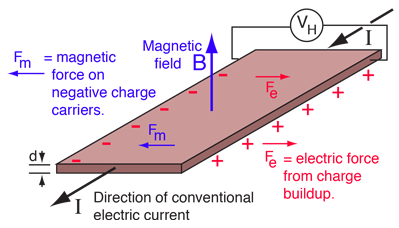
需要注意的是,图中电流 I 的方向是 conventional current 的方向,因此电子的运动方向与之相反。这进一步使你不得不经过一系列的‘右手定则’操作来确定力的方向。

The Hall voltage is given by

Hall电压由
VH = IB/ned
V H = IB/ned(专名或术语)
Show
显示

where n = density of mobile charges and e = electron charge.

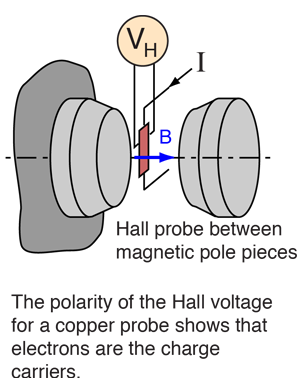
The Hall effect can be used to measure magnetic fields with a Hall probe.

霍尔效应可以用来测量磁场,使用霍尔探头。
其中,n 为自由电荷的密度,e 为电子电荷。
Hall probe for magnetic field measurement
霍尔探头用于磁场测量
Index

Magnetic force applications

Magnetic field concepts
索引 磁力应用 磁场概念
 
HyperPhysics***** Electricity and Magnetism
HyperPhysics ***** 电学和磁学
R Nave
Go Back
返回


Hall Voltage for Positive Charge Carriers

正电荷载流子的霍尔电压

The transverse voltage (Hall effect) measured in a Hall probe has its origin in the magnetic force on a moving charge carrier.

霍尔探头测量的横向电压(霍尔效应)源于磁力对运动的载流子的作用。

The magnetic force is Fm = evdB where vd is the drift velocity of the charge.

磁力是 F_m = e v_d B,其中 v_d 是电荷的漂移速度。

The current expressed in terms of the drift velocity is

以漂移速度表示的电流是
I = neAvd
I = neAv d(专名或术语)
Show
显示

where n is the density of charge carriers. Then

其中n是载流子的密度。然后
Fm = eIB/neA
F_m = eIB/neA

At equilibrium

处于平衡状态
Fm =Fe=VHe/W
Show
显示

And substituting gives

代入后得到
VH = IB/ned
V H = IB/ned(专名或术语)
Index

Electromagnetic force

Magnetic force

Magnetic field concepts
索引 电磁力 磁力 磁场概念
 
HyperPhysics***** Electricity and Magnetism
HyperPhysics ***** 电学和磁学
R Nave
Go Back
返回


Hall Probe

霍尔探针

The measurement of large magnetic fields on the order of a Tesla is often done by making use of the Hall effect. A thin film Hall probe is placed in the magnetic field and the transverse voltage (on the order of microvolts) is measured.

测量约特斯拉量级的强磁场通常利用霍尔效应实现。将薄膜霍尔探头置于磁场中,测量横向电压(约微伏)。

Sometimes a thin copper film of thickness d on the order of 100 micrometers is used for a Hall probe. Taking the charge carrier density to be

有时会使用厚度约为100微米的薄铜膜作为霍尔探头。将载流子密度取为
n=8.47x1028 electrons/m3
n=8.47×10²⁸ 电子/立方米
Show
显示
For I = amperes
magnetic field B = Tesla
and d = x10^ meters.
The Hall voltage is
VH = IB/ned =
x10^ volts.
x10^伏特。
中文译文中的待填/计算数值依次对应:1:vb 2:vp。实际数值以上方原输入框为准。
对于 I = 安培,磁场 B = 特斯拉,d = 10^x 米。霍尔电压是 V_H = IB/(ned)。
中文译文中的待填/计算数值依次对应:1:i 2:b 3:db 4:dp。实际数值以上方原输入框为准。
Index

Electromagnetic force

Magnetic force

Magnetic field concepts
索引 电磁力 磁力 磁场概念
 
HyperPhysics***** Electricity and Magnetism
HyperPhysics ***** 电学和磁学
R Nave
Go Back
返回


Charge Carriers in the Hall Effect

霍尔效应中的电荷载流子

The Hall effect is a conduction phenomenon which is different for different charge carriers. In most common electrical applications, the conventional current is used partly because it makes no difference whether you consider positive or negative charge to be moving. But the Hall voltage has a different polarity for positive and negative charge carriers, and it has been used to study the details of conduction in semiconductors and other materials which show a combination of negative and positive charge carriers.

霍尔效应是一种传导现象,其特性因不同的电荷载体而异。在大多数常见的电气应用中,通常使用 conventional current,部分原因在于无论考虑正电荷还是负电荷移动,其效果并无区别。但霍尔电压的极性却因正电荷和负电荷载体而不同,并已被用于研究半导体及其他表现出正负电荷载体组合的材料的传导细节。

The Hall effect can be used to measure the average drift velocity of the charge carriers by mechanically moving the Hall probe at different speeds until the Hall voltage disappears, showing that the charge carriers are now not moving with respect to the magnetic field. Other types of investigations of carrier behavior are studied in the quantum Hall effect.

霍尔效应可以用来通过以不同速度机械移动霍尔探头,直到霍尔电压消失,从而测量载流子的平均漂移速度,这表明载流子现在相对于磁场不再运动。其他类型的载流子行为研究则在量子霍尔效应中进行。
Index

Electromagnetic force

Magnetic force

Magnetic field concepts
索引 电磁力 磁力 磁场概念
 
HyperPhysics***** Electricity and Magnetism
HyperPhysics ***** 电学和磁学
R Nave
Go Back
返回