Electric Charge
电荷
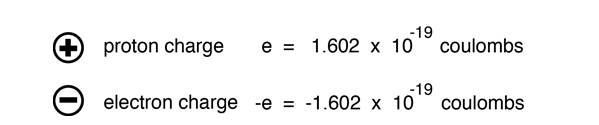
The unit of electric charge is the Coulomb (abbreviated C). Ordinary matter is made up of atoms which have positively charged nuclei and negatively charged electrons surrounding them. Charge is quantized as a multiple of the electron or proton charge:
The influence of charges is characterized in terms of the forces between them (Coulomb's law) and the electric field and voltage produced by them. One Coulomb of charge is the charge which would flow through a 120 watt lightbulb (120 volts AC) in one second. Two charges of one Coulomb
each separated by a meter would repel each other with a force of about a million tons!
电荷的单位是库仑(符号为C)。普通物质由原子组成,原子核带正电,周围环绕着带负电的电子。电荷是量子化的,是电子或质子电荷的整数倍:电荷之间的相互作用通过它们之间的力(库仑定律)以及它们产生的电场和电压来表征。一库仑的电荷是通过120瓦灯泡(120伏交流电)在一秒内流动的电荷量。两个各为一库仑的电荷相距一米时,它们之间的排斥力大约是一百万吨!
The rate of flow of electric charge is called electric current and is measured in Amperes.
In introducing one of the fundamental properties of matter, it is perhaps appropriate to point out that we use simplified sketches and constructs to introduce
concepts, and there is inevitably much more to the story. No significance
should be attached to the circles representing the proton and electron, in
the sense
of implying a relative size, or even that they are hard sphere
objects,
although that's a useful first construct. The most important
opening idea,
electrically, is that they have a property called "charge" which is
the same
size, but opposite in polarity for the proton and electron. The
proton has
1836 times the mass of the electron, but exactly the same size
charge, only
positive rather than negative. Even the terms "positive" and
"negative" are
arbitrary, but well-entrenched historical labels. The essential
implication
of that is that the proton and electron will strongly attract each
other, the historical archtype of the cliche "opposites attract".
Two
protons or two electrons would strongly repel each other. Once you
have
established those basic ideas about electricity, "like charges
repel and
unlike charges attract", then you have the foundation for
electricity and can build from there.
在介绍物质的一个基本性质时,或许适当指出,我们使用简化的示意图和模型来引入概念,实际上背后还有许多内容。不应将代表质子和电子的圆圈赋予任何意义,比如暗示它们的相对大小,或者认为它们是刚性球体,尽管这在最初是一个有用的模型。从电学角度看,最重要的初始概念是它们具有一个称为“电荷”的性质,大小相同,但极性相反:质子的电荷是正的,电子的电荷是负的。质子的质量是电子的1836倍,但它们的电荷大小完全相同,只是极性不同。即使“正”和“负”这样的术语也是任意的,但已被历史所沿用。这个基本含义是,质子和电子会相互强烈吸引,这正是俗语“相反相吸”的历史原型。两个质子或两个电子则会相互强烈排斥。一旦你确立了关于电学的基本观念——“同性电荷相斥,异性电荷相吸”,你就为电学奠定了基础,可以由此进一步深入。
From the precise electrical neutrality of bulk matter as well as from detailed microscopic experiments, we know that the proton and electron have the same magnitude of charge. All charges observed in nature are multiples of these fundamental charges. Although the standard model of the proton depicts it as being made up of fractionally charged particles called quarks, those fractional charges are not observed in isolation -- always in combinations which produce +/- the electron charge.
从宏观物质的精确电中性以及详细的微观实验中,我们知道质子和电子的电荷量大小相等。自然界中观察到的所有电荷都是这些基本电荷的倍数。尽管标准模型将质子描述为由称为夸克的分数电荷粒子组成,但这些分数电荷 never 被单独观察到——总是以组合的形式出现,产生±电子电荷。
An isolated single charge can be called an "electric monopole". Equal positive and negative charges placed close to each other constitute an electric dipole. Two oppositely directed dipoles close to each other are called an electric quadrupole. You can continue this process to any number of poles, but dipoles and quadrupoles are mentioned here because they find significant application in physical phenomena.
孤立的单个电荷可以称为“电单极”。相等的正负电荷相互靠近时构成一个电偶极子。两个方向相反的偶极子相互靠近时称为电四极子。你可以继续这个过程得到任意数量的极,但这里提到偶极子和四极子是因为它们在物理现象中具有重要意义。
One of the fundamental symmetries of nature is the conservation of electric charge. No known physical process produces a net change in electric charge.
自然界的基本对称性之一是电荷的守恒。目前尚未发现任何物理过程能够产生净的电荷变化。
电荷流动的速率称为电流,单位是安培。 |