Larmor Precession
 |
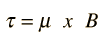
When a magnetic moment μ is placed in a magnetic field B, it experiences a torque which can be expressed in the form of a vector product 当磁矩μ置于磁场B中时,会受到一个可以表示为向量积的力矩。
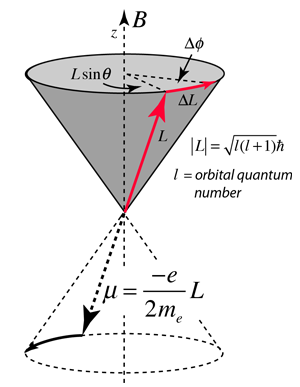
 For a static magnetic moment or a classical current loop, this torque tends to line up the magnetic moment with the magnetic field B, so this represents its lowest energy configuration. But if the magnetic moment arises from the motion of an electron in orbit around a nucleus, the magnetic moment is proportional to the angular momentum of the electron. The torque exerted then produces a change in angular momentum which is perpendicular to that angular momentum, causing the magnetic moment to precess around the direction of the magnetic field rather than settle down in the direction of the magnetic field. This is called Larmor precession. 对于静态的磁矩或经典电流环,这种力矩会使磁矩与磁场B对齐,因此这代表了其最低能量配置。但如果磁矩来源于电子绕核运动,那么磁矩与电子的角动量成正比。此时施加的力矩会使角动量发生变化,该变化量垂直于角动量,导致磁矩绕磁场方向进行进动,而不是最终稳定在磁场方向上。这种现象称为Larmor进动。
|
When a torque is exerted perpendicular to the angular momentum L, it produces a change in angular momentum ΔL which is perpendicular to L, causing it to precess about the z axis. Labeling the precession angle as φ, we can describe the effect of the torque as follows:

The precession angular velocity (Larmor frequency) is

These relationships for a finite current loop extend to the magnetic dipoles of electron orbits and to the intrinsic magnetic moment associated with electron spin. There is also a characteristic Larmor frequency for nuclear spins.
In the case of the electron spin precession, the angular frequency associated with the spin transition is usually written in the general form

where γ is called the gyromagetic ratio (sometimes the magnetogyric ratio) and g is the electron spin g-factor. This angular frequency is associated with the "spin flip" or spin transition, involving an energy change of 2μB. An example for magnetic field 1 Tesla follows.

The characteristic frequencies associated with electron spin are employed in electron spin resonance (ESR) experiments, and those associated with the nuclear spin in nuclear magnetic resonance (NMR) experiments.
Magnetic force applications
Magnetic field concepts
Reference
Rohlf, Sec 8-4
Larmor precession wiki
| HyperPhysics***** Electricity and Magnetism
HyperPhysics ***** 电学和磁学 | R Nave |