Bilingual edition: English is preserved and Chinese follows each unit. Terminology uses the confirmed v20260916 glossary; automated semantic review remains traceable.
中英双语版:英文原文完整保留,中文紧随对应单元;术语采用 v20260916 确认表,自动语义审校结果可追溯。

Electron Spin

电子自旋

Spin "up" and "down" allows two electrons for each set of spatial quantum numbers.
自旋‘上’和‘下’允许每组空间量子数对应两个电子。

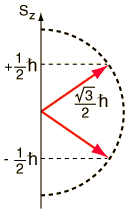
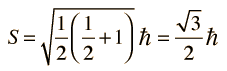
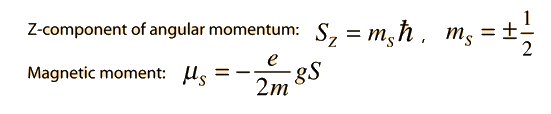
An electron spin s = 1/2 is an intrinsic property of electrons. Electrons have intrinsic angular momentum characterized by quantum number 1/2. In the pattern of other quantized angular momenta, this gives total angular momentum

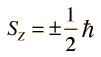
The resulting fine structure which is observed corresponds to two possibilities for the z-component of the angular momentum.
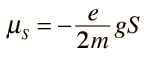
This causes an energy splitting because of the magnetic moment of the electron

一个电子自旋 s = 1/2 是电子的固有属性。电子具有由量子数 1/2 特征化的固有角动量。在其他量子化角动量的模式中,这导致总角动量。所观察到的精细结构对应于角动量 z 分量的两种可能性。这导致了由于电子磁矩而产生的能量分裂。

Further discussion

进一步讨论
Index
索引
 
HyperPhysics***** Quantum Physics
HyperPhysics ***** 量子物理
R Nave
Go Back
返回


Electron Spin

电子自旋

Two types of experimental evidence which arose in the 1920s suggested an additional property of the electron. One was the closely spaced splitting of the hydrogen spectral lines, called fine structure. The other was the Stern-Gerlach experiment which showed in 1922 that a beam of silver atoms directed through an inhomogeneous magnetic field would be forced into two beams. Both of these experimental situations were consistent with the possession of an intrinsic angular momentum and a magnetic moment by individual electrons. Classically this could occur if the electron were a spinning ball of charge, and this property was called electron spin.

20世纪20年代出现的两种实验证据表明电子还具有一个额外的性质。一种是氢谱线的紧密分裂,称为精细结构。另一种是施特恩-格拉赫实验,该实验显示1922年,一束银原子通过不均匀磁场时会被分成两束。这两种实验情况都与单个电子具有固有角动量和磁矩一致。经典物理中,这种情况可以解释为电子像一个带电的旋转球体,这一性质被称为电子自旋。

Quantization of angular momentum had already arisen for orbital angular momentum, and if this electron spin behaved the same way, an angular momentum quantum number s = 1/2 was required to give just two states. This intrinsic electron property gives:

角动量的量子化已经出现在轨道角动量中,如果这种电子自旋也表现出相同的行为,就需要一个角动量量子数s = 1/2来给出仅两个状态。这种固有电子性质给出:
Index
索引
 
HyperPhysics***** Quantum Physics
HyperPhysics ***** 量子物理
R Nave
Go Back
返回


Electron Intrinsic Angular Momentum

电子的固有角动量

Experimental evidence like the hydrogen fine structure and the Stern-Gerlach experiment suggest that an electron has an intrinsic angular momentum, independent of its orbital angular momentum. These experiments suggest just two possible states for this angular momentum, and following the pattern of quantized angular momentum, this requires an angular momentum quantum number of 1/2.

实验证据,如氢的精细结构和施特恩-格拉赫实验,表明电子具有内在的角动量,这种角动量与它的轨道角动量无关。这些实验表明这种角动量只有两个可能的状态,按照角动量量子化的规律,这要求角动量量子数为1/2。

With this evidence, we say that the electron has spin 1/2. An angular momentum and a magnetic moment could indeed arise from a spinning sphere of charge, but this classical picture cannot fit the size or quantized nature of the electron spin. The property called electron spin must be considered to be a quantum concept without detailed classical analogy. The quantum numbers associated with electron spin follow the characteristic pattern:

有了这些证据,我们可以说电子具有自旋1/2。一个旋转的带电球体确实可以产生角动量和磁矩,但这种经典图像无法解释电子自旋的大小或量子化性质。被称为电子自旋的性质必须被视为一个量子概念,而没有详细的经典类比。与电子自旋相关的量子数遵循特征模式:
Illustration
示例
Electron Spin Magnetic Moment
电子自旋磁矩
Index
索引
 
HyperPhysics***** Quantum Physics
HyperPhysics ***** 量子物理
R Nave
Go Back
返回


Electron Spin Magnetic Moment

电子自旋磁矩

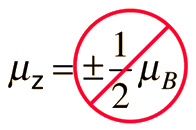
Since the electron displays an intrinsic angular momentum, one might expect a magnetic moment which follows the form of that for an electron orbit. The z-component of magnetic moment associated with the electron spin would then be expected to be


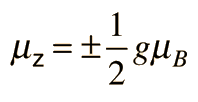
but the measured value turns out to be about twice that. The measured value is written

where g is called the gyromagnetic ratio and the electron spin g-factor has the value g = 2.00232 and g=1 for orbital angular momentum. The precise value of g was predicted by relativistic quantum mechanics in the Dirac equation and was measured in the Lamb shift experiment. A natural constant which arises in the treatment of magnetic effects is called the Bohr magneton. The magnetic moment is usually expressed as a multiple of the Bohr magneton.

由于电子具有内在的角动量,人们可能会预期其磁矩遵循电子轨道角动量的磁矩形式。与电子自旋相关的磁矩的z分量则应为但测得的值却约为两倍。测得的值写作其中g称为旋磁比,电子自旋的g因子值为g=2.00232,而轨道角动量的g因子为g=1。g的精确值由相对论量子力学在狄拉克方程中预测,并在拉姆-赛曼移位实验中测量得到。在处理磁效应时出现的自然常数称为玻尔磁子。磁矩通常表示为玻尔磁子的倍数。

The electron spin magnetic moment is important in the spin-orbit interaction which splits atomic energy levels and gives rise to fine structure in the spectra of atoms. The electron spin magnetic moment is also a factor in the interaction of atoms with external magnetic fields (Zeeman effect).

电子自旋磁矩在自旋-轨道相互作用中起重要作用,这种相互作用会分裂原子能级,并导致原子光谱中的精细结构。电子自旋磁矩也是原子与外部磁场相互作用的因素(塞曼效应)。

The term "electron spin" is not to be taken literally in the classical sense as a description of the origin of the magnetic moment described above. To be sure, a spinning sphere of charge can produce a magnetic moment, but the magnitude of the magnetic moment obtained above cannot be reasonably modeled by considering the electron as a spinning sphere. High energy scattering from electrons shows no "size" of the electron down to a resolution of about 10-3 fermis, and at that size a preposterously high spin rate of some 1032 radian/s would be required to match the observed angular momentum.

术语‘电子自旋’不应被字面理解为经典意义上的描述,即上述磁矩的来源。当然,一个带电旋转的球体可以产生磁矩,但上述得到的磁矩大小无法合理地通过将电子视为旋转的球体来建模。高能电子散射实验显示,电子的大小在约10⁻³费米的分辨率下仍不可测,而在这样的尺寸下,要匹配观测到的角动量,所需的自旋速率将高达约10³²弧度/秒,这显然是不合理的。
Index
索引
 
HyperPhysics***** Quantum Physics
HyperPhysics ***** 量子物理
R Nave
Go Back
返回


Stern-Gerlach Experiment

施特恩-格拉赫实验

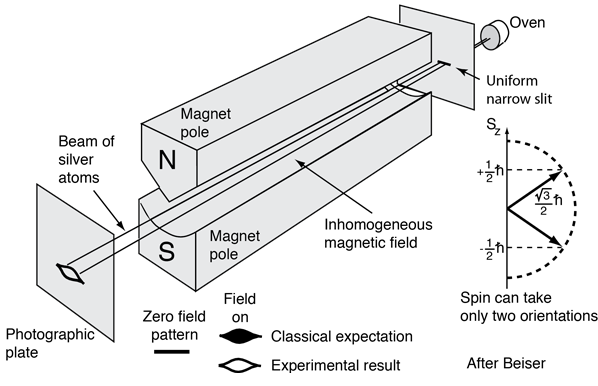
This experiment confirmed the quantization of electron spin into two orientations. This made a major contribution to the development of the quantum theory of the atom.

这个实验证实了电子自旋的量子化,分为两种方向。这为原子的量子理论发展做出了重大贡献。

The potential energy of the electron spin magnetic moment in a magnetic field applied in the z direction is given by

在z方向施加的磁场中,电子自旋磁矩的势能由下式给出

where g is the electron spin g-factor and mB is the Bohr magneton.

其中,g是电子自旋g因子,m_B是玻尔磁子。

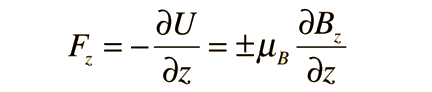
Using the relationship of force to potential energy gives

利用力与势能的关系得到

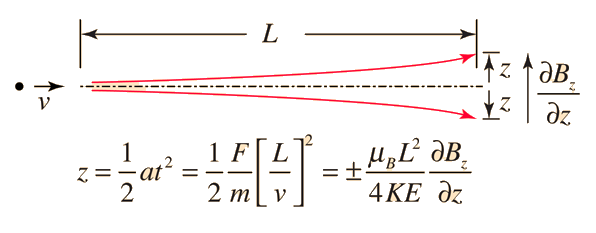
The deflection can be shown to be proportional to the spin and to the magnitude of the magnetic field gradient. It is inversely proportional to the particle kinetic energy.

偏转可以证明与自旋和磁场梯度的大小成正比,与粒子的动能成反比。

Why does the beam split into two parts?

为什么光束会分成两部分?
Index

Great experiments of physics

Reference
Beiser
Perspectives of Modern Physics
索引 物理学的伟大实验 参考 Beiser 现代物理的视角
 
HyperPhysics***** Quantum Physics
HyperPhysics ***** 量子物理
R Nave
Go Back
返回


Stern-Gerlach Experiment

施特恩-格拉赫实验

In 1921, Otto Stern and Walter Gerlach performed an experiment which showed the quantization of electron spin into two orientations. This made a major contribution to the development of the quantum theory of the atom.

1921年,奥托· Stern 和沃尔特· Gerlach 进行了一个实验,该实验显示电子自旋被量化为两种方向。这一发现对原子量子理论的发展做出了重大贡献。

The actual experiment was carried out with a beam of silver atoms from a hot oven because they could be readily detected using a photographic emulsion. The silver atoms allowed Stern and Gerlach to study the magnetic properties of a single electron because these atoms have a single outer electron which moves in the Coulomb potential caused by the 47 protons of the nucleus shielded by the 46 inner electrons. Since this electron has zero orbital angular momentum (orbital quantum number l=0), one would expect there to be no interaction with an external magnetic field.

实际实验是用从热炉中射出的银原子进行的,因为它们可以很容易地通过照相乳胶进行检测。银原子使斯特恩和格拉赫能够研究单个电子的磁性质,因为这些原子有一个外层电子,它在由原子核47个质子所产生的库仑势场中运动,这些质子被46个内层电子所屏蔽。由于这个电子的轨道角动量为零(轨道量子数l=0),人们预期它不会与外部磁场发生相互作用。

Stern and Gerlach directed the beam of silver atoms into a region of nonuniform magnetic field (see experiment sketch). A magnetic dipole moment will experience a force proportional to the field gradient since the two "poles" will be subject to different fields. Classically one would expect all possible orientations of the dipoles so that a continuous smear would be produced on the photographic plate, but they found that the field separated the beam into two distinct parts, indicating just two possible orientations of the magnetic moment of the electron.

Stern 和 Gerlach 将银原子束引入非均匀磁场区域(见实验示意图)。一个磁偶极矩会受到与磁场梯度成正比的力的作用,因为两个‘极’将受到不同的磁场。经典物理预期所有偶极矩的取向都是连续的,从而在相纸片上产生模糊的分布,但实验结果却显示磁场将束流分成两个部分,表明电子的磁矩只有两种可能的取向。

But how does the electron obtain a magnetic moment if it has zero angular momentum and therefore produces no "current loop" to produce a magnetic moment? In 1925, Samuel A. Goudsmit and George E. Uhlenbeck postulated that the electron had an intrinsic angular momentum, independent of its orbital characteristics. In classical terms, a ball of charge could have a magnetic moment if it were spinning such that the charge at the edges produced an effective current loop. This kind of reasoning led to the use of "electron spin" to describe the intrinsic angular momentum.

但电子如何获得磁矩呢?如果电子的角动量为零,就不会产生所谓的‘电流环’来产生磁矩。1925年,萨缪尔·A·戈德斯米特和乔治·E·乌伦贝克提出,电子具有内在的角动量,这种角动量与它的轨道特性无关。用经典术语来说,如果一个带电球体以某种方式旋转,使得边缘的电荷产生有效的电流环,它就会有磁矩。这种推理导致了用‘电子自旋’来描述内在角动量的说法。
Index

Great experiments of physics

Reference Rohlf, Sec 8.4
索引 物理学中的伟大实验 参考 Rohlf,第8.4节
 
HyperPhysics***** Quantum Physics
HyperPhysics ***** 量子物理
R Nave
Go Back
返回